Call for Equality Impact Assessment
This is a guest post co-written by Jon Collins and Natasha Finlayson, Chief Execs respectively of the Prisoners’ Education Trust and Working Chance.
Prison as a chance for education
For thousands of women, prison is not just where education begins but where it finally becomes possible. However, education hours in women’s prisons have fallen by an average of 30%, compared with 25% across men’s prisons. Many women in prison have limited access to formal learning, which is often squeezed between other demands in an overstretched regime. That offer is now shrinking further. The cuts have left hundreds of education staff without jobs, narrowing the curriculum and leaving women with fewer chances to learn.
Education key to resettlement
This matters because many women in prison are not arriving with an established career to pick back up. They are disproportionately likely to have experienced disrupted schooling, poverty, mental ill-health, substance dependency, domestic abuse or time in care, often in combination. Collectively, these factors push many women out of education long before they reach custody.
For women in prison, education can be the bridge to a different future. It builds confidence, purpose and skills that women carry beyond the prison gates, while reducing reoffending and improving access to jobs and training on release. The evidence is clear, and our charities see these outcomes realised by the women we work with every day.
The scale of unmet need is stark. Initial assessments of English and maths skills conducted when women enter custody found that, in 2024–25, two thirds of women were likely to struggle with everyday literacy and more than four in five (83%) were likely to struggle with everyday maths. Addressing this can be the difference between a woman leaving prison ready to work or leaving with many of the same barriers she went in with.
But investment in prison education means more than basic English and maths support. It means putting in place the additional support many learners need to make education truly accessible. Over half of all people in prison enrolling on a course have a confirmed learning difficulty or disability (LDDs), and evidence suggests women in prison have LDDs at a higher rate than men. Concerns have already been raised that the recent cuts have put support for these learners at risk.
Rebuilding confidence
Many women our charities work with arrive having lost confidence in their ability to learn, work or pursue opportunities. Education in prison can start to rebuild that. It offers achievement and structure at an unsettling time and helps women see themselves as a learner or professional – rather than an “offender”.
As one woman supported by Prisoners’ Education Trust put it,
“My studies have enabled me to improve my self-worth – a student, not merely a prisoner.”
Education in prison is not only important for women who have previously experienced disrupted learning. Claire, who was supported by Working Chance after her release, already held a degree and a postgraduate qualification when she went into prison. Yet she still found her peer mentoring course one of the most valuable parts of her time there. It gave her the skills to support others while inside, but what mattered most, she said, was that it gave her
“the chance to think seriously about what kind of life I wanted to build after.”
“From what I saw, the challenge was rarely persuading women to learn or a lack of appetite to engage with education in prison. It was making the space for them to do so.”
She is right to challenge the assumption that women need convincing: when prison education is available, women are more likely than men to take part.
Solid evidence base
The evidence shows a need for more education in prison, not less. The government has made reducing reoffending and getting Britain working two of its defining missions. As a new Prime Minister takes up the mantle, those ambitions cannot be achieved by continuing to scale back one of the most effective rehabilitation tools available.
These cuts must be reversed across prisons for men and women alike. But because women have been hit hardest, the government should also publish a full Equality Impact Assessment of the cuts, setting out their impact on women’s access to education and rehabilitation. Ministers should also review prison education to ensure it is designed and commissioned in a way that delivers the access, quality and support that all learners need.
Cutting prison education is damaging. That women’s prisons have been hit hardest, despite women arriving in custody with greater educational needs and more complex barriers to learning, makes the decision even harder to justify. Education gives women the skills, confidence and opportunity to build a different future after prison. At precisely the moment many stand to benefit most from it, we are giving them less.
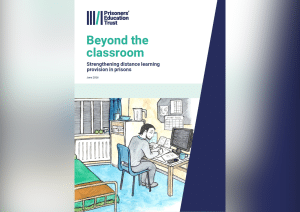
Thanks to Ian Cuthbert and Prisoners’ Education Trust for kind permission to use the header image in this post.