This is a guest post by Jon Collins, Chief Executive of the Prisoners’ Education Trust.
Last year, it emerged that prison education was facing substantial cuts as a result of the new contracts that came into effect from 1 October. There was not, however, any official confirmation of the extent of the reductions or the differences in how individual prisons would be affected.
To address this, the Ministry of Justice has now published prison-by-prison information on how many hours of education were planned in the last six months of the old contracts (April-September 2025), the first six months of the new contracts (October 2025-March 2026) and the next 12 months (April 2026-March 2027).
The Ministry of Justice’s decision to publish this data is welcome. The detailed nature of what they have made available will make it much easier to understand both what has happened and the impact that it is having. The procurement process for new contracts is inevitably complex and largely confidential. They could have hidden behind that. Instead, this data brings much-needed clarity to the situation.
However, the data makes for grim reading, as we have set out in an explainer on our website.
More cuts to come
Comparing the last six months of the old contracts with the first six months of the new ones, there has been an overall reduction of 21% in the number of education hours planned. It is impossible to argue that this will not have had a significant impact on the breadth and volume of what is available to learners.
Moreover, there are more cuts to come.
Looking at the financial year that started on 1 April, there will be a further reduction of 5% in the total number of planned hours. That means that the total cut will be 25%. Data for future years isn’t available, so there is no way of knowing whether there will be further year-on-year reductions.
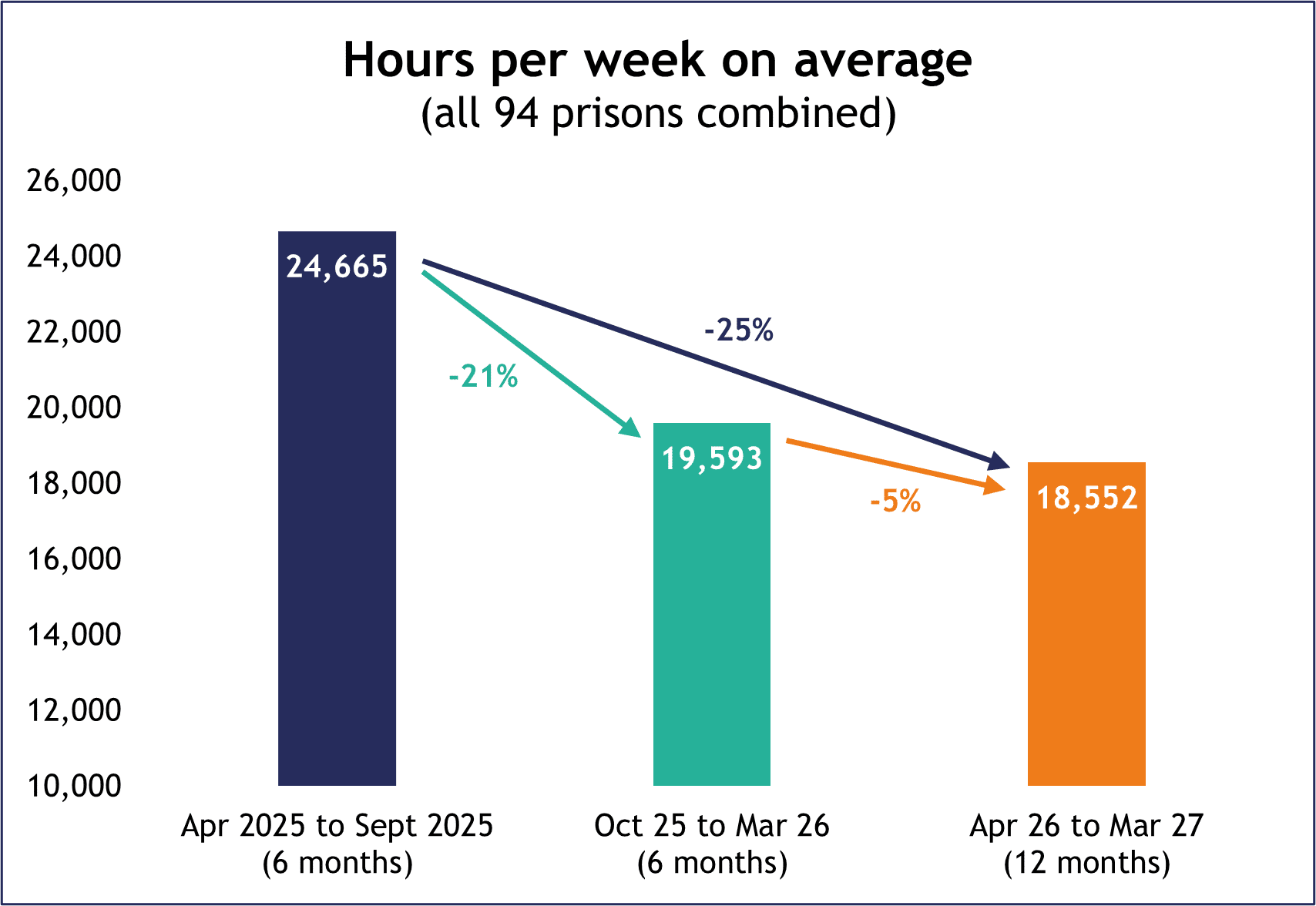
While the average cut is 25%, there are broad variations between prisons. Six prisons have had the number of hours they can provide reduced by more than 50%. The biggest cut, at North Sea Camp, is 58%. There are some winners – eight prisons will see an increase – but the vast majority of prisons (84 of the 94 covered by this data) have had their provision cut and will have to reduce what is on offer to learners.
Staff made redundant and courses axed
Evidence is starting to emerge of the impacts that these cuts are having.
For example, in December the Independent Monitoring Board National Chair set out what individual IMBs had witnessed. This included staff redundancies, cuts to vocational courses, and people with specific needs being disproportionately affected.
More recently, in an independent review of progress at HMP Elmley, HM Inspectorate of Prisons said that “new education contracts delivering far fewer hours than previously had led to the loss of staff and had created uncertainty. Staffing levels were deteriorating and, if this could not be rectified, the progress made would be impossible to sustain.”
The IMB for HMP Ford noted that “the cuts mean that it is simply not possible for the team to deliver education of the quality and quantity provided in previous years, no matter how hard they try”.
An impossible situation for prisons
So what should happen next?
It remains the case that education should be at the heart of an effective prison system, giving people the knowledge, skills and confidence to thrive on release. Cutting education is a mistake and should be reversed. However, this may not be possible. Budgets are tight, contracts have been signed, and more money is unlikely to be forthcoming from the Treasury any time soon.
If cuts cannot be reversed then the focus must be twofold.
Firstly, it is essential that the best possible use is made of the available funding. This means increasing attendance, which in turn means looking at how regimes can ensure that people can get out of their cells and into education departments on time and every time. Too often classes are cancelled or left half-filled because there aren’t enough officers to escort people to education. Prisons must also make effective use of their Dynamic Purchasing System (DPS) funding, making the most of every available penny.
Secondly, we should be documenting the impact that these cuts in provision are having. When it comes to making the case for more funding in the future, we must be able to explain why less provision has had a negative impact. Otherwise, the case for a future increase in funding will inevitably be weakened.
But any discussion about future funding is likely to be years away. In the meantime, cutting provision just as Ofsted reports were starting to show signs of improvement was, as we’ve said previously, madness.
This Ministry of Justice data demonstrates the extent of these cuts and the impossible situation that many prisons are in, with their provision cut in half. Prison teachers will continue to do their best and at PET we will continue to provide access to distance learning. But those who will suffer the most will be people in prison who just want the chance to turn their lives around.
Thanks to Ian Cuthbert and the Prisoners’ Education Trust for kind permission to use the header image.