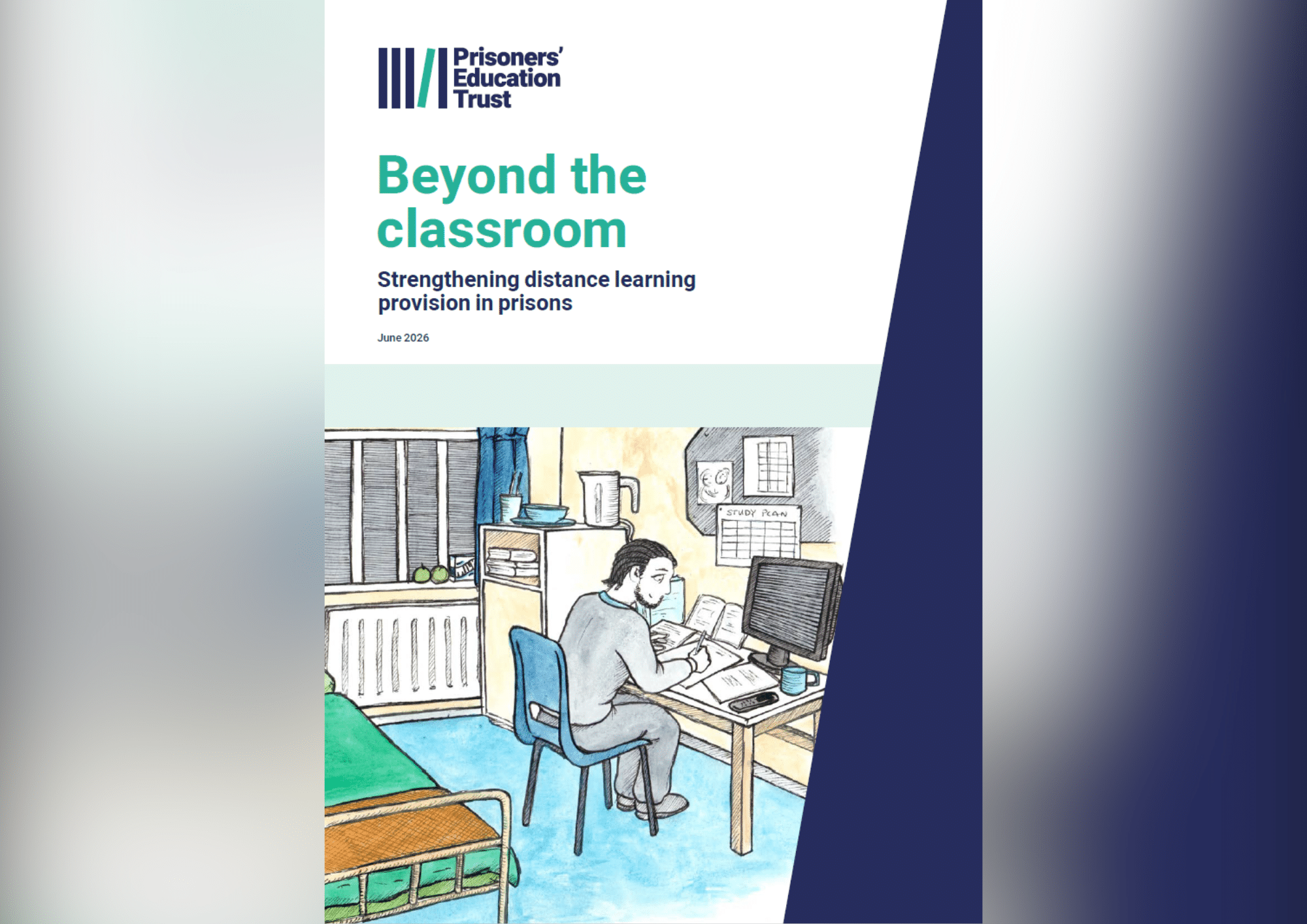
This is a guest post by the Prisoners’ Education Trust’s Policy Manager Mark O’Mahony on a recent PET report: Beyond the classroom.
Beyond the Classroom
Our new report, Beyond the classroom, explores the experiences of people studying distance learning courses in prison and the views of the prison staff who make it possible. What struck me most in writing it was how often distance learning succeeds not because of the wider system, but in spite of it—through the determination of learners and the support of prison staff who go above and beyond.
Limited opportunities
Nearly two-thirds of people entering prison (65%) are likely to struggle with everyday literacy, while 69% are likely to struggle with everyday maths. Core prison education therefore rightly focuses on English and maths up to Level 2 (roughly equivalent to a pass at GCSE), alongside digital skills and English for Speakers of Other Languages.
But once a learner reaches Level 2—a major achievement—the opportunities available in classrooms can narrow sharply. The same is true for the roughly one in ten learners who enter prison already at or beyond that level.
Without distance learning, many would find the doors to a much wider range of academic, vocational and professional qualifications firmly closed.
As one PET learner put it:
“All courses I’ve attempted to complete through PET challenge me academically whilst pushing me further towards my aims. Without PET I don’t know where I’d be as most prisons only offer up to Level 2 maths and English.”
“Just that bit of support can be really powerful”
Opportunities for continued educational progression are important. Education can support learners’ wellbeing and give people something positive to focus on during long periods in their cells. Prison staff tell us it can also contribute to a more stable prison regime. Evidence from the Ministry of Justice’s Data Lab shows that distance learning with PET can reduce reoffending and improve job prospects after release.
However, distance learning does not run itself. Although learners study independently, they need advice to choose the right course, reliable access to materials and IT, somewhere suitable to work, and arrangements to be made for assessments and exams.
Many learners also benefit from encouragement when their confidence falters or the pressures of prison life threaten to interrupt their studies. As one Distance Learning Coordinator told us:
“Seeing the student, sitting with them and providing support is so important… Just that bit of support can be really powerful for keeping people on course. I think it’s one of the best parts of the job.”
Going above and beyond
Our report found no shortage of commitment or good ideas in prisons. At one Category B prison, a learner developed a business case for a peer mentoring scheme and presented it to the senior leadership team. Learners in paid roles now provide much of the day-to-day support for distance learning, creating a community around study while also freeing up staff time. At a Category A prison, learners can use computers in houseblock common rooms to type up essays and assignments at weekends, when the education department is closed.
These examples show what can be achieved when distance learning is understood, valued and prioritised, but they should not be used to suggest that every prison can reproduce the same results with the resources they have available. Good practice depends on staff having the time, permission and operational capacity to put it into effect.
Those conditions are becoming harder to secure. Recent cuts have removed 25% of core education capacity in public sector prisons in England. In women’s prisons, the cut is steeper, at 30%. Some prisons have reduced the protected time staff have available to support distance learning, introduced waiting lists or caps on applications, or stopped supporting distance learning altogether.
One coordinator described the consequences plainly:
“My hours have been reduced. Can I fit in everything I need to in the two days I have? Yes, I can, because I stay late and I work through my lunch break. Would I like to have three days? Yes, absolutely.”
That is a powerful example of a member of staff going above and beyond. It is also an unsustainable basis for essential educational provision.
Reversing the cuts
There are practical steps prison leaders can take. They can ringfence staff time, support peer mentoring, and give learners access to IT and suitable study spaces. As the examples in our report show, these things can make a tangible difference.
However, even for the most effective and committed of prison staff and leaders, broader systemic challenges make maintaining high quality provision difficult. The government must restore and stabilise prison education capacity by reversing the cuts. Further support for provision should also be provided through improved national guidance that sets out clear expectations for distance learning across the estate alongside a national strategy for digital provision.
The government must also remove the arbitrary barriers that block some learners from continuing to progress. That means abolishing the six-year rule, which currently prevents people with more than six years left on their sentence from accessing student finance for higher education.
Strengthening distance learning in prison
The key finding from Beyond the classroom is not simply that every prison should seek out existing best practice and copy it. It is that government must understand what makes that good practice possible and work with prisons to ensure that those conditions exist more widely.
With the right support, more prisons can build on the commitment and good practice already evident across the estate, opening doors to further learning, employment and new possibilities beyond prison.