Feeling unsafe "inevitable"
HM Inspectorate of Prisons’ latest review of survey responses from children in custody published today (22 September 2026) has found that standards across the youth estate remain generally poor, with violence continuing to blight children’s lives, too many spending long periods locked in their cells and inadequate education provision.
The review analysed evidence gathered from inspections, survey findings and interviews with children living in four young offender institutions (YOIs) in England and Wales and one secure training centre (Oakhill STC) between April 2025 and March 2026. It found that, despite some isolated improvements, outcomes remained unacceptable in most establishments.
Some positives
The report is based on five inspections – four in YOIs and one in the STC. Inspectors found some progress overall, but improvement in most establishments was slow and fragile, and children still spent too long in their cells. While safety had improved at Werrington and the provision of work at Wetherby had enhanced purposeful activity, both areas were judged to be not sufficiently good.
Werrington
A stable leadership team at Werrington had worked to identify children who frequently made or used weapons and placing them on a four-week management plan. This included additional cell searches, restriction of privileges such as dining out of cell, and the requirement to move cells when directed, and had led to a reduction in the use of weapons in the institution. In addition, there had been some success in reducing the number of children who needed to be kept apart from one another for safety reasons.
Wetherby
The governor at Wetherby had responded to substantial weaknesses in the education provision and had worked to mitigate the impact by providing more work and vocational training. These included the introduction of ‘Q branch’ (where children worked with staff to carry out minor repairs), a horticulture project and waste management initiative. Children were enthusiastic about these new opportunities, which allowed some to access to more than 11 hours a day out of cell.
Parc
At Parc, better joint working between the education provider and the prison had expanded education, skills and work provision, which were now judged by Estyn to be good. Education was much improved and children were making good progress. At the time of the inspection leaders were managing an increased population but this had not impacted negatively on outcomes which we judged to be good in all four healthy prison tests.
But more problems
Despite these improvements, there were continued, long-running weaknesses in safety and education in the establishments. Only Parc was safe enough and Ofsted judged the overall effectiveness of education as ‘inadequate’ at every YOI in England and ‘requires improvement’ at Oakhill STC. These issues were most acute in the south of England. At Feltham YOI inspectors found behaviour management in disarray and observed many examples of rules not being enforced, poor behaviour being rewarded and children reacting aggressively to staff.
Oakhill failing
At Oakhill, outcomes were so concerning that the Chief Inspectors invoked the Urgent Notification Protocol. Just before the inspection visit, the centre director and one of the two deputy directors had been formally suspended from their duties. The other deputy director had also been dismissed recently from employment. Another 30 staff had been suspended in the months before the inspection. There were fundamental weaknesses in safeguarding at the STC, and a failure by leaders to report serious matters to local authority children’s services and the local authority designated officer.
Conclusion
Charlie Taylor, the Chief Inspector of Prisons, is clearly increasingly frustrated by the lack of substantial progress despite the high resource levels in the youth secure estate:
“In recent years there have been multiple false dawns in institutions holding children. Although any improvement in outcomes for this particularly vulnerable group of detainees is welcome, it needs to be sustained and accelerated. The challenge for national leaders is to consolidate the small gains of 2025–26 and take advantage of the lower population to create a system of custodial institutions that are able to meet the high levels of need of the children that remain.”
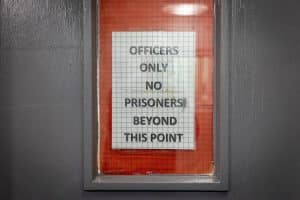
Thanks to Andy Aitchison for kind permission to use the header image in this post. You can see Andy’s work here