
Too little support
A new “key findings” paper published by HM Inspectorate of Prisons today (27 March 2026) says that prisoners awaiting trial or sentencing have poorer outcomes than those serving a sentence. The inspectorate says that despite the fact that people on remand now make up around a fifth of the prison population, too few jails have developed a strategy to manage these men and women, increasing their vulnerability and leaving many unable to access vital support.
The report
The paper, ‘Everything is after sentencing’: The experiences of remand prisoners is based on inspection reports of 12 reception prisons. It found that in three-quarters, remand prisoners made up over half of the population, with some jails experiencing a rapid rise in this cohort.
The paper makes for grim reading:
“Although remand prisoners can report having higher rates of mental health problems and depression, and an increased risk of suicide, they often did not get enough support when they first arrived in jail. They were less likely than sentenced prisoners to know how to contact independent groups who could help them, be able to shower every day, get clean clothes that fit them and to have their own cell, and they were often not engaged in purposeful activity. Prisoners awaiting trial did not always get the additional visits to which they were entitled, or enough help to keep in touch with their families. Remand prisoners received too little support to resolve issues in the community, including sorting out housing, benefits and finance before they were released, and this was particularly concerning for prisoners found not guilty at trial who, while in prison, could have lost their employment or home.”
An increasing problem
There are two distinct cohorts of remand prisoners: those awaiting trial and those waiting to be sentenced. In December 2025 16,520 adult prisoners were on remand, representing 19% of the total prison population, compared to 13% ten years earlier. Of this group, 10,835 prisoners were untried and 5,685 were convicted unsentenced.
Outcomes
The report lists a number of key areas in which remand prisoners get a much inferior service to those serving sentences.
A lack of early days support
The first few days in prison are some of the most important for identifying and addressing prisoners’ needs. However, inspectors found that remand prisoners did not always receive enough support. They were less likely to be able to access their personal property or to be able to phone family members. Access to bail and legal information was reported to vary between prisoners with Forest Bank providing a good service and Wandsworth and Lewes none.
Little integration into prison life and culture
The inspectorate’s survey findings highlighted several areas where daily life for remand prisoners was significantly poorer than for those serving a sentence. For example, fewer remand prisoners had their own cell and they often had to share a space designed for one. They were less likely to be able to have a shower every day and were more likely to say they did not have enough clean clothes that fitted them, which may have caused particular concern if they had an upcoming court appearance.
A large proportion of prisoners on remand are located on first night or induction wings. There is a high turnover of prisoners on these wings, making it difficult to provide appropriate clothing, shoes, appliances and furnishings to everyone. Prolonged stays on these wings were likely to contribute to more negative experiences for remand prisoners. This is a particular problem because not only have the numbers of people on remand increased but many are being held for much longer periods because of the growing backlog in court cases.
Reman prisoners also found it harder to access healthcare and had limited time out of their cells and involved in any sort of activity.
Inspectors did find some positive practice with HMP Durham looking to meet the education needs of remand prisoners and HMP Chelmsford their employment needs.
Remand prisoners are entitled to more regular visits but some prisons did not have enough social visit slots for prisoners to receive them. At one (unnamed) prison, the number of visits available had not returned to pre-COVID levels and those on remand could not receive their full allowance, which caused considerable frustration.
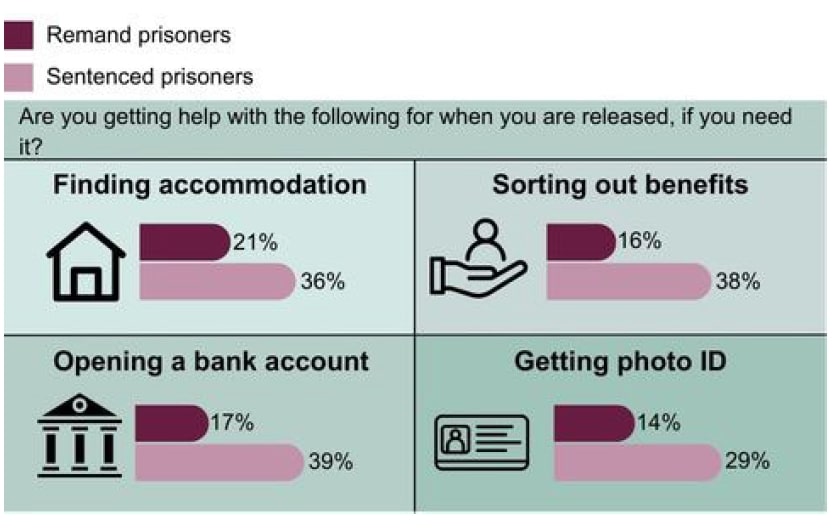
Resettlement support
Completing the picture, remand prisoners also got less help with resettlement including for the essential practicalities (such as accommodation) set out in the infographic above. Chief Inspector of Prisons Charlie Taylor urged both HMPPS and individual prisons to rectify this situation:
“In many of the prisons cited in this report, we found too little being done to help the particularly vulnerable cohort of remand prisoners. Although we highlight some areas where the difficulties faced by these prisoners were beginning to be addressed, with the growth in this population now endemic, the prison service and individual jails must think more strategically about how they support these men and women.”
Thanks to Andy Aitchison for kind permission to use the header image in this post. You can see Andy’s work here