
Unrelenting pressure on prison capacity
Last Thursday (29 January 2026), the MoJ released a number of regular statistical bulletins which show the unrelenting pressure on the criminal justice system in general and the prison population in particular. Key statistics include:
- A (pretty staggering) 48,931 people were released early from prison on the SDS40 initiative in the period between 10 September 2024 and 30 September 2025
- Despite this the prison population remains virtually unchanged from last year – the most recent figure (26 January 2026) is 87,212 people in prison.
- 12,836 people were recalled to prison in the THREE MONTH period between July and September 2025. This is an increase of 29% on the previous year and most commentators (including myself) belief that a significant component of this increase is the high number of people in prison being released early without access to proper support. While the Government does publish the number of early releases, it is careful not to publish recall figures for this group.
- There were 246,502 offenders under probation supervision as at 30 September 2025, an increase of 2% on the previous year. Again, this is at least partly related to the volume of people released early.
- In the 12 months to December 2025, there were 394 deaths in prison custody, an increase of 15% from 342 deaths in the previous 12 months.
I provide further details below.
Overall demand
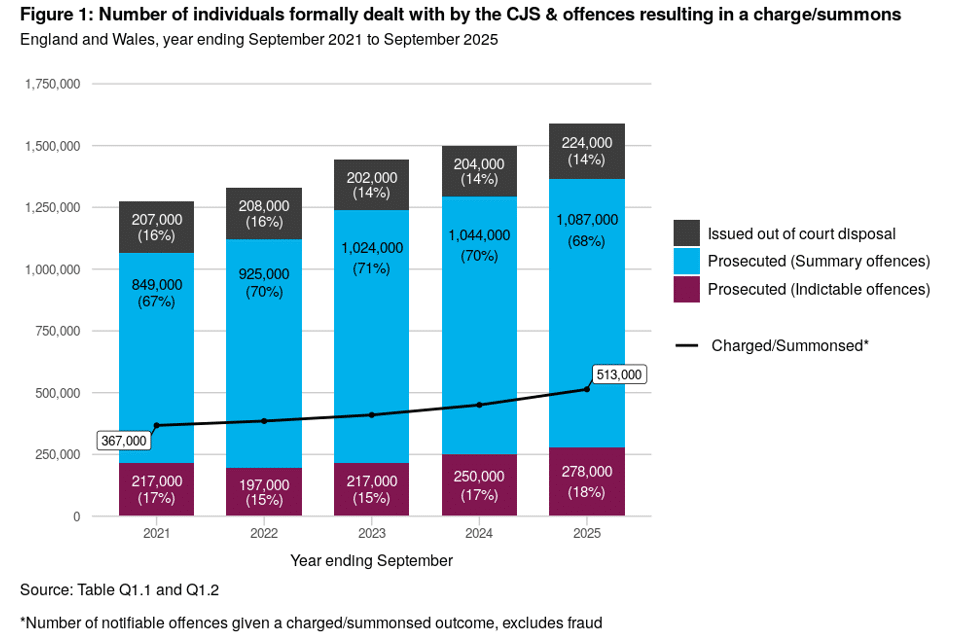
The criminal justice system is getting busier and busier. The number of individuals formally dealt with by the CJS in England and Wales increased by 6% in the latest year, the highest seen since year ending September 2017.
There were 6.73 million crimes recorded by the police in the latest year, a 1% increase from the year ending September 2024. Levels of police recorded crime (including fraud) have tended to increase over the last decade from 4.33 million in the year ending September 2015. Changes and improvements in police activity and recording practices are a major driver behind the increase in police recorded crime since March 2014.
The number of recorded crimes that resulted in a charge has increased by 14% in the latest year to 513,400 and is the highest seen since year ending September 2017. This increase has partly driven the rise in the flow of more serious indictable offences into the courts.
Out of court disposals increased by 10% in the latest year, back to levels seen in 2017 as a result of increases in community resolutions, which increased by 16%, to a series high at 179,000 (see the Out of Court Disposals chapter). All other types of out of court disposals fell in the latest year.
The number of defendants prosecuted and convicted both increased by 5% in the latest year, the highest seen since 2017.
These figures are helpfully illustrated by an official chart in the latest criminal justice quarterly statistics just published.
Prison population
It’s easy to see why this high volume of early releases is necessary when we look at the number of people entering and leaving prison. In the most recent quarter for which we have data (July-September) 2025, there were 19,413 first receptions into prison (3% up on the previous year) but only 14,038 releases (6% down on 2024).
The remand population which has been at record levels since just after the pandemic, has stabilised.
The 31 December 2025 remand population figure of 16,628 is slightly lower compared with December 2024 (a decrease of 2%). The untried remand population and the convicted unsentenced remand population both fell by 2% when compared to the end of December 2024, to 10,930 and 5,698, respectively.
The number of people serving extended determinate sentences continues to grow On 31 December 2025, 9,343 prisoners were serving such sentences, up 8% since 31 December 2024. EDS prisoners account for around 1 in 9 of the total prison population. The EDS sentence replaced the notorious IPP sentence with people requiring to serve a longer proportion of their sentence in prison in addition to an extended licence period. The main difference is that this licence period is finite.
The number of ‘unreleased’ prisoners serving life sentences (7,570) has increased by 2% compared to one year ago whereas the number of ‘unreleased’ IPP prisoners fell by 12% to 924. Interestingly, the number of ‘recalled’ prisoners serving life sentences increased by 7% to 901 when compared to 31 December 2024, and the number of ‘recalled’ IPP prisoners has decreased by 7% to 1,464 over the same period.
Probation caseload
As at 30 September 2025, there were 246,502 offenders supervised by the Probation Service in England and Wales (Figure 2). This has remained broadly stable over recent years, increasing by 2% compared to 30 September 2024 and, more recently, increasing by just 0.9% compared to 30 June 2025.
Between the end of September 2024 and the end of September 2025, court order caseload increased by 3% from 107,124 to 110,167, with the number of offenders on a community order (CO) fluctuating but remaining stable and those on a suspended sentence order with requirements (SSO) increasing by 7%.
The total caseload of offenders supervised before or after release from prison at the end of September 2025 was 141,329, representing an increase of 2% compared to the end of September 2024. While the overall growth in pre- and post-release supervision since September 2023 has been primarily driven by the post-release caseload, recent trends show a shift in this dynamic. Between September 2024 and September 2025, the increase was similar across both categories; in fact, the pre-release supervision caseload saw a slightly larger proportional increase of 3% (rising to 77,130) compared to a 2% increase in post-release supervision (rising to 64,298). This broader upward trend since late 2023 coincides with the introduction of the early release schemes introduced by this and the previous government.
Conclusion
The recently passed Sentencing Act sets out an ambition to sentence more people who are currently receiving short periods of imprisonment to community sentences instead. Future editions of these statistics will let us know the extent to which this ambition has been realised.
Thanks to UX Indonesia for kind permission to use the header image in this post which was previously published on Unsplash.