New Prison Factfile
Anyone and everyone who wants accurate up-to-date information on what is going on in our prisons relies on the prison factfiles produced by the Prison Reform Trust. Known as the Bromley Briefings, they are issued twice a year. The most recent edition was published this morning (5 February 2026). I use mine so regularly, I have a shortcut to it on my desktop.
The Briefings always lead with an editorial, this edition focuses on the Sentencing Act and its likely impact – both positive and negative.
10 key prison facts
As usual, I have perused the 96-page Briefing in depth and found 10 key facts to share in this post. Since readers of the blog are more than averagely well informed about penal affairs, I have tried to feature some of the less well-known issues.
1 Prison admissions
47,000 people were sent to prison to serve a sentence in the year to June 2025. Well over half (57%) had committed a non-violent offence and almost one third (32%) were sentenced to serve six months or less.
2 Longer prison sentences
More than three times as many people were sentenced to 10 years or more in 2024 than in 2010. For indictable offences, the average prison sentence is now 69.9 months — more than two and a half years longer than in 2010. Indeed, 8,622 people are serving a standard determinate sentence of 10 years or more — around one in eight (12%) of sentenced prisoners. This is a very high figure when you consider that this dos not include life sentences.
3 The growth of EDS
More than one in seven of the sentenced prison population (13%) are serving an Extended Determinate Sentence (EDS) and are not subject to automatic release until the end of their full custodial term.
4 IPPs
Despite its abolition, there are 946 people in prison serving an IPP sentence who have never been released. Nearly all (99.6%) are still in prison despite having already served their tariff. Almost three-quarters of unreleased IPP prisoners (73%) have spent an additional 10 years or more in prison on top of their tariff. One quarter (25%) have served an additional 15 years or more. The median tariff length is between two and four years. 1,476 people are serving an IPP sentence in prison on recall—they account for more than three in five of the imprisoned IPP population (61%).
But there are promising signs of change. In 2024 recalls were down 6% and releases up 22% — driven by an increase of over a third (34%) in re-releases following a recall.
5 Remand
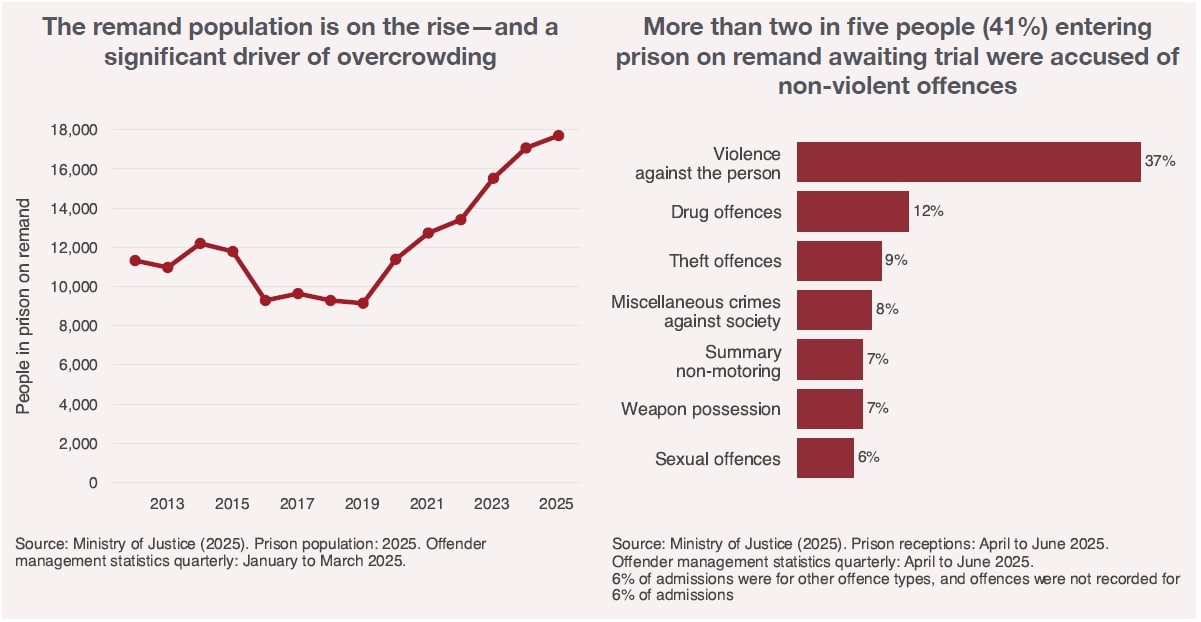
The number of people on remand stubbornly remains at its highest level in at least 50 years. People on remand account for one in five of the prison population (20%)—almost 18,000 people. The majority are awaiting trial (66%), whilst the rest are awaiting sentencing.
In September 2022, almost a third of people (32%) on remand had been held in prison beyond the six-month custody time limit — nearly 4,600 people. One in 20 (5%) had been there for longer than two years — 770 people. The government has subsequently said that it is too costly to provide this data.
6 Prison conditions
Around a quarter of people in prison are housed in prisons with Victorian-era accommodation. Compact spaces originally built on the outskirts of cities, they have now become enclosed by urban expansion, making further improvements difficult and exacerbating the problems of overcrowding. Green space is limited, and both damp/coldness and overheating problems are caused by thick walls and poor ventilation. Narrow landings and steep staircases cause accessibility problems for an ageing prison
population.
Inspectors raised concerns about living conditions in 24 of the 38 adult prisons inspected in 2024–25. Overcrowding persisted, with cramped cells and insufficient screening around toilets. Vermin infestations were not uncommon.
7 Cost
The cost of a prison place in 2023–24 was 3% higher in real terms than 2010–11. The average annual overall cost of a prison place in England and Wales is now £56,987.
8 Foreign nationals in prison
Foreign nationals (non-UK passport holders) currently make up one in eight people in prison in England and Wales (12%). On 30 September 2025 there were 10,737 foreign nationals in prison. Foreign national prisoners come from 175 countries—but over half are from 11 countries (Albania, Poland, Ireland, Romania, India, Jamaica, Lithuania, Pakistan, Iraq, Iran, and Portugal).
9 Women serving long prison sentences
There are 358 women serving an indeterminate sentence in prison— almost all on life sentences (98%). They account for one in ten women in custody (10%). The number of women serving an indeterminate sentence who have yet to be released has more than doubled since 2002.
Women convicted of more serious crimes are spending longer in prison. Between 2015 and 2025, the number of women serving long sentences of four to less than 10 years has declined by a third (33%), but the number serving sentences of 10 years or more has increased by almost the same proportion (32%).
10 Children in custody
The number of children sentenced to in custody fell steeply from 4,657 in 2009–10 to 660 children in 2023–24, although this number was an increase of 21% on the year before (546 children).
Sentence lengths are getting longer. The average custodial sentence length for children increased from 11.3 months in 2010 to 17.5 months in 2024.
At the end of November 2025 there were 379 children in custody in England and Wales; 15 children were aged 14 or younger.
More than two in three children in custody in 2024 were there for offences of violence against the person (68%).
More than two in five children in custody (43%) are on remand.
Thanks to Andy Aitchison for kind permission to use the header image in this post. You can see Andy’s work here