
System has busiest year since 2017
Last week’s (published 3 April 2026) quarterly Criminal Justice Statistics (which cover the period ending 31 December 2025) reveal the latest trends in the volume of cases going through the system. The headline trends are:
- The number of individuals formally dealt with by the Criminal Justice System in England and Wales – 1.59 million individuals – increased by 3% in the latest year.
- In the latest year, there was an 11% increase in community resolutions from 163,700 to 181,700 driving the overall increase in out of court disposals (up to 226,300).
- There was a 9% increase in prosecutions for indictable offences, the highest level seen since 2016.
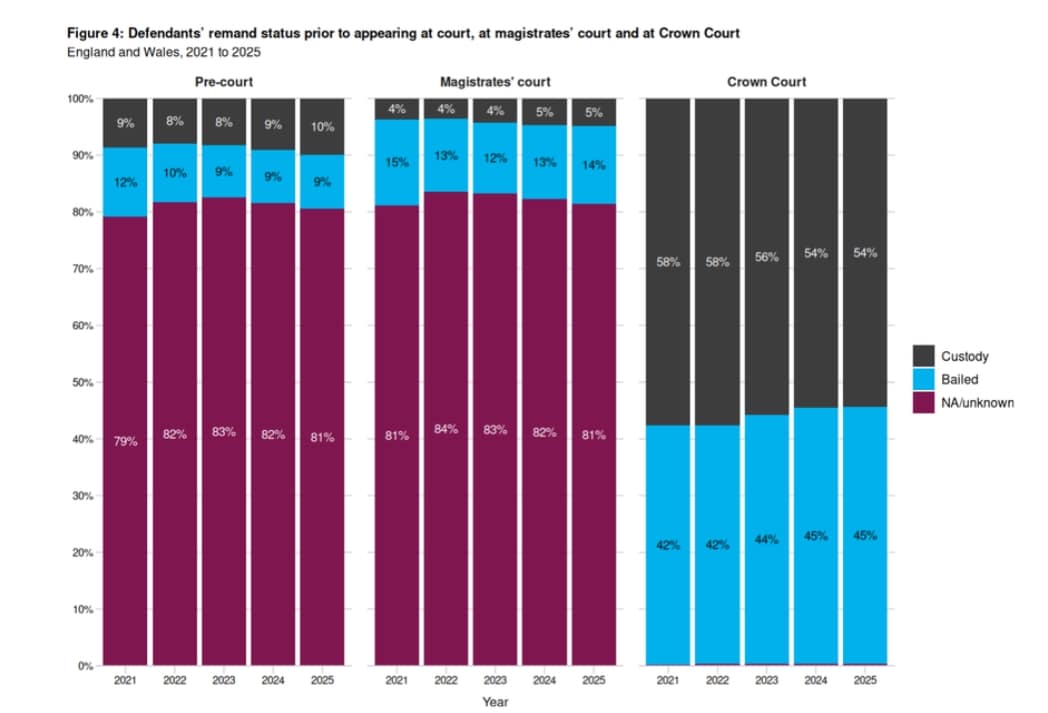
- The number of defendants remanded in custody at magistrates’ courts rose to 67,000, a series high, though the proportion of those remained stable at 5%.
Out of Court Resolutions
Out of court resolutions (OOCRs) are sanctions used by the police to address offences without the need to be dealt with at court. There were around 226,300 OOCRs issued in 2025, which represents an increase of 7% when compared to the previous year.
This rise is due to the continued increase in the use of community resolutions – with 181,700 issued (an 11% increase) in 2025, representing a series high and accounting for 80% of all OOCRs issued. The largest increases were seen in drug offences (22%) and robbery offences (15%).
There was a decrease of 8% across all other OOCR types combined when compared to the previous year. Cannabis/khat warnings and penalty notices for disorder (PNDs) decreased by 90% and 15%, respectively, while cautions fell by 6%.
Although caution volumes decreased in most offence groups there were small increases in those issued for Possession of weapons offences (3%) and Public Order offences (7%). The overall cautioning rate was largely unchanged on the previous year, around 8% which is a series low.
Prosecutions
In 2025, there were 1.36 million defendants proceeded against at magistrates’ courts (including Single Justice Procedure cases), an increase of 3% compared to the previous year and the highest seen since 2017.
The volume of prosecutions for the more serious indictable offences increased by 9%, while the volume of summary offences increased by 1%. The increase in summary offences was driven by a 5% increase in summary motoring offences to 803,000 (a series high).
Prosecutions increased across all indictable offence groups, including 18% increases for sexual offences (up by 2,400) and public order offences (up by 3,500), and 13% increases for drug offences (up by 6,000) and fraud offences (up by 600).
Remands
At magistrates’ courts, the total volume of those remanded in custody increased 6% from last year and is the highest volume seen in the previous decade (67,000). However, the proportion remanded in custody showed little change on the previous year at 5%. The volume of those remanded in custody for more serious indictable and triable either way offences are at a series high, at 13,100 and 47,500 respectively.
At the Crown Court, the volume of defendants remanded in custody fell slightly to around 57,900 compared to the previous year (58,500). The proportion of defendants remanded in custody remained at 54% in 2025, while bail also remained stable at 45%.
Sentencing
The average custodial sentence length (ACSL) fell slightly on the previous year for all offence types and indictable offences. The overall decrease in ACSL was partly due to an increase in theft offences, which attract shorter sentences and partly by falls seen across many other offence groups.
There were 1.20 million offenders sentenced in 2025, a 1% increase on the previous year. Most offenders (77%) continued to be sentenced to a fine, with summary motoring offences accounting for 76% of all fines issued.
There were 88,100 offenders sentenced to immediate custody – this represents an increase of 9% on the previous year and is the highest level seen since 2017 (91,400). The custody rate for indictable offences was unchanged on the previous year (33.3% to 33.5%) but is up more than five percentage points from a decade ago (28%). The highest custody rates in the latest year were seen for robbery and sexual offences, at 60% and 54% respectively.
The proportion of offenders receiving a custodial sentence of less than 12 months remained unchanged at 58%. The volume of custodial sentences of under 12 months increased by 10% and by 8% for sentences of 12 months and over.
It will be interesting to see whether the newly implemented Sentencing Act – which introduces a presumption against short term sentences – has any impact in next year’s figures.
Thanks to Luke Chesser for kind permission to use the header image in this post which was previously published on Unsplash.