Police Commissioners and the voluntary sector
New publication from Clinks and the Revolving Doors Agency highlights nine key issues for new Police and Crime Commissioners to work with the voluntary sector.

New publication from Clinks and the Revolving Doors Agency highlights nine key issues for new Police and Crime Commissioners to work with the voluntary sector.

A recent briefing from the National Crime Agency stated that due to the increasing security measures at ports, people smugglers have started to turn to new and more expensive methods of getting asylum seekers and illegal immigrants onto UK soil.

Police officers and health and social care workers are particularly at risk of violence at work.

The children who are being criminalised whilst teenagers are the same children who, when younger, were sympathetically viewed as vulnerable, innocent and highly deserving of society’s help and protection.

The UN Office on Drugs and Crime estimates that drug trafficking, counterfeiting and many other forms of illicit trade bring in an estimated $870 billion every year.

The government is not waiting to see what the turnout will be at the second Police and Crime Commissioner elections on 5 May (last time it was less than 5%) but is pressing on now in its desire to expand the role of PCCs.

Accountability is key. For PCCs to have a proper mandate, turnout at this year’s PCC elections (5 May 2016) will need to be much higher than the (less than) 15% who voted at the original elections in 2012.

As always, it is difficult to speculate how accurately these figures reflect the amount of drink and drug driving on our roads. While drivers are routinely tested when they are involved in serious accidents, the majority of arrests for drink and drug driving reflect police activity.

Why is the technology to overcome electronic immobilisers (in existence and available for some years now) not widely used by car thieves?
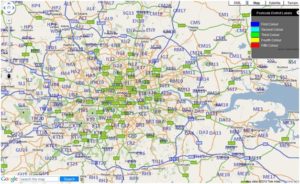
Alarming variation in rape prosecution rates across England and Wales.

Overall, the decreasing use of Stop and Search (and the increasing proportion of stops resulting in arrests) will be seen as very positive developments by most commentators. The disproportionate use of Stop and Search against Black communities remains an issue, although some will point to higher arrest rates as justification (although we really need to see the outcomes of those arrests to make a more informed judgement).
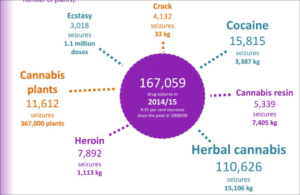
Of course, it’s impossible to know that proportion of drugs imported into and used in England and Wales were seized and very tempting to attribute any drop in seizures to the reduction in the number of police personnel.