Peer-led review
A new (May 2026) report presents the findings of a peer-led review by the Building Futures Network Group (a Prison Reform Trust initiative) at HMP Frankland, drawing on the experiences of people with direct knowledge of the Category A review process. It explores how the process is understood and experienced by those subject to it, highlighting the emotional and practical impacts of a system often perceived as opaque, inconsistent and difficult to navigate.
The research
This report explores the complexities and challenges of the Category A review process, which is used to assess whether Category A prisoners can have their risk downgraded. It is based on consultations with those who have direct experience and expertise of the review process. Central to this is work done by the Building Futures Network Group at HMP Frankland, and surveys completed by those serving time at the prison. The report also draws on discussions with His Majesty’s Prisons and Probation Service (HMPPS), including the central Category A Review Team (CART).
What is the Category A review process?
The prison system in England and Wales categorises adult men based on the security measures required, using categories that range from A to D. Category A is assigned to those individuals deemed to pose the highest risk if they were to escape. The assignment of Category A is linked to people’s index offence and is usually reviewed shortly after sentencing and then, with some exceptions, again after two years and annually thereafter.
Balancing security with rehabilitation is a central challenge for the prison system. Within this, the Category A review process is vital to public safety, individual wellbeing and to using prison capacity – which is currently under huge pressure – efficiently, ensuring people can progress through the sentence and be held in prisons appropriate to their risk. In doing so, the review process should ensure fairness and transparency.
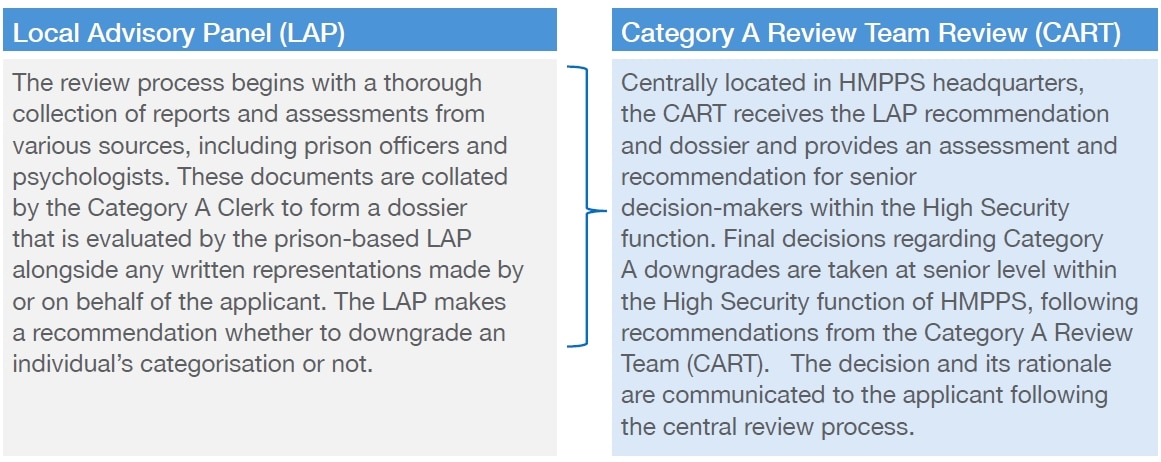
Applicants and/or their solicitor can make written representations but do not attend the LAP or CART, although in rare cases the CART will offer an oral hearing.
Core themes
Four key themes emerged from consultations with prisoners who have direct experience of the Category A review process. These themes were:
The review process is opaque, and its importance is not always understood or evidenced by the actions of those involved.
Participants highlighted that fairness requires the review process to be based on accurate and high-quality information about an applicant’s behaviour, engagement and progress being consistently recorded prior to review. However, many felt that the LAP and the CART often make decisions based on inaccurate data and poor-quality reports, giving examples of gaps in reporting key information, inaccuracies, or out-of-date information being included. Some also felt frustrated by not being able to challenge the inclusion of non-disclosable intelligence from security, which is routinely not summarised in accordance with a Prison Service Instruction.
Poor communication and inconsistency left many confused by the process and the range of factors that feed into a review.
For example, the consolidation process (where people need to demonstrate learning from programmes they have undertaken) was not understood by many participants or explained by psychologists. Participants also found the various tests for assigning and downgrading Category A status confusing and illogical. Some people are unaware whether and when their reviews are taking place, leading to feelings of helplessness and a lack of trust in the system.
Pressures on the prison system are undermining the review process and the relationships that shape the timing and quality of information considered.
Many participants highlighted a lack of contact with and high caseloads of Prison Offender Managers (POMs) and keyworkers. In addition, some reported a lack of contact with prison-based psychologists and not being able to access interventions that would help them to reduce their risk. Combined, this undermined the quality, accuracy and relevance of reports.
The review process did not always reflect the representations made by applicants and/or their legal advisors in explaining outcomes.
Some participants reported not being able to make representations due to delays or errors in receiving the category A review dossier. In addition, many participants felt that the process gave far more weight to prison-based (as opposed to independent) psychologists and did not adequately consider the views of those officers that saw them frequently. Some participants felt that the workings of the CART in particular do not operate under the principles of fairness, openness, transparency, and accountability.
Taken together, these experiences suggest that the Category A process is being hampered by a lack of transparency, low levels of engagement from some key players, poor or inaccurate data, information and reporting, and delays. This is resulting in a lack of accountability, low levels of trust in the system and negative impacts on prisoners including confusion, helplessness and anxiety. It is no surprise that chronic under-staffing is exacerbating these problems.
Recommendations
The report makes a substantial number of recommendations but the principal one is that HMPPS should carry out a root and branch review of the process.
One fact that shows how difficult the process is to understand for those subject to it is that New guidelines were introduced between 2014-2020, following work completed by members of the The Long-Term High-Security Estate and psychologists from HMP Frankland. This led to the introduction of new templates for report authors to use and instructions on best practice on how to write the reports, but the guidance has so far remained unpublished – unlike their predecessors.
Thanks to Andy Aitchison for kind permission to use the header image in this post. You can see Andy’s work here