Public Protection Risks
A new (10 July 2026) report from the National Audit Office has found that while HMPPS has rapidly expanded electronic monitoring, now tagging around 29,000 people – thousands of individuals may not be actively monitored despite having a tagging requirement.
Not fit for purpose?
The NAO report is nothing if not timely with demand for electronic monitoring set to rise significantly from this September following the Sentencing Act 2026, which aims to ease prison pressures by managing more offenders in the community. It estimated that up to 22,000 additional individuals would be tagged each year from 2027, placing further strain on a system that had already been performing poorly.
The context
HMPPS estimates that monitoring a tagged individual costs on average £4,900 per year. This equates to an estimated annual direct cost of £133 million for 2025-26, including costs incurred by probation but excluding wider system costs such as courts and police activity.
History
In October 2023, MoJ awarded new contracts to: Serco, to fit tags and monitor tagged individuals; and Allied Universal Electronic Monitoring (Allied), to supply the tags and monitoring system. This followed the reprocurement of the EM service as part of its 2021–2026 EM expansion programme. The new service went live in May 2024, with a transition period as the new suppliers took over and moved services onto new systems and devices. But by mid-2025, MoJ and HMPPS acknowledged there had been significant performance issues, including long delays in fitting tags.
You can see the key facts and figures from the NAO report below, in the section which I have reproduced in full from the report.
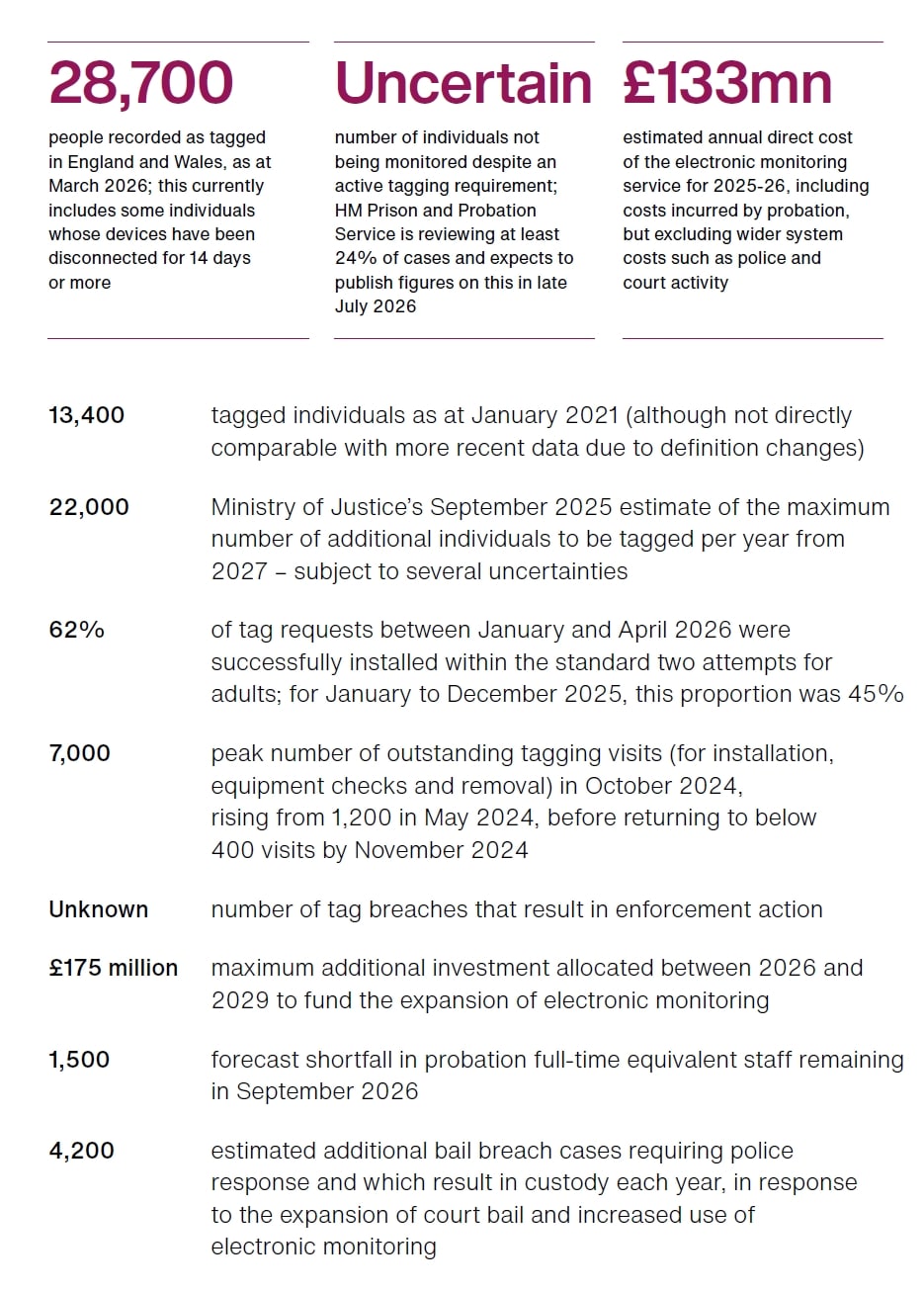
Key findings
HMPPS met its aim to increase the EM population to around 25,000 by 2025, through its 2021 expansion programme. For example, it extended EM to new groups through GPS tagging for certain acquisitive crimes and offenders at risk of committing domestic abuse and rolling out alcohol monitoring for some prison leavers.
As a result, the EM population in England and Wales increased significantly from around 13,400 in January 2021 to 28,700 by March 2026 (although changes to definitions mean these two numbers are not directly comparable). Individuals tagged after leaving prison form the largest EM population (37%), followed by those on court bail (34%).
Confused measurement of success
The NAO notes that there is no shared understanding of what a more responsive EM system should look like or how it should be measured. MoJ’s 2022 EM strategy set out a vision for a robust, innovative and data-driven system. This system would enable officials to respond quickly to breaches (non-compliance with EM conditions) to manage risks effectively in the community.
HMPPS set expectations for its main suppliers through contract key performance indicators (KPIs). However, there is no shared definition of what ‘more responsive’ means, including how quickly police or probation officials should act on breaches. This is partly because agencies such as the police sit outside MoJ and HMPPS’s control.
While Serco’s contract does not require it to provide officials with details of an individuals’ breach until 29 to 53 hours after it occurs, some stakeholders expected breaches to trigger a faster response.
Poor performance
It is clear that the EM system is performing poorly:
There were delays in fitting and removing tags and notifying officials of potential breaches between August 2024 and July 2025. During this period, the backlog of visits to fit, check or remove tags increased significantly to a peak of 7,000 visits in October 2024 from 1,200 in May 2024.
HMPPS does not have an accurate understanding of the number of individuals that should be monitored and are not (‘unmonitored’), but this number could be significant: As of March 2026, HMPPS was reviewing around 8,900 cases of individuals recorded as having an active EM order but no tag.
Probation and police staff report that poor quality information and capacity constraints limit their ability to respond promptly to breaches: The police also raised concerns that breaches of court bail conditions often result in limited consequences when cases return to court but are resource-intensive to respond to. A lack of data on response times and outcomes prevented the NAO from assessing the scale of these issues.
There are a number of flaws in the contract. For example, Serco’s tag-fitting KPI measures whether it has made two attempts to tag an individual within the required time period for 95% of cases, not whether those attempts are successful at fitting a tag. In February 2026, although Serco met its 95% timeliness target for tag-fitting visits, it was only successful in fitting a tag for 62% of the individuals it visited after those two attempts. This mismatch in real world performance results from factors both within and outside of Serco’s control, but the bigger point is that HMPPS has no accurate understanding of performance which makes it harder to address failings.
Improving but unclear outcome measurement
MoJ and HMPPS have carried out three impact evaluations on EM. These show some promising results of EM reducing reoffending while individuals are tagged. The findings include reductions in reoffending for those wearing radio frequency tags and efficiencies for the police through schemes to tag those convicted of acquisitive crimes such as theft. However, gaps remain in understanding effectiveness after the tag is removed, and across different EM groups. Without clarity on which groups benefit most from EM and how effectiveness varies, MoJ lacks a strong basis for prioritising or targeting EM if capacity becomes constrained.
Recommendations
The NAO sets out three short-term recommendations for the MoJ & HMPPS to reduce the impact of new demand on an under-performing system:
In the short-term, to manage rising demand, MoJ and HMPPS should, by September 2026:
- set out a proposed system-wide approach to risk management, and share this with partners to support a coordinated response;
- set out the key operational intelligence needed from partners, and make best use of available information to monitor emerging capacity, performance and public protection risks, recognising this will be incomplete; and
- establish comprehensive escalation thresholds and contingency plans, setting out when and how senior leaders should intervene where system performance or capacity deteriorates.
The NAO also recommends that by December 2026, they should also produce a clear plan to strengthen the evidence base on electronic monitoring (EM) effectiveness further, including how this evidence might inform priorities for EM if delivery capacity becomes constrained.
Thanks to Andy Aitchison for kind permission to use the header image in this post. You can see Andy’s work here