Co-production
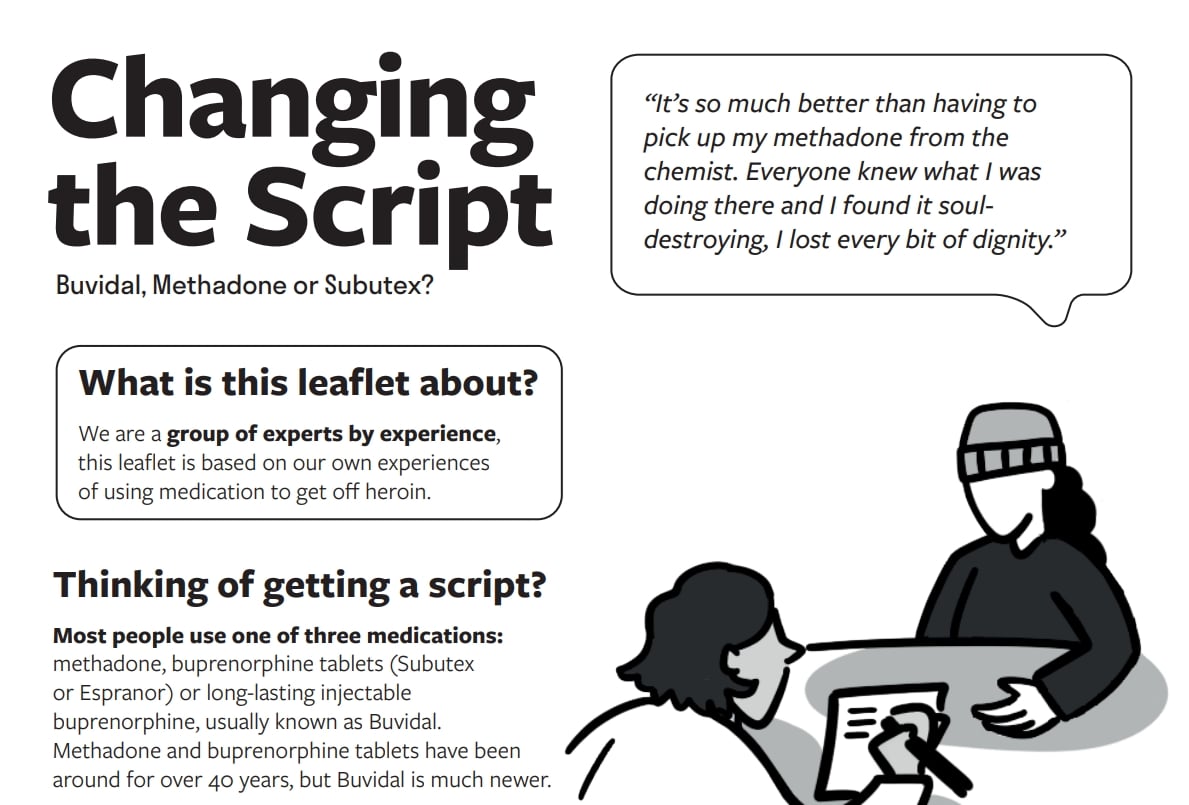
Today’s blog post features a new information leaflet designed by people with experience of using opioids to help others who might want to use medication to help start their recovery journeys. I was lucky enough to be involved with a group of experts by experience convened by Revolving Doors to co-produce the leaflet.
The process
The process for creating the leaflet was simple in design but surprisingly lengthy and challenging to get right. Andy Williams, Director of Involvement at Revolving Doors, advertised the project to their members asking for interest from anyone with lived experience of using opiates and substitute medications. We were lucky enough that half a dozen people with wide-ranging experiences from all over the country wanted to get involved.
The roles
The roles in our partnership were straightforward. The experiences and opinions of the Revolving Doors members were central throughout. As a group, they decided what should go into the leaflet and briefed the designers and signed off on the final product.
Andy organised and facilitated the meetings while I wrote up a series of drafts of the content to help push the project forward.
The process was both incredibly rewarding and stimulating and at times quite challenging for all of us.
The rewards
The initial meetings were characterised by high energy and lots of learning. Revolving Doors members were very generous in sharing their experiences with full honesty, focusing on what they had learnt including the mistakes they had made along the way.
Having seen dozens of different drug information leaflets, members quickly reached a consensus about the type of messages they wanted to share and the types of language and images they were happy to use.
Members were clear that too many leaflets were written in language that was too technical or medical and did not speak to people who were still actively using opiates. They despaired of stereotyped images of drug users or images of needles and syringes.
They were also very clear that everyone’s experience was unique and that although they felt they had lots of helpful experiences and information to share, they did not want in any way to prescribe how people should navigate their individual recovery journeys.
The challenges
There were a number of challenges that we all struggled with throughout the process including:
- How comprehensive the leaflet should be. There are clearly a number of difference medications that people have successfully used to manage their opiate use and start their recovery journeys. Methadone and buprenorphine tablets (such as Subutex and Espranor) have both been around for over 40 years but long-lasting injectable buprenorphine (usually known as Buvidal) was much more recent. The group felt that most heroin users had a good understanding of the pros and cons of methadone and buprenorphine tablets but that information about what it was like to take Buvidal was much less available. We had lots of discussions about whether the leaflet should cover all three substitute medications equally or whether it should focus on injectable buprenorphine. In the end, the group decided that people would be more interested to know more about Buvidal.
- The size of the leaflet. Our single biggest challenge was to condense the leaflet into a format that felt accessible and people would actually want to pick up and read. The first couple of meetings created so much nuanced information that we could easily have written a 24 page booklet but we knew that most people actively using heroin were unlikely to pick up and read something that long. Over time, the leaflet reduced in size to the two-sided A4 sheet you can download below. This was a really difficult process for all of us; leaving out so many real life experiences and associated learning felt quite brutal and difficult to do at times.
- How “fancy” the design should be. One of the principles the group decided on early in the process was that the leaflet should be attractive and make people want to pick it up and read it. But having taken advice from comms people in the drug and alcohol field, it was clear that if people were going to print their own copies, it had to be in black and white and have easy to print images. This wasn’t an easy circle to square.

Final thoughts
The principles of practice being informed by lived experience and the value of peer-to-peer interventions are well established in the drugs and alcohol field. However, this project made it clear to me that these principles are not always successfully extended to the production of information and that getting a short user-friendly information sheet is nowhere near as straightforward as I had imagined.
My sense of the project is that all of us found it enormously enriching, learning from each other, even if we drove each other a little crazy at times as we decided just how to condense all the group’s knowledge and experience into a usable leaflet. None of us thought it would take us nine meetings at the outset but we all felt the project was communicating something of real value and no-one wanted to bail out until we were all happy with the final product.
If you work or volunteer in a setting where they are people who use heroin or other opiates, please consider downloading the leaflet and printing out a few copies to make available. Just make sure you set the printer to print both sides!
Funding and independence.
The leaflet was developed independently by Revolving Doors lived experience members and myself, with funding through an independent grant from Camurus, the manufacturer of Buvidal. Camurus had no involvement in its content or editorial decisions.
It is intended to support informed choice and does not recommend any particular medication.