
Highest number of sexual offences ever still tip of the iceberg
Despite this very substantial rise in the number of sexual offences recorded by the police, it’s important to remember that sex offences remain the most under-reported crime.

Despite this very substantial rise in the number of sexual offences recorded by the police, it’s important to remember that sex offences remain the most under-reported crime.

Perhaps the most pleasing finding of this ONS report is that the decrease in the number of violent crimes has been influenced more by a fall in repeat victimisation than a fall in one-off victimisation.
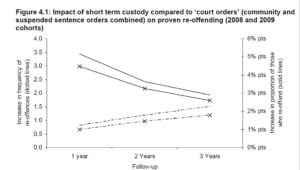
It will be fascinating to see if the new Community Rehabilitation Companies can reduce the reoffending rates of short term prisoners now that they have the first opportunity to provide supervision to this group.

There is a clear evidence base to show that good relationships between offenders and their supervisors are important for the identification of needs, ongoing engagement with their sentence, and ultimately for rehabilitation. The research shows that successful supervision requires

Another consequence of these lengthy monolithic contracts is that it is very difficult for governments to change policy direction. Reform makes the point that to implement change a new government will often have to compensate existing providers and institute new, lengthy and expensive procurement processes. Although old providers may get some compensation, all potential

This is just the latest piece of research that reinforces the need to develop a more integrated system of social care. Although few argue against a more co-ordinated approach, we seem to have made very little progress towards constructing it with joined-up commissioning apparently as difficult to achieve as ever.

The Crime Survey for England and Wales (CSEW) found that crime in the year ending September 2014 was 11% down on the previous year and the lowest estimate since the CSEW began in 1981. There was an estimated 7 million incidents of crime against households and resident adults in England and Wales.

“time and resources are frequently being wasted as a consequence of the practice of adjourning the sentencing hearing so that the Probation Service can prepare a presentence report (PSR) for cases that either do not require a PSR or when an oral report would suffice.”

This then creates the problem of a provider who is ‘too big to fail’. If a provider under-performs, the government may not be able to remove them due to the difficulty of replacing lost capacity, undermining the threat of sanctions written into contracts.

A prime example of this is the government’s radical overhaul of the probation service – “Transforming Rehabilitation” – where new (mainly private) providers will require the active cooperation of a wide range of other agencies such as drug treatment providers etc. to reduce reoffending. Some of the new providers have already stated that they do not wish to spend any of their contract revenue on this provision but expect other agencies to provide high quality services to offenders without any additional incentives.

In my view, implementing rapid sanctions alone is unlikely to promote reduced drug use or offending. Desistance and recovery rarely involve a simple, linear path to success. If every relapse is met with 5 days in custody, it is hard to envisage how offenders will achieve the long term stability and abstinence required to build a personally fulfilling and law-abiding lifestyle.

The central conclusion of the report is that the Criminal Justice System’s approach to young black men of African Caribbean descent is based on the supposition that they belong to a gang, and that young Muslim men are, or soon will be, engaged in terrorist activity.