The most recent (23 October 2026) in the Probation Inspectorate’s Academic Insight series examines the issue of Children and young people who have displayed harmful sexual behaviour. Produced by Stuart Allardyce & Peter Yates, the report unpicks this problematic issue and provides advice on balancing proportionate risk management measures with a supportive approach.
Background
While the large scale of child sexual abuse is usually acknowledged (the latest research concludes that at least 20 per cent of girls and 10 per cent of boys are sexually abused during childhood), much less attention is paid to the fact that a significant proportion of those who cause sexual harm to children are themselves under the age of 18.
In the last major UK study of child maltreatment, it was found that 66 per cent of contact sexual abuse reported by children and young people was by other children under the age of 18.
HSB
Although a wide range of terms have been used to describe situations when adults become concerned about children’s sexual behaviour, this phenomenon has increasingly been described as ‘harmful sexual behaviour’ (HSB) in the UK.
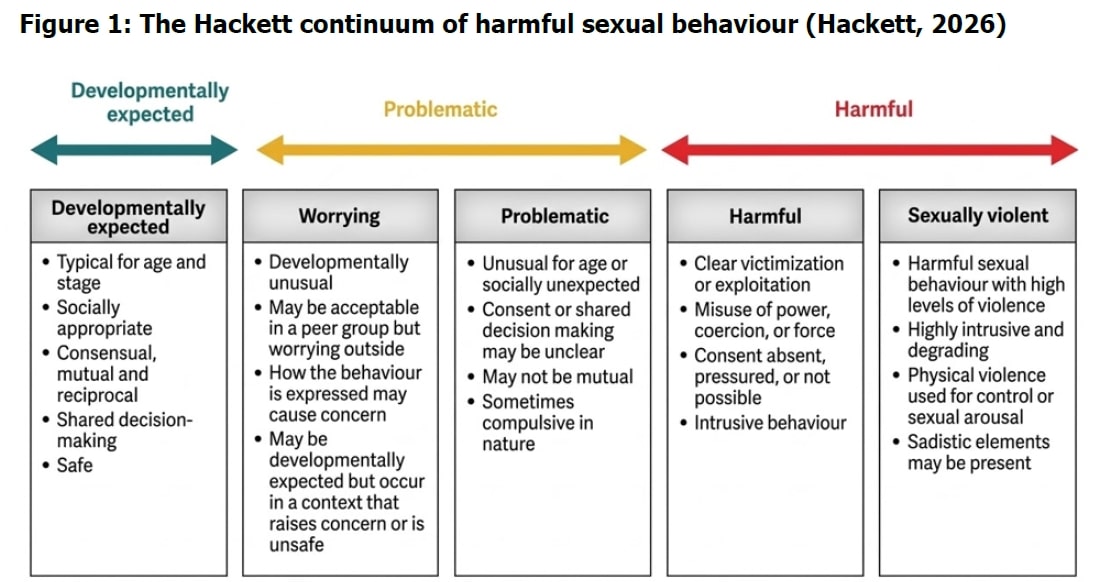
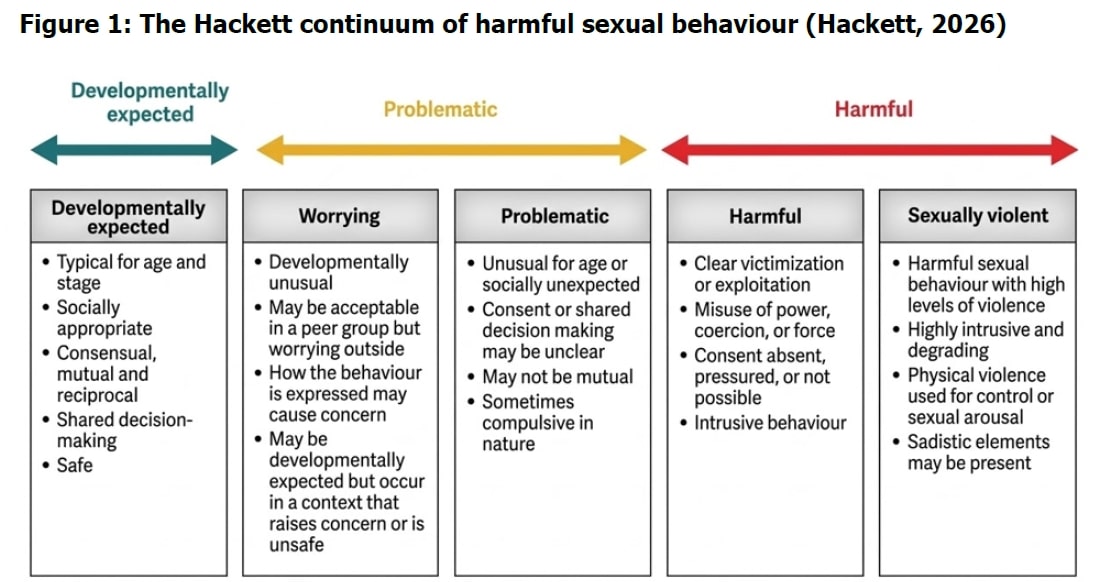
As set out in the infographic I have reproduced from the report below, children’s sexual behaviours may best be described as lying on a continuum from developmentally expected, through worrying, problematic, harmful and sexually violent behaviours.
Assessment
The authors explain that assessing what constitutes developmentally expected sexual behaviour at each developmental stage is not straightforward. Some behaviours that are developmentally expected in young children are concerning if they continue into adolescence and vice versa.
They recommend that the level of assessment should be proportionate to the behaviours displayed, requiring more comprehensive assessment if initial indications are that the behaviour is problematic or harmful. Detailed assessment of children’s sexual behaviour is indicated if the behaviour meets any or all of the following criteria:
- it occurs at a frequency greater than would be developmentally expected
- it interferes with the child’s development
- it occurs with coercion, intimidation, or force
- it is associated with emotional distress
- it occurs between children of different ages
- it repeatedly recurs in secrecy after intervention by caregivers.
The complexity of this issue is also aggravated by the different contexts in which HSB can take place: in the family; at school and other organisational settings; in the community (rare for children) & online.
The authors are clear that there is no single theory of why children display HSB although a recent literature review identified 10 “pathways” including child sexual abuse victimisation; living with domestic and family violence and hypermasculinity.
Responses
The authors caution that immediate responses to HSB depend on interacting considerations relating to the level of risk to and from the child and young person, their age, and the contexts in which they live and in which the HSB has taken place. They helpfully suggest that assessments need to address four key questions:
- Why has the young person behaved in this way?
- How likely are they to do it again? To whom? And in what circumstances?
- What do we need to do now to manage the risks that are presented?
- What do we need to do in the longer term to reduce the levels of risk presented and to help the child to move on from their harmful behaviour?
The report emphasises the importance of developing a holistic response which is tailored to the needs of the particular child, the risks they may present, and the context in which they live. They say that proportionate risk management measures are essential but must be balanced with nurture, encouragement, and opportunities for the child to develop healthier social and relationship skills.
They recommend an approach which builds on those skills and relationships that promote resilience. In general, each child requires individual attention within a systemic approach so they become more able to:
- overcome any problems with emotional and sexual regulation
- understand their own feelings and behaviours as well as the feelings and behaviours of others
- work towards resolution of any past trauma
- develop social and relationship skills in the context of home, school, and community
- meet their own needs in a socially acceptable way
- sustain longer-term change, anticipating future stresses they may encounter.
Conclusion
This is a valuable starting point for anyone working with a child or young person who has displayed harmful sexual behaviour. The report makes it clear that, given the prevalence of HSB, most practitioners working with this age group will need to develop this set of skills and receive good quality training, support & supervision.