The hidden life of Muslims in prison
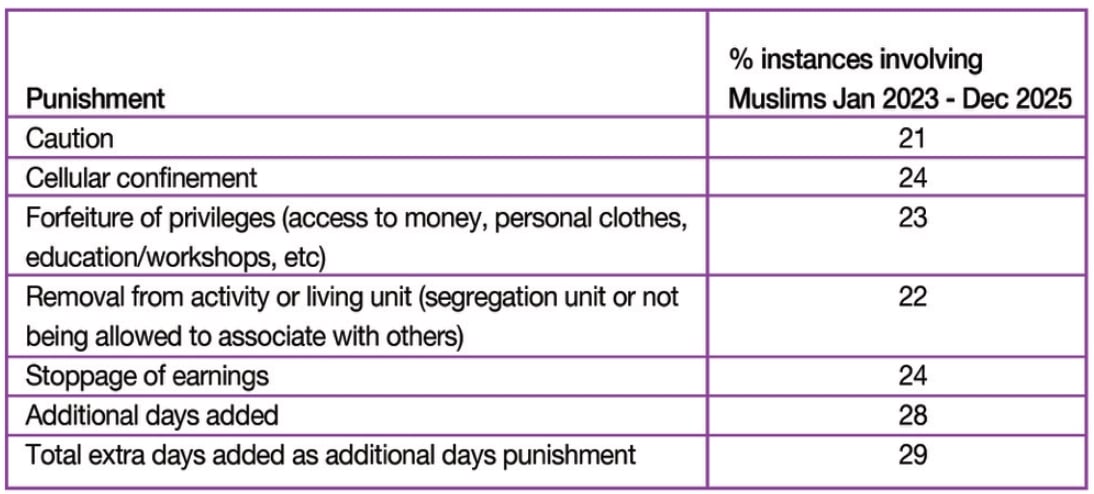
The Muslim charity Maslaha has just published the third in a series of briefings under the title “The hidden life of Muslims in prison”. The new briefing focuses on adjudications in prisons and argues that they are applied more harshly against Muslims with the result that Muslim prisoners are less likely to be considered for jobs and education in prison and more likely to have additional days added to their sentence.
The research
To find out more about how prison rules are applied, Maslaha analysed HMPPS published data on adjudications across men’s prisons from 2023 to 2025. They also analysed HMPPS Offender Equalities Annual reports for the same time period, which includes data on incentives and privileges.
The findings
Incentives and privileges
Maslaha reports that Muslim prisoners are also likely to encounter disparate outcomes in the Incentives and Earned Privileges scheme. In 2024/25 Muslim prisoners had the highest proportion of prisons with a Standard (49%) and Basic (8) incentive status and the lowest proportion of prisoners with an Enhanced incentive status (43%) out of all religion or belief groups.
This trend, whereby Muslims are more likely on standard and base and least likely to have enhanced status, has not changed in five years of reporting.
Which level of Incentive you are on is probably the most important determinant of your prison experience. The higher your incentive level, the benefits you receive include:
- being able to spend more of your money
- get more visits from your family and friends
- earn more money
- have a TV in your cell
- wear your own clothes
- spend more time outside of your cell.
These incentives vary from prison to prison.
Maslaha spoke to a number of Muslim prisoners who talked about what they saw as stereotypes of Muslim prisoners as being the main cause of this disparity with Muslims seen as a threat with expressions of faith such as growing a beard, making the call to prayer, praying and congregating with other Muslims all seen as “risky” and vulnerable to being punished.
Conclusion
Maslaha expresses concern that these disparities have persisted over many years and could well be exacerbated by the provisions of the Sentencing Act which will introduce the concept of earned progression which will result in those prisoners who are deemed to be behaving well being released earlier from their sentences.
Thanks to Andy Aitchison for kind permission to use the header image in this post. You can see Andy’s work here