
Combatting new forms of extremism
A recent (1 April 2026) report from the House of Commons Home Affairs Committee warns that the Prevent referral mechanism is unprepared to deal with reality of modern extremism. The report says that Extremism is evolving rapidly. It acknowledges that long-standing threats such as Islamist extremism and right-wing extremism persist, but notes that new trends in extremism are emerging, including children and young adults being drawn into extremism, hybridised and conflicted ideological belief systems, and an over-representation of neurodiverse individuals and those with mental health conditions in referrals to the government’s counter-terrorism Prevent programme.
Online spaces
The report details how online spaces play a central role. Social media and gaming platforms, online forums, influencers, and creative tools such as memes, humour and coded messaging make extremist narratives easily accessible and highly engaging, particularly for younger audiences. Algorithms push a steady stream of harmful content while advances in technology, including generative AI, lower barriers to producing extremist and harmful content.
A disproportionate number of individuals who are neurodiverse and those with mental health conditions are being drawn into new forms of extremism. Com networks, online networks of predominantly teenage boys seeking to inflict harm and engaging in a range of criminality, are an example of how the extremism landscape is evolving. These trends are being seen internationally as well as in the UK.
Impact of Israel-Hamas conflict
In addition, there are rising incidents linked to anti-blasphemy activism, anti-Israel extremism, anti-Muslim hostility and eco-extremism, driven by divisive, inflammatory and apocalyptic rhetoric. There are a range of underlying drivers to new forms of extremism, including geopolitical events, most notably the Israel-Hamas conflict, the rapid spread of mis- and disinformation, the mainstreaming of antisemitic and anti-Muslim rhetoric, social exclusion and discrimination, and grievance-based narratives. Malign state actors, including Russia and Iran are also using mis- and disinformation to sow fear, mistrust and division, targeting young people in particular and blurring the lines between state threats, terrorism and non-ideologically motivated violent extremism.
Government not keeping pace
The Committee’s main point is that the government’s current approach to countering extremism has not kept pace with these changes. It is overly reliant on counter-terrorism systems like the Prevent programme, which aims to stop people from becoming terrorists or supporting terrorism, and is not designed for dealing with the complexity of current extremist threats.
Prevent is becoming saturated with non-ideological cases, many of which would be better supported through health, education or community-based interventions rather than through a counter-terrorism lens. Prevent is also poorly adapted to identify individuals being drawn into extremism online.
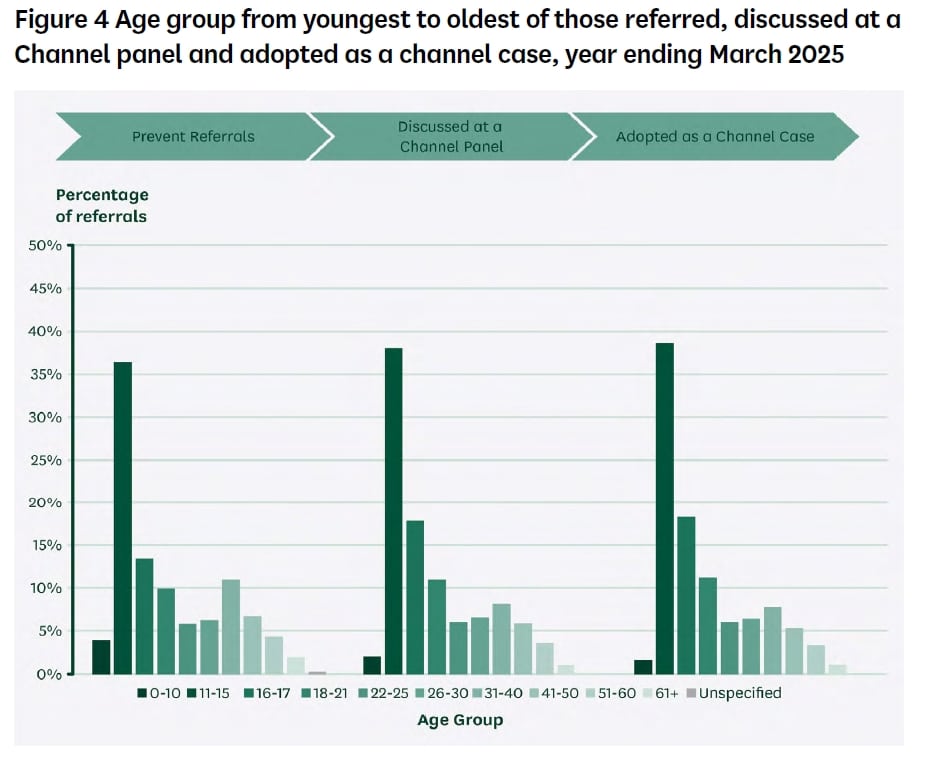
A clear illustration of this is that children aged 11–15 years represented the highest numbers of those discussed at a Channel panel and adopted as a Channel case. Multi-agency Channel Panels assess individuals referred to Prevent if the police consider that person to be at risk following initial checks.
The chart reproduced below shows that children aged 17 and under accounted for 4,715 of all referrals (8,778) to Prevent in year ending March 2025.
Recommendations
The Committee’s primary recommendation is that the Home Office should embed the Prevent programme within the wider safeguarding system and introduce a triage structure that sits above Prevent. This will ensure that cases suitable for the types of intervention that Prevent offers are funnelled to Prevent and cases more suited to other forms of support are directed elsewhere, without having to first pass through Prevent.
A triage system would create a single point of entry, or ‘big front door’ through which a broad range of concerns can be assessed before being offered a suitable package of support. This would apply to concerns relating to vulnerability, neurodiversity, mental health, violence fascination, or any form of concern around an individual’s risk and capacity to hurt themselves or others. This triage function should sit above Prevent, ensuring that Prevent is used only for cases with a genuine risk of radicalisation to terrorism, consistent with its statutory purpose.
The Committee also urges the Home Office to establish a coherent, long-term research and evidence-gathering programme on new forms of extremism. The UK currently lacks the empirical data needed to understand where and how radicalisation is occurring, particularly online, and how best to intervene.
The Committee’s third principal recommending is the need to strengthen digital and media literacy. It says that young people must be equipped to analyse online material critically, recognise manipulative content, understand algorithms, and identify AI-generated or deceptive content.