Food and desistance
This is a guest post by Kevin Wong & Julie Parsons
When we told (some) colleagues that we’d been commissioned to produce an edited book about food and rehabilitation, we were met with raised eyebrows, bemusement, incredulity, even pity. Food’s ubiquity, its quotidian nature, rendered it mundane. What could you write about food that could possibly elevate it into a serious topic of study?
Fortunately, attested to by the publication of: The Role of Food in Rehabilitation and Resettlement: Good Food and Good Lives we found others willing to tread this intellectual hinterland.
That the study of food, rehabilitation and resettlement has generally been overlooked was the point. Its prosaic guise concealing something complex and unexpected, an unassuming eatery that turns out magic in a bowl. Moreover, as food scholars remind us – “food looks like an object but is actually a relationship […] endlessly interpretable, as gift, threat, poison, recompense, barter, seduction, solidarity, suffocation”
Food and desistance
Away from academic musings, of course the evergreen question for policy makers and practitioners – facing the Sisyphean task of helping people with convictions desist from crime – is how can food contribute to desistance? For Julie, this was related to her long-term interest in the sociology of food, especially Simmel’s (1910) arguments relating to sociability and the sociology of the meal, which serves as a ‘symbol upon which the security of belonging together could always be re-established’. Notably this has been explored in relation to her research with National Charity Award winning voluntary sector organisation LandWorks. For Kevin, this combined his longstanding work, evaluating resettlement and rehabilitation programmes with his personal interest in growing and cooking food, rooted in a childhood immersed in catering.
What follows in the book therefore illustrates the multiple ways in which food interventions such as growing, cooking and sharing of food and eating together (commensality) addresses desistance. Specifically, the desistance factors succinctly presented in the evidence synthesis (on reducing reoffending) published by the Ministry of Justice (Cordle and Gale 2025).
Desistance factors (Cordle and Gale 2025) | Food interventions |
Relationships with family and significant others | · “Doing commensality” – people in prison and family members eating together in a meaningful way (in the visiting room) to reunite and strengthen family bonds (Adams et al 2025) · Men at the Clink restaurant in HMP Cardiff cooking, serving and eating a Christmas dinner together with their families – as a means of bonding with the family but also showing and taking pride in what they can do and demonstrating how they have changed (Graham 2025) |
Being employed | · Acquiring horticultural skills at LandWorks leading to meaningful work (Parsons 2025) · Acquiring catering skills at Back on Track which are recognised and appreciated through the café by members, staff and visitors alike – which spur them to think about catering as a meaningful employment option (Wong et al 2025) · Acquiring horticultural skills in prison, growing food in prison – Greener on the outside (GOOP) (Baybutt et al 2025) |
Motivation and self-belief and Having hope | · Supported through the interventions above and others such as the Community Table in British Colombia where formerly incarcerated women meet together to cook, share food, tell stories and support each other (Timler et al 2025) |
Reintegrating into society | · Community payback schemes (Nornir Stockport) which supplement dwindling supplies of surplus food for community pantries and social supermarkets with community payback grown and processed food products – to address food poverty (Nicholson 2025) · The café at Back on track as a community space shared by members (service users) staff and visitors alike, where they socialise, eat in the same space – where the £1 Thursday three-course lunch brings members together (Wong et al 2025) · The daily lunch at LandWorks where volunteers (from the community) cook lunch (using food grown on site by people on day release and probation) with people on day release and on probation, where the trainees, volunteers, staff and visitors eat together; show appreciation for whoever has cooked the food and at the end of meal celebrate successes, completing training, getting a volunteering position elsewhere, getting a job (Parsons 2025) · The community table (in British Colombia) – mutual support (post-release) through cooking together, sharing food and eating together (Timler et al 2025) |
Having a non-criminal identity | |
Being believed in |
The Appeal of Food
What are the common features of these interventions that appeal to people with convictions and practitioners? Drawing on the research conducted by ourselves and our fellow authors the following stand out.
Bottom-up
These food activities are not mandated, prescribed by government, HMPPS, the MoJ or some other institutional body. They have grown organically. Practitioners trial something – such as at LandWorks – let’s get staff, people on day release from prison, volunteers and community members cooking food they’ve grown and have lunch together – seeing the positive response from all and consequently making it a daily feature.
Feedback loops
When we enjoy food, we compliment the person who makes it. It’s a short feedback loop. We don’t have to wait months, years to get a result. For all of us (including people on probation, on day release, in prison) presenting food they’ve cooked may be nerve-wracking (attested to by the catering trainees at Back on Track) but we receive instant affirmation. Growing food can take longer, sowing seeds in modules, transplanting them into pots, planting out, it can be weeks, maybe months, but the appearance of shoots, then leaves, flowers, fruit (we’re thinking courgettes and squashes) marks steady progress, hope, and all growing well – the reward of an abundant harvest.
Us (not them and us)
Prison staff and people in prison tending the veg patch together, having lunch together gave them the time and space to see each other as individuals observed through the Greener on the outside for prisons (GOOP) schemes. At LandWorks where everyone sits down to enjoy lunch as equals: staff, people on day release, people on probation, volunteers, members of the local community and visitors. The ‘café that cares’ at Back on Track, where service users, volunteers, staff, visitors, trustees gather for a coffee, tea, a snack, lunch.
Food connects us
It seems too obvious to say it, but let’s do it anyway – food connects us as people. It allows us to express our humanity, to step away from the roles that we inhabit, whether as professionals, people on licence, on a community order, a volunteer with lived experience. Our personal lives, with our families, friends, significant others, are marked by food which offer expressions of love, mutuality, reciprocity and celebration. One of us recalls being told by an ‘old-time’ probation officer how in the 1970s, he would mark the completion of a community order by taking the probationer out for a pint. This would be unthinkable, given the contemporary awareness of alcohol use, risk and so forth. Its contemporary equivalent would perhaps be a cappuccino and cake. It exemplifies Shadd Maruna’s (2011) cogent argument for the significance of ritual as a way of marking reintegration and acceptance for people with convictions.
Intrinsic v instrumental
Food interventions have the potential to transcend their instrumental function and offer people with convictions – intrinsic value. How does this play out? Adopting the realist evaluation stance on programmes – it’s individuals’ volition and their responses to the resources that programmes provide – not the programmes per se – that lead to behavioural change (Pawson and Tilley 1997). It’s that old desistance chestnut – people need to want to change. With the right programme at the right time, they can be helped to do so. This is illustrated in the ‘thought diagrams’ below for a person in prison, depicting their initial motivations for joining a horticultural programme and then their later reasoning after being on the programme for a while. But note, its small steps change, not transformational leaps.
Initial reasons

Later reasons

To conclude
In their chapter in the edited book, Kelsey Timler and her colleagues (2025) note that “we make new memories through the making and sharing of food […] we hold space for the whole person, the whole story, the whole potential of what we might make together”.
Food interventions have the potential to engender hope for people with convictions. In a similar vein, such hope (and optimism) that people can and will change is also required by practitioners working at the coal face. Food interventions offer this. As for policy makers and commissioners, our pitch is simple, take a punt, give practitioners and service users, encouragement, space, time and some resource – often not that much – to try out some of the approaches we’ve sketched out above.
Here’s the link again: The Role of Food in Rehabilitation and Resettlement: Good Food and Good Lives
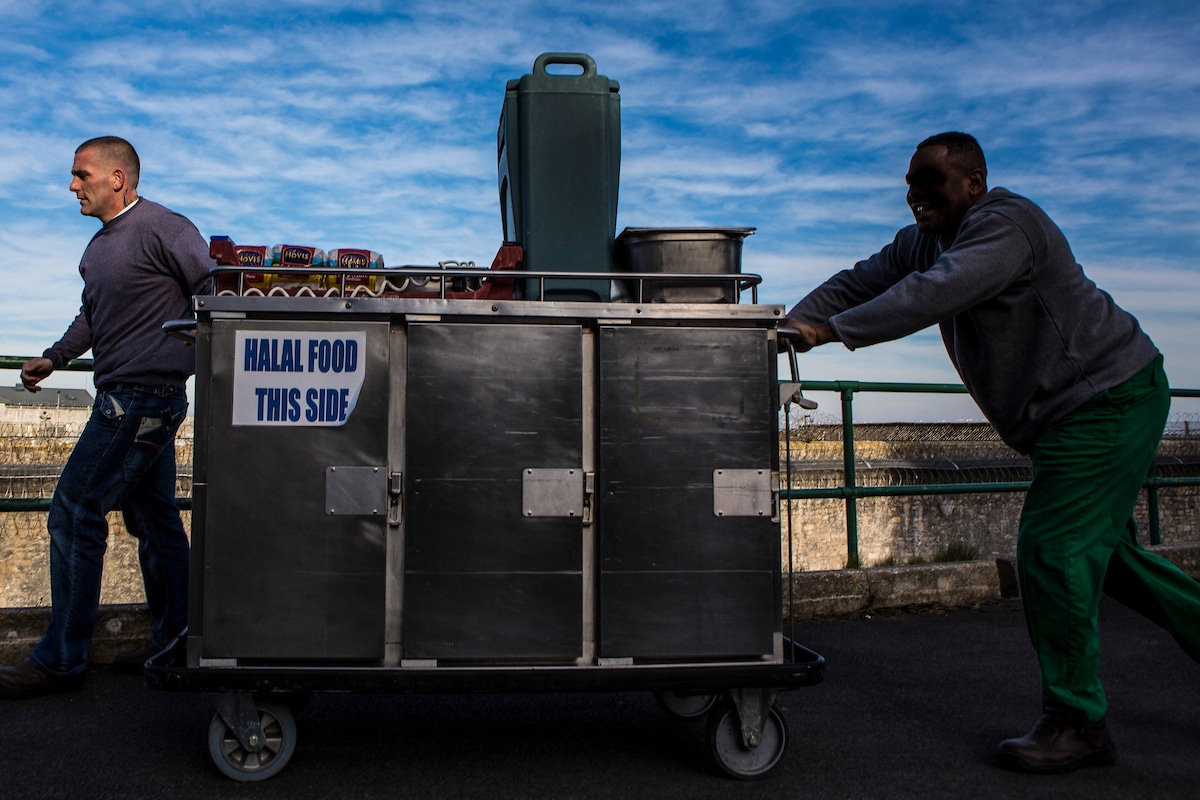
Thanks to Andy Aitchison for kind permission to use the header image in this post. You can see Andy’s work here