Earlier this week (12 October 2026), the Institute for Government published its latest report tracking the performance of the criminal justice system. As usual, the report is collated and produced by Cassia Rowland and is an invaluable, impartial assessment of the state of our CJS. Yesterday, we looked at the IfG’s assessment of performance in prisons and probation. Today’s post finds the IfG painting a more positive picture of policing since the 2024 general election.
Context
The IfG report starts by saying that policing was a rare area of public policy which was generally improving when the Starmer government took office in July 2024 – albeit from a low base. Officer numbers had increased sharply under the police uplift programme, launched by the Johnson government. Charges and other positive resolutions to crimes were rising. Most types of crime were falling or flat.
Of course there were many challenges including falling public trust and confidence.
The IfG’s assessment is that the Starmer government set clear, well-chosen objectives and successfully galvanised action to follow through on them. It notes that the proposals for police reform in this January’s white paper have provided a sense of direction and a positive vision for policing, but cautions that, they are potentially in conflict both with the Burnham government’s emphasis on local leadership and devolution, and with some goals in other criminal justice services.
The IfG concedes that many of the reforms in policing are at relatively early stages, making it challenging to assess progress in the past year. This means that their performance tracker takes a more qualitative approach than is the Institute’s norm to determine whether the changes proposed are likely to further the government’s objectives, as well as to assess some of the downsides or trade-offs they may face.
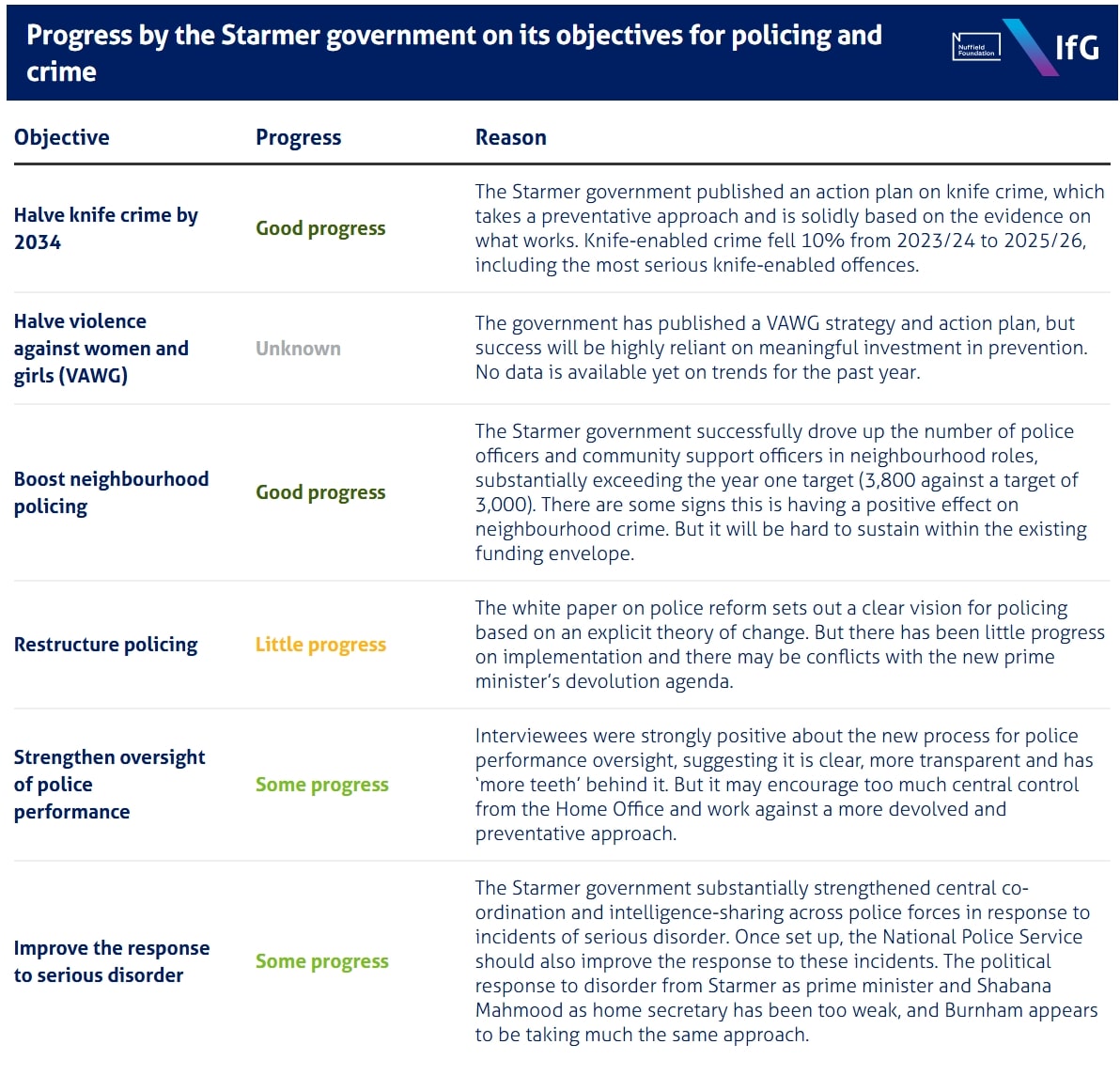
The performance trackers are always accessible and well presented and this current edition provides the helpful summary of policing progress against key government objectives reproduced below.
Neighbourhood policing
The IFG says that the government is currently ahead of its target on neighbourhood policing, substantially exceeded its first-year target for neighbourhood officers, with an increase of more than 3,800 against a target of 3,000. Almost 3,500 of these are warranted officers, while just over 300 are PCSOs. Around 500 are still in training, but destined for neighbourhood roles. Even discounting those who are in training, however, this is almost a 20% increase in the number of officers in neighbourhood roles in a single year.
Local crime falls
The IfG reports signs that the increase in neighbourhood officers and a focus on local crime may be having a positive effect on crime. While most crime types have been in sustained decline since the 1990s, low-level theft incidents rose sharply from 2022/23 to 2024/25, with recorded shoplifting up 55% and estimated theft from the person (such as pickpocketing or snatch theft) almost doubling in two years. But, in the past year, these have dropped significantly. More serious forms of theft, including domestic burglary (13%) and theft of vehicles (31%), have also fallen sharply.
Knife crime
The report is similarly upbeat on knife crime, saying that targeted action on knife crime appears to be delivering results, with a notable (10%) drop in serious offences from 2023/24 to 2025/26.
VAWG
The IfG acknowledges that they key government objective of tackling violence against women and girls (VAWG) is both slower and harder to track. These offences commonly happen in private, domestic settings and are much less likely to be reported to the police, or to lead to prosecutions and convictions.
Police reform
The IfG recommends that the Burnham government should build on the clear vision for police reform set out under Starmer, recommending the realignment of local forces with strategic authorities on a one-to-one basis.
Police performance oversight
The report acknowledges that performance remains varied and concerning many areas but argues that the revised police performance process has more teeth and provides stronger Home Office oversight. It says that the new approach should make it possible to respond earlier and more effectively when forces are performing poorly. The IfG makes clear, however, that this view is largely reliant on two assumptions:
- There is enough capacity and capability in the wider policing system to provide effective support for forces that are struggling.
- Oversight and ‘grip’ from the Home Office will be more effective at holding forces to account and improving performance than local scrutiny by police and crime commissioners and mayors.
Conclusion
The IfG summarises the government’s mid-term report:
“policing continues to face serious and enduring performance problems. The past two years have not seen consistent improvements, with poor crime investigation and safeguarding continuing to be major concerns. However, the Starmer government made good progress on its key objectives and was on track to meet its goals on neighbourhood policing and knife crime, although there is still a long way to go on both. It also produced a roadmap for reform and revamped the performance management process, with a clear theory of change for how these will drive further performance improvements. Crucially, there are early signs this progress may be increasing public confidence in policing.”
It goes on to make four key recommendations to government:
- Implement the police performance framework flexibly, allowing mayors, police and crime commissioners and policing authorities (once established) to set their own priority metrics and provide meaningful strategic direction for forces.
- Commit to aligning police force boundaries to strategic authorities on a one-to-one basis, even where this means splitting up existing forces.
- Ensure mayors, police and crime commissioners and policing authorities (once established) keep the power to sack the chief constable of their force.
- Maintain the focus on neighbourhood policing and targeting knife crime hotspots.