Focus on diversion
The Women’s Justice Board has just (16 March 2026) published its report to the Justice Secretary with a set of recommendations for reducing women’s imprisonment. The report acknowledges that the changes recommended in the Corston Review (published almost twenty years ago in 2007) have not taken place and sets out a series of recommendations.
The case for a female offender strategy
The report sets out the rationale for implementing the vision set out by Baroness Corston which is is to end women’s imprisonment in all but the more serious cases. Women in contact with the CJS are often among the most vulnerable in society. Many have multiple and complex needs, often derived from the traumatising experience of domestic abuse and other forms of violence against women and girls (VAWG).
They are often primary caregivers and many have fallen through the safety net of statutory services. The government aims to reduce the women’s prison population sufficiently to close a women’s prison, in other words about 400 fewer women in prison at any one time. The report says that as well as diverting more women from prison, we need to support more in the community and prevent far more from entering the CJS at all.
Implementing a whole system approach
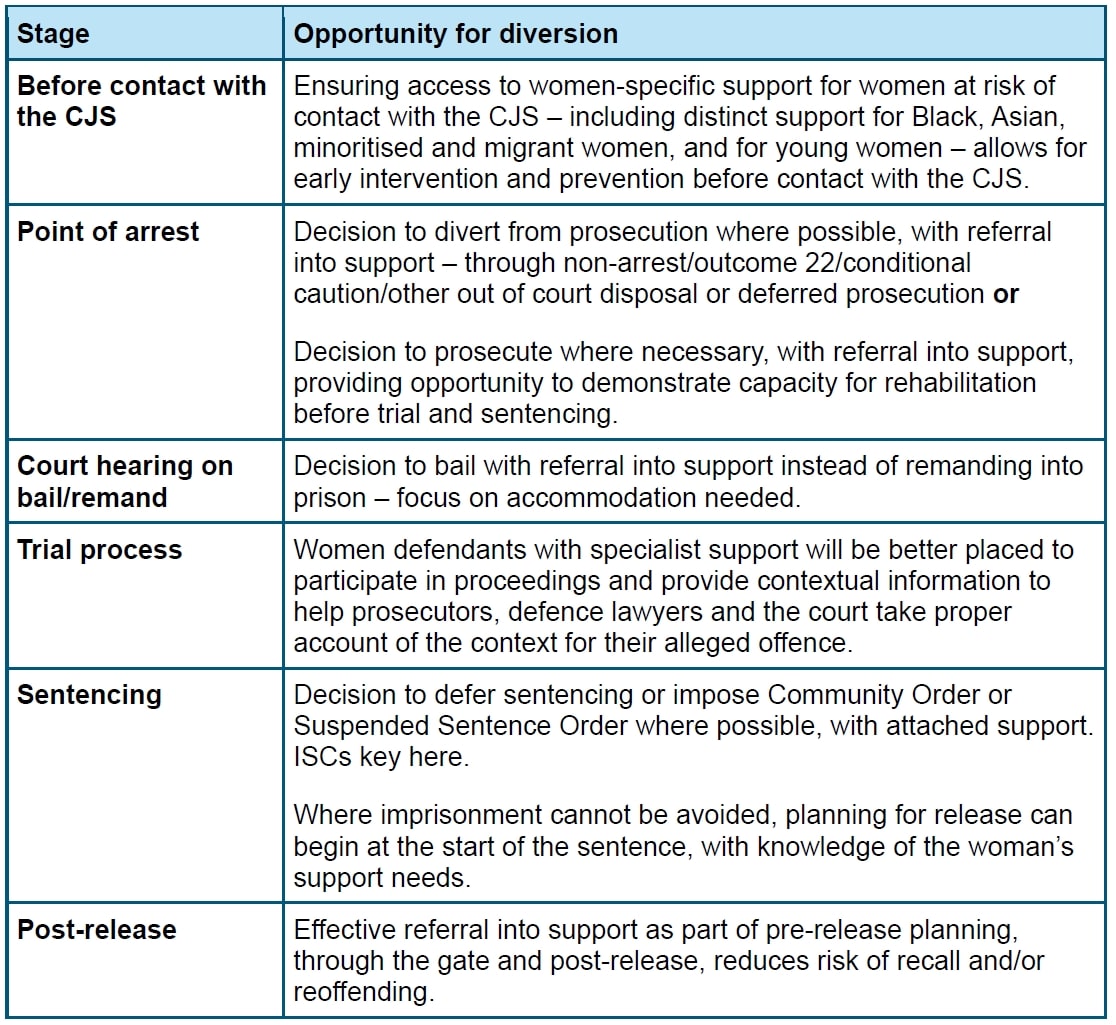
The report includes the table reproduced below which summarises the stages at which there are opportunities to divert women and reduce the risk of harmful imprisonment.
Recommendations
The report says that Women’s specialist services in the community are fundamental to this whole system approach but notes that for many years funding for Women’s Centres and other services has been precarious and short term. It calls for the Government to invest in these services for the long term.
The report makes a series of recommendations to the MoJ which are summarised below:
Women’s Justice Reform Programme
The MOJ and Welsh Government should establish a two- to three-year Women’s Justice Reform Programme to provide oversight for delivery of all the actions proposed in this report and to lead three projects over the next year:
- Driving gender-informed implementation of the ISR and IRCC.
- Intensive support for developing local whole system approaches.
- Transforming the funding of women’s specialist services and unlocking other sources of support for women.
Anti-racist, intersectional approach to addressing disparities
An anti-racist, intersectional approach should be adopted for all this work, to address disparities faced by Black, Asian, minoritised and migrant women, and those with other protected characteristics.
Early intervention, prevention and diversion
- Introduce incentives, accountability mechanisms and support to ensure all police forces have gender-specific, trauma-informed diversion pathways for women, including a strong focus on reducing arrests and increasing deferred prosecution.
- Improve scrutiny of, and expand referrals into, the NHS female L&D pathway to ensure consistent, effective practice everywhere.
- Strengthen decision-making by police and prosecutors about victims of VAWG who are accused of offending and provide effective defences.
- Address disproportionate criminalisation of women for non-payment of fines resulting from TV licence evasion, Council Tax or truancy.
Community solutions
- Reduce remand and recall for all women through legislation and focused work under the Women’s Justice Reform Programme.
- Support effective expansion of women’s ISCs.
- Improve resettlement prospects by removing barriers to employment.
- Conduct a rapid study into the circumstances and needs of longer sentenced women currently in prison, to support individual sentence progression and draw out learning to reduce future imprisonment where appropriate for women accused of more serious offences.
Pregnant women and mothers
- Legislate to end imprisonment of pregnant women in all but the most exceptional cases; embed and strengthen improvements in care of pregnant women where imprisonment cannot be avoided; develop and promote residential alternatives to custody for pregnant women for use as bail accommodation or as part of a community sentence.
- Promote non-custodial sentencing of mothers of children under 18 through directions and awareness raising with sentencers.
- Improve outcomes for pregnant women and mothers in contact with the CJS.
Young adult women
- Develop and publish a Young Women’s Strategy in the next year aimed at preventing young women’s entry into the CJS and imprisonment, particularly for care experienced young women and victims of VAWG (including modern slavery, human trafficking and criminal or sexual exploitation), aligning strategically with youth justice reforms and including a strong focus on reducing remand and increasing access to 1:1 support, mentoring and suitable housing.
- Provide specific health and wellbeing support for young women in contact with the CJS, including those in prison.
Thanks to Andy Aitchison for kind permission to use the images in this post. You can see Andy’s work here