The Rapid Deployment Cells Programme
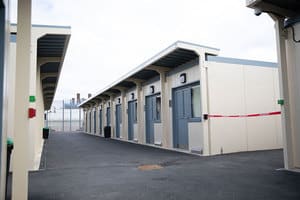
The MoJ has just (16 October 2025) published a process evaluation of early delivery of the the Rapid Deployment Cells (RDC) Programme. RDCs are modular, self-contained units with a 15-year lifespan placed in existing Category C, Category D and women’s estate prison grounds and designed for low-risk prisoners.
While the process of building a new prison usually takes years with much of that time taken up by the planning process, RDCs provide a quicker way of the Government tackling the prison overcrowding crisis.
RDCs typically go on existing prison grounds, utilising small parcels of land that are unsuitable for larger houseblocks. These single and double storey units are designed to “provide decent accommodation, incentivise good behaviour and prepare prisoners for resettlement“.
The cellblocks
Not all RDCs are the same but there were a lot of common features:
- External Layout: At all prisons, RDCs were connected to each other in terraced rows. The layout, however, varied. At some prisons, the RDCs were arranged in rows and blocks with pathways in the middle. At others, there were two separate units on the RDC wing, each with distinct appearances. Finally, at some prisons, the RDCs were set out in a rectangular layout and were double stacked.
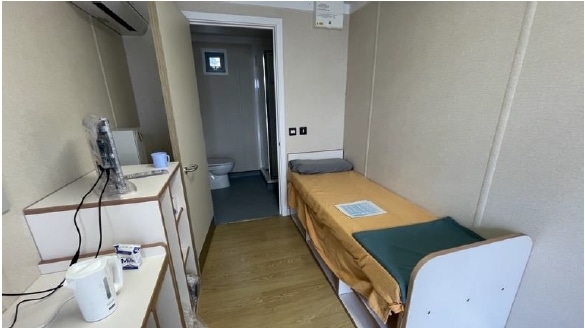
- Cell: All cells had a private ensuite, with a shower and a toilet, a desk, chair and bed. At several prison sites, researchers noted TVs and air conditioning, which had heating and cooling features. Overall, cells were consistently described as modern by researchers and prisoners.
- Communal Areas: Researchers observed association rooms, laundries, and kitchens at all prison sites. Association rooms featured TVs, chairs, tables, and some had dartboards, pool tables, and fish tanks. Laundry areas included washing machines and dryers. All kitchen spaces were equipped with cookers, hobs, extractor fans and designated halal areas, with some equipped with boiling hot water taps, toasters, and air fryers. These spaces were consistently described as modern and clean.
- Outdoor Space: Green spaces varied across prison sites due to the size of available land, but most featured flower beds and plants. One prison site had road signs with different street names directing to various parts of the RDCs, and canopies covering the walkways.
- Additional Facilities: At one prison site, researchers observed a storage space repurposed as a gym, equipped with cycling and rowing machines alongside storage utilities like mops and cleaning equipment. Another site featured a room with four phones.
The evaluation
This evaluation, by Anya Fedorov, Wura Gerasimov, Sarah Connor and Rosie Chalam-Judge, assesses how the programme in the five sampled prisons was delivered, perceptions of its outcomes, and key lessons learnt. These sites were in the first and second tranches of delivery. It draws on 96 interviews with 69 prisoners, 16 officers and 11 governor grade leaders across five prisons in England between September 2024 and February 2025, supported by observational data.
The findings are organised under three categories:
Purpose and identity
- Critical relief: RDCs provided timely capacity at a time the prison estate faced near-maximum occupancy.
- Net capacity gain varied: RDCs provided additional capacity at most sites included in the evaluation. However, in one prison, RDCs replaced decommissioned accommodation, improving quality but resulting in no net capacity gain.
- Enhanced prison management: RDCs were perceived by prison staff to reduce violence and self-harm, improving efficiency and safety.
- Behavioural incentive: RDCs were seen by prisoners as aspirational, functioning as de facto rewards incentivising good behaviour.
- Variation in eligibility criteria: At all sites risk-assessed prisoners were considered suitable for RDCs if they demonstrated good behaviour, but other criteria (e.g. offence type, sentence length, employment) varied significantly across sites at governor discretion. Some prisoners reported inconsistent criteria within their prison leading to perceptions of unfairness. As prisons are dynamic environments, eligibility criteria are kept under review according to operational circumstances and the prisoner cohort.
- Enhanced regimes: Later curfews and more autonomy created more progressive environments compared to main wings.
Prisoner and staff outcomes
- Independent living: Self-cook kitchens, laundry rooms and ensuite bathrooms supported practical life skill development and autonomy for prisoners assessed as safe to access them.
- Improved release preparedness: Prisoners described feeling more equipped to transition to community life, citing increased control and reduced institutionalisation.
- Safer environments: Strict entry criteria and good behaviour fostered a calm, respectful culture with minimal violence or drug use.
- Better relationships: Both prisoner-prisoner and prisoner-staff relationships reportedly improved, marked by trust, respect, and informal, humanising interactions.
- Wellbeing benefits: Prisoners and staff reported improved mental health and reduced stress in RDCs compared to main wings.
- Design strengths and limitations: RDCs offered dignity and accessibility, but, in some sites, concerns were raised about storage, lack of in-cell call bells, limited communal space, and outdoor exposure during poor weather.
- Staff experience: Officers appreciated improved CCTV and space, but some cited poor layout visibility, lack of Tannoy systems, and inadequate rest facilities for staff as design issues.
Implementation
- Delivery timelines were ambitious: Timeline assumptions for tranche 1 and tranche 2 sites were overly ambitious, having been set with limited available information due to their innovative design and delivery, and need to expedite deployment. Timeline assumptions did not factor in enough time for risks that materialised such as planning or ecological issues. These issues led to programme extensions at some sites.
- Delivery challenges: Some deployments ran smoothly, however some hit delivery challenges such as contractor vetting delays.
- Security and logistics: Prison-specific constraints like gate access procedures and operational priorities were not fully factored into timeline assumptions.