This is a guest post by Natasha Porter, CEO & Founder of Unlocked Graduates.
A prison cannot outperform the quality of its frontline staff. This is because the role of the prison officer has a huge impact on the day-to-day lives of prisoners: they set the culture on the wing, spend the most time on the landings, and have access to every single prisoner, even those who choose not to engage with anyone else.
A relational role
Many of the challenges faced by prison officers will be familiar to other frontline professionals, like teachers or police officers, because at its heart, it is a relational role. What makes it especially difficult and complex however is the prison service’s position as a service of last resort. Too often prisons are inheriting responsibility for damage left elsewhere in the system, including by difficult social challenges that many prisoners have faced throughout their lives. One in four prisoners grew up in care and about half left school without a single qualification. A sizable proportion of those in our prisons were not able to be reached by social workers, teachers, doctors or the police.
The role of the prison officer is to manage and support a group of people who can be incredibly challenging to work with, many of whom have been repeatedly failed by public services, some since early childhood.
Training
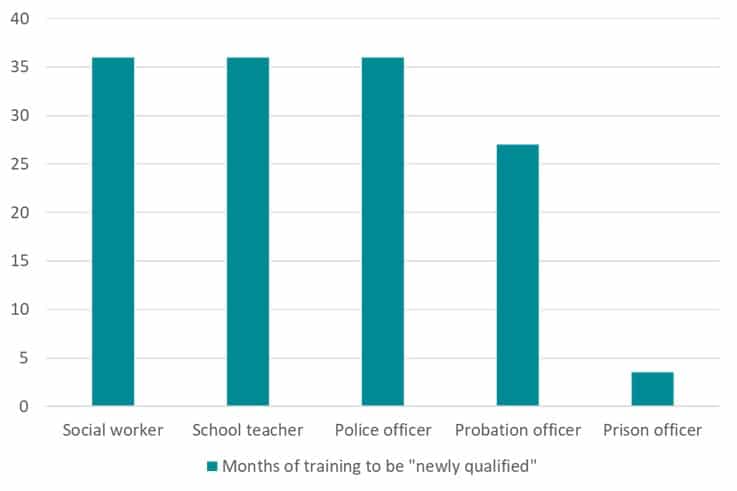
This is why the gap between how we recruit, train and support prison officers and the work we need them to do is self-defeating. This is particularly apparent when compared with the training and support other frontline public sector roles further upstream, who are dealing with groups of people who have less entrenched and compounded disadvantage. Historically prison officers compensated for this by having strong cultures of experienced staff supporting new recruits, but as we have lost so many years of experience from the service, this gap between the job and training provided is stark.
Codifying our training
So why have we decided to codify our training in this way? The inspiration comes from the education sector. I spent the best part of a decade as a teacher in challenging inner-city schools.
When I was training my biggest concern was whether I would be able to manage poor classroom behaviour. At the time the pervasive narrative in teacher training was that behaviour management could not be taught but instead was personality based and intrinsic, often developed through life experience or just having the right personality to start with. New teachers either had it and would flourish, or they didn’t and would leave.
It turned out this just wasn’t true.
A structured approach to training
Four years into my teaching career, a groundbreaking book came out which codified techniques for classroom management. This was released alongside videos and a coaching model so teachers could rehearse how to manage classroom behaviour by mastering a series of small steps or techniques. This structured approach to training, known as instructional coaching, is commonly used in sports coaching and medical training.
Since the model was introduced to teaching, it has become the best evidenced professional development tool in history.
Prison officers deserve proper training
Our view at Unlocked is that prison officers deserve equally high-quality training, and so for the past nine years we have been developing a similar approach.
Since 2016 we have been observing prison officers, interviewing experienced staff and prisoners, and using this not only to build a strong evidence base around what it is that some of the best officers did that worked, but also codifying this into training. Since our first residential training programme in 2017 we have trained 900 prison officers in their first two years of practice, so we have an unusually extensive data set outlining what “good officers” do.
A couple of years ago, Harry Fletcher-Wood agreed to help us write a book attempting to codify the strategies we had identified. He checked our best bets, observing officers who hadn’t come through Unlocked, kicking the tires to make sure what we had identified was replicable, rather than accidentally capturing something personality-based or particular to a specific group of officers.
The book
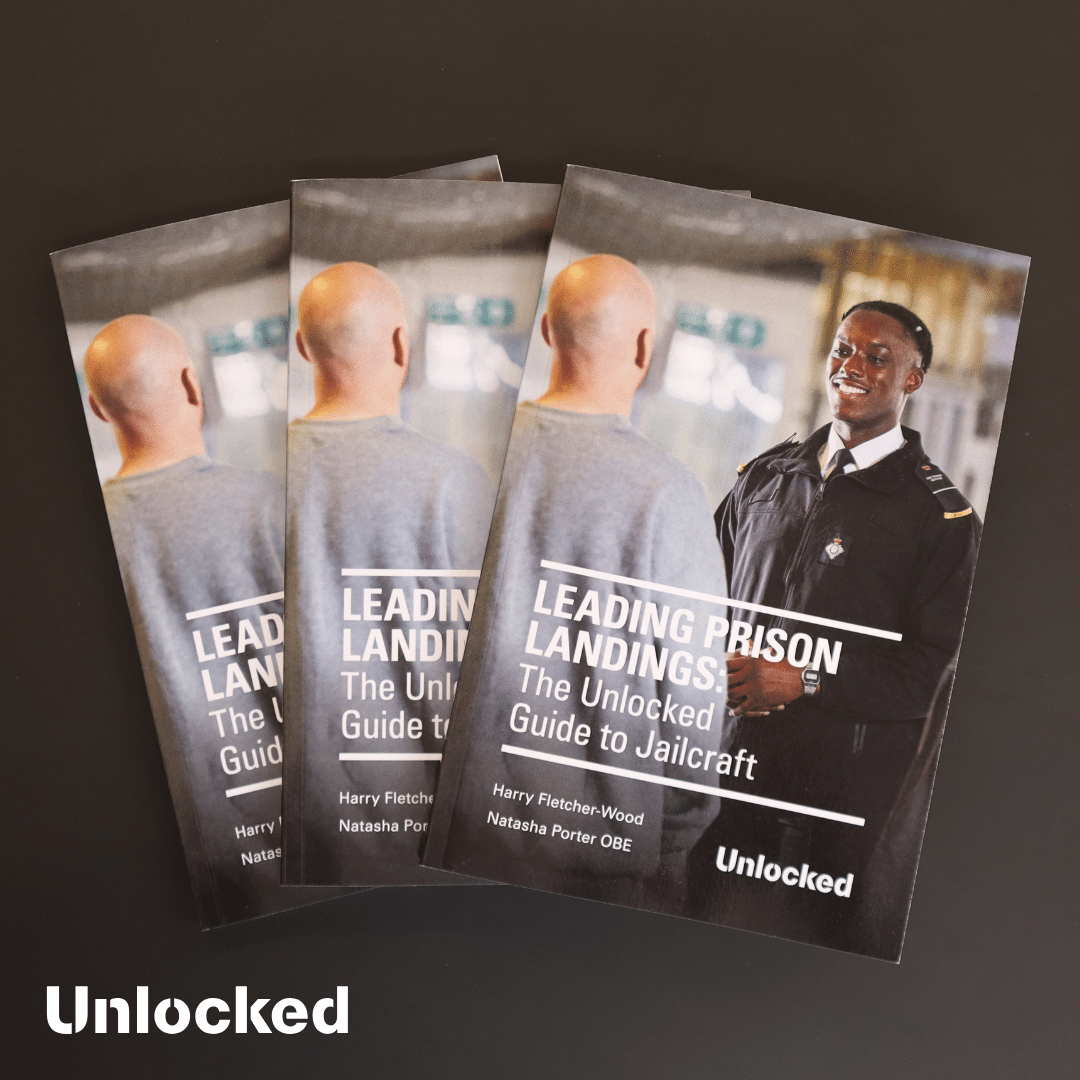
Our new book, Leading Prison Landings: The Unlocked Guide to Jailcraft is the codification of our approach to developing good prison officers, and we have made it available to anyone who is interested. Our hope is that this will enable all prison officers, new and experienced, to take ownership of their own development and improve their practice.
Part of developing the prison officer profession is agreeing the body of defined skills that a prison officer needs to develop. I would argue that there still isn’t absolute consensus about what a prison officers’ role is, but at Unlocked we are clear that this is a complex relational job that requires continued professional development and specific expertise.
The skills covered in the book focus on how to build and sustain authority in prison, how to de-escalate situations and maintain order, how to support prisoners through their journeys to change, and how to look after your own wellbeing in the prison environment.
Our ambition is that a prison officer who works through this book will become more confident and competent in their role. We have also had lots of interest from other sectors: other professionals who work in prisons, but also police, teachers and social workers who work in settings on the outside.
A testament to work on the landings
This book is a testament to the incredible relational practice that exists on the frontline of our prisons: I have seen great prison officers who, despite minimal training, are able to positively engage people who social workers, teachers and medical professionals have written off as unreachable. But we cannot expect an entire workforce to develop this complex professional skillset through “life experience” or colleague osmosis, especially when so much prison officer expertise has left in recent years. That is why we have decided to take this approach and share it with the world.
You can buy your copy here.