HMPPS workforce latest
Yesterday (20 November 2025), HMPPS published its quarterly workforce statistics showing staff numbers on 30 September this year. Compared to 30 September 2024, the number of staff in Public Sector Prisons have decreased by 1,161 (3.1%) although Probation Service staff increased by 495 (2.4%).
Prison staffing
There were 22,534 FTE band 3-5 prison officers in post on 30 September 2025. These are the key operational grades in public sector prisons; consisting of band 3 prison officers, band 4 officer specialists, band 4 supervising officers, and band 5 custodial managers.
This figure is a decrease of 1,015 FTE (4.3%) since 30 September 2024 and a slight decrease of 168 FTE (0.7%) prison officers compared to 30 June 2025. The overall resourcing picture across the prison workforce is broadly stable. However, there are some challenges with staff experience at a national level, as well as persistent recruitment and retention challenges in certain areas of the country.
There were also 5,388 FTE band 2 operational support staff in post on the same date. This corresponds to a decrease of 204 FTE (3.6%) FTE since 30 September 2024 and of 31 FTE (0.6%) operational support staff since 30 June 2025.
As the chart below shows, despite ongoing recruitment campaigns, the number of prison officers over the last five years has remained pretty stable. The total number of band 3-5 prison officers was 21,884 in March 2020, rose to a peak of 23,590 on 31 March 2024 and has now fallen to 22,534.
Overall in the last 12 months covered by these figures, 3,386 people joined the prison service and 4,170 left, a net loss of 784 people.

Probation staffing
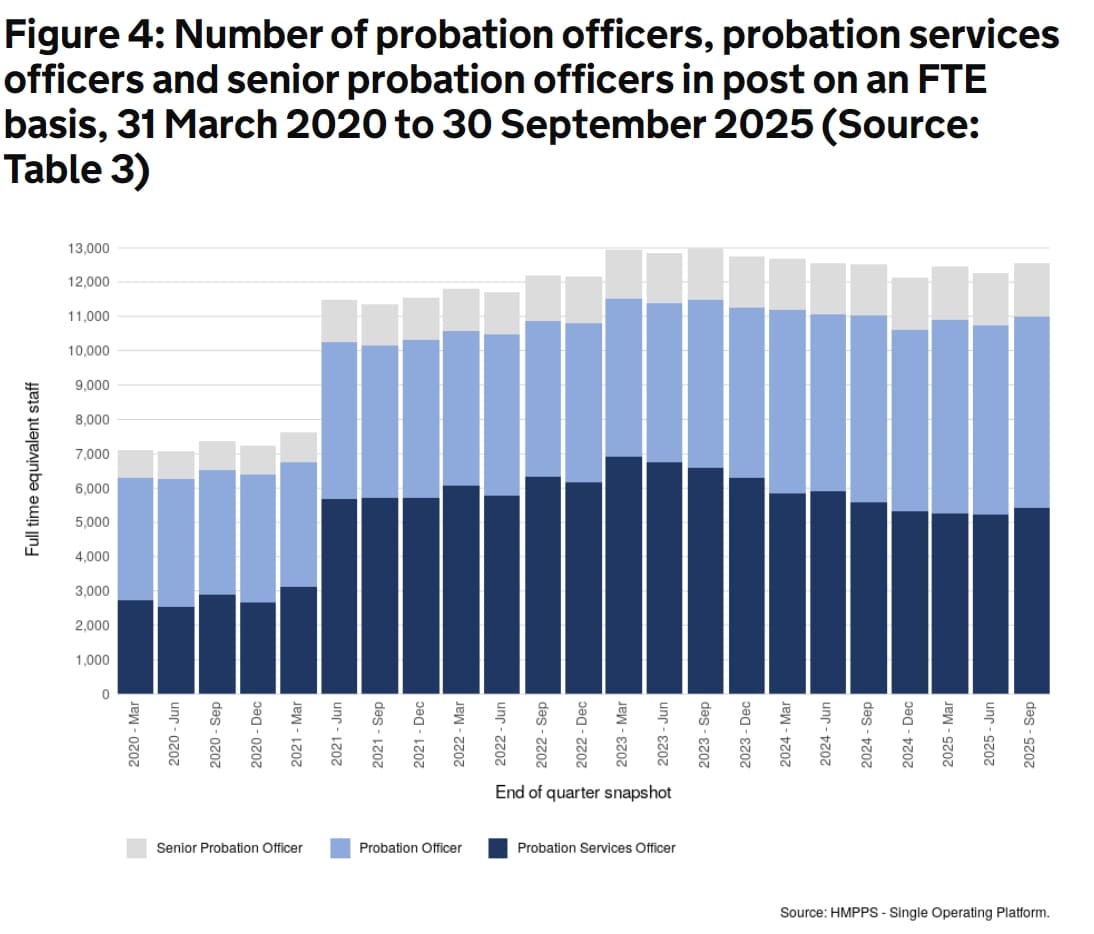
Key grades in the Probation Service include band 3 probation services officers (PSOs), band 4 probation officers (collectively known as probation practitioners), as well as band 5 senior probation officers. Staff who are training to be a probation officer work as a probation services officer during their training, so a proportion of the probation services officers in post will be working towards the professional probation officer qualification. This means that the numbers of PSOs can fluctuate markedly when a whole group of trainees graduate and become fully qualified probation officers.
As at 30 September 2025, there were 5,409 FTE band 3 probation services officers in post, a decrease of 177 FTE (3.2%) over the past year but an increase of 196 FTE (3.8%) over the quarter.
For the 2025/26 financial year, the MoJ has committed publicly to onboarding at least 1,300 Trainee Probation Officers and it will confirm whether it has met that commitment in the April 2026 transparency release.
On the same date, there were 5,576 FTE band 4 probation officers, representing an increase of 140 FTE (2.6%) over the past year and a slight increase of 58 FTE (1.0%) compared to the previous quarter. The bulletin admits that this a shortfall of 1,555 full-time equivalent probation officers against the target staffing level. This target will increase over the coming years when the recommendations of the Independent Sentencing Review come into force which should result in more people being sentenced to community orders instead of short terms of imprisonment.
There were also 1,552 FTE band 5 senior probation officers, showing an increase of 57 (3.8%) over the previous year and of 26 (1.7%) since the last quarter.
Overall in the last 12 months covered by these figures, 2,493 people joined the probation service and 1,981 left, a net gain of 512 people.
You can see from the chart below that efforts to increase chronically low probation staffing levels have mainly stalled over the last eighteen months.
Conclusion
Recruiting sufficient numbers of competent prison and probation staff is the most important component of the Government’s attempts to get our criminal justice system functioning properly again. It remains an uphill battle.
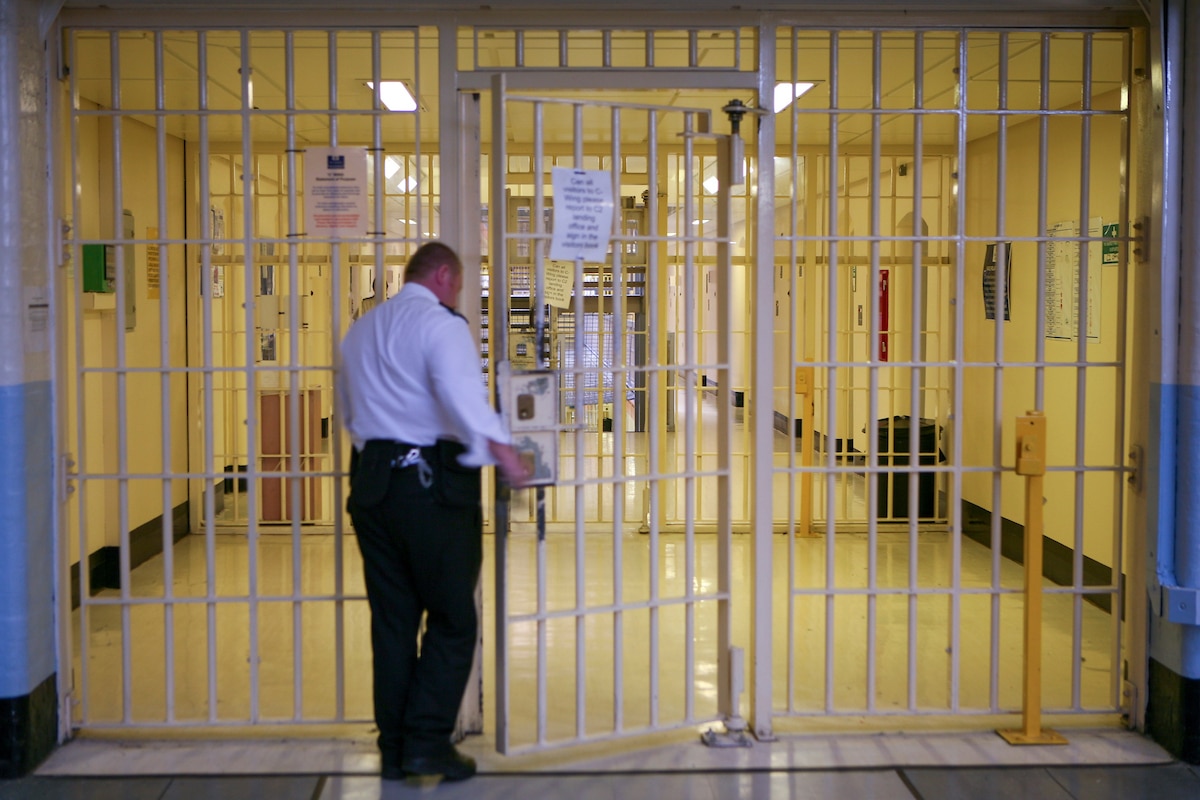
Thanks to Andy Aitchison for kind permission to use the header image in this post. You can see Andy’s work here