Crime Survey data
Last week (12 December 2024) the Office for National Statistics published its latest overview of the extend and trends of illicit drug use, drawing on data from the latest edition of the Crime Survey for England and Wales and covering the year ending March 2024. The headline findings are:
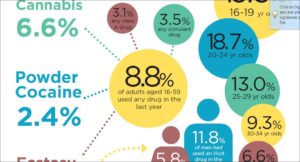
The Crime Survey for England and Wales (CSEW) estimated 8.8% of people aged 16 to 59 years (around 2.9 million people) reported using any drug in the last 12 months for the year ending (YE) March 2024; there was no statistically significant change, compared with YE March 2023.
Around 3.0% of people (approximately 1 million people) reported using a Class A drug in the last 12 months; there was no statistically significant change from the previous year.
Cannabis use decreased to 6.8% of people (around 2.3 million people) from 7.6% (around 2.5 million people) in the previous year, returning to levels seen a decade ago.
Use of nitrous oxide and crack cocaine decreased, compared with the previous year from 1.3% to 0.9%, and 0.1% to 0.03%, respectively; magic mushroom use increased from 0.8% to 1.1%.
Around 1.8% of people were frequent drug users (more than once a month); this is a decrease from the previous year (2.3%).
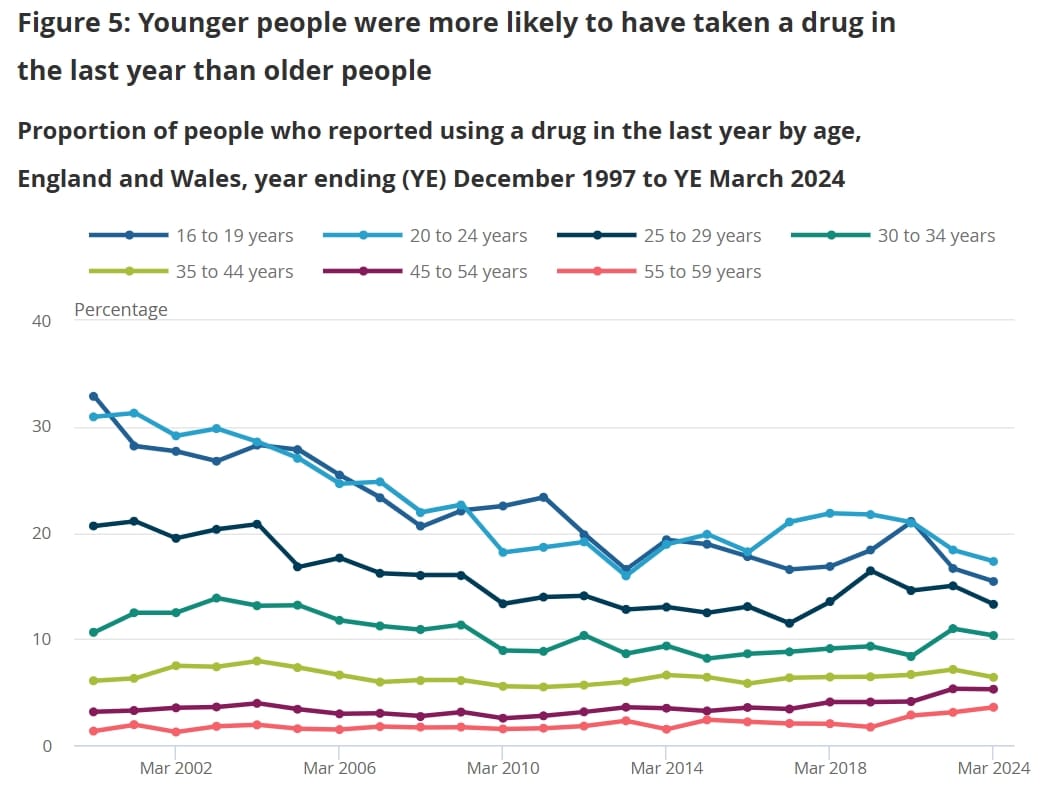
Drug use was higher among people aged 16 to 24 years, with 16.5% reporting any usage; there was no statistically significant change, compared with previous year.
Individual drug use trends
Cannabis
Cannabis has consistently been the most used drug in England and Wales since estimates began in 1995. In the latest year, 6.8% of people aged 16 to 59 years and 13.8% of people aged 16 to 24 years reported having used the drug in the last year. Levels were lower for those aged 16 to 59 years, compared with year end (YE) March 2023 (7.6%), but there was no statistically significant change for those aged 16 to 24 years.
Powder cocaine
There was no statistically significant change in the prevalence of powder cocaine use in the last year for people aged 16 to 59 years (2.1%) and 16 to 24 years (3.8%), compared with the previous year.
Nitrous oxide
In the last year, 0.9% of people aged 16 to 59 years had used nitrous oxide. This is a decrease, compared with 2023 (1.3%). There was no statistically significant change in the use of nitrous oxide in those aged 16 to 24 years (3.3%), compared with the previous year, but levels were lower, compared with 2014 (7.6%).
Ecstasy
Prevalence of ecstasy use in the last year remained similar to the previous year. Around 1.2% of people aged 16 to 59 years and 2.2% of people aged 16 to 24 years reported taking this drug in the last year. However, ecstasy use was lower in 16 to 59 year olds, compared with YE March 2014 (1.6%).
Hallucinogens
There was no statistically significant change in the prevalence of overall hallucinogen (lysergic acid diethylamide and magic mushrooms) use in the last year in people aged 16 to 59 years (1.2%) or 16 to 24 years (2.9%), compared with YE March 2023. However, there was an increase in magic mushroom use in people aged 16 to 59 years, from 0.8% to 1.1%.
Other drugs
Prevalence of use in the last year was below one percent for all other individual drug types, except for ketamine (2.9%) and new psychoactive substances (1.7%) in those aged 16 to 24 years. There was no statistically significant change in ketamine use, compared with YE March 2023 and YE March 2014 in those aged 16 to 24 years. However, there was an increase in those aged 16 to 59 years (0.8%), compared with YE March 2014 (0.6%).
There were no statistically significant changes for other individual drug types, compared with YE March 2023 . This is except for crack cocaine use in those aged 16 to 59 years, which decreased to around 0.03% from 0.10%.
Age of drug users
As is always the case, the proportion of younger people aged 16 to 24 years (16.5%) reporting any drug use in the last year was higher for the year ending March 2024, compared with older people aged 25 to 59 years (7.2%).
There were no statistically significant changes in any drug use in the different age groups, compared with YE March 2023. However, there were increases in any drug use for those aged 45 to 54 years and 55 to 59 years, compared with YE March 2014.
There has been a narrowing in the differences between age groups since these data were first collected in the 1990s. This is a result of drug use decreasing in younger age groups and increasing in older age groups.
Obtaining drugs
A friend, neighbour or colleague was the most common source of obtaining illegal drugs (48.9%) and nitrous oxide or new psychoactive substances (NPS) (37.8%) among people aged 16 to 59 years who had taken drugs in the last 12 months in the year ending March 2024. The next most common source of illegal drugs was a known dealer (11.2%). The next most common source for nitrous oxide or NPS was a shop (14.8%).
Two-fifths of people aged 16 to 59 years (39.2%) claimed it would be “very” or “fairly” easy to obtain illegal drugs within 24 hours, which is similar to the previous year (38.0%). A quarter (25.4%) of people claimed it would be “very” or “fairly” easy for them to obtain nitrous oxide or NPS within 24 hours, which is also similar to the previous year (24.9%).