Revolving Door
The hidden cost of England’s so-called “prolific offenders” the people repeatedly in the headlines for shoplifting and low-level crime – is laid bare in research by Revolving Doors and Newton.
The report (published yesterday, 20 October 2025) brings together the experience of the ‘revolving door’ of reoffending with innovative analysis of real public sector data, including case notes. It reveals new findings about the toll that punishment without rehabilitation and key missed opportunities has on people, public finances and public services.
The cohort
The report estimates that there are at least 29,000 people in England and Wales with a level of unmet need and a pattern of offending behaviour or engagement with the criminal justice system who meet the definition of the revolving door. This cohort is committing at least 130,000 crimes a year. Their levels of unmet need are very high and tend to be clustered or layered together.
Costs
Over just one year, this research found many examples of individuals whose interactions – to the justice system alone – cost in excess of £100,000 per year, even where offending is of a lower level of seriousness. Lifetime costs for some single individuals run beyond £1.4m.
Analysis of reference data, open-source public service data and HMG’s own cost-of-crime methodology estimates the national impact on the justice system alone (prisons, probation, courts, police) to exceed £242m every year.
The socio-economic impact is between £735m and £1.65bn. This is likely an underestimate due to unrecorded crime and other crime types not included in the initial analysis. The true figure is probably closer to £5bn.
Common patterns of experience
There are common patterns of experience amongst the revolving door cohort represented in the archetypal personas developed through the work.
These patterns can be found not only in the lives of those interviewed, but also in the data held by services. While there is nuance, the consistency of these experiences provides a clear blueprint for the person-centred, relational services (the how) and trauma-informed solutions (the what) that are needed.
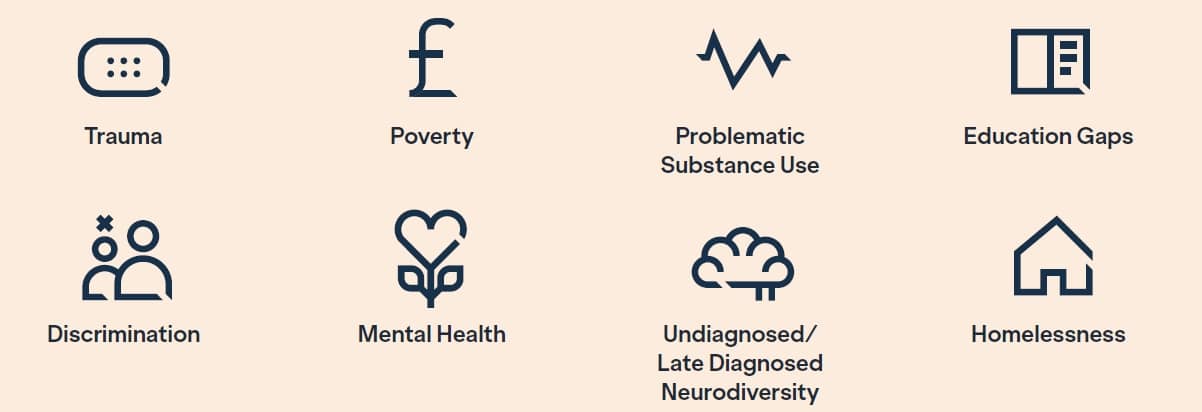
Mental health issues, housing challenges, poverty and financial exclusion, problems with drugs and alcohol, experience of trauma in early life, experience of social care interventions as a child, violence in the household and late diagnosis of neurodiversity all combine to present a cohort of individuals with diversity and a clear depth of need.
The research found that whilst there are common patterns, there are, of course, many variations in individual lives. Starting points can be very different. Whilst school exclusion is a shared experience for many in the revolving door, some of the people Revolving Doors spoke to came from loving homes and did well at school. Whatever the route in, once caught in the revolving door, transactional, low-impact interactions with public services are a common thread. Insights showed multiple interventions that serve only to escalate towards the criminal justice system at the expense of other needs which are left unmet. People interviewed for this report consistently said that social services and policing responses can feel overbearing and end up harming trust in authority.
Conclusions and Recommendations
The report argues that improving support to this cohort of people stuck in the revolving door (and thereby reducing the impact on and cost to public services) is entirely possible.
It says that the Government doesn’t need to build new services from scratch, but to better coordinate, better target, better listen, and close gaps between siloes by reconsidering how individuals with complex, overlapping needs are supported.
The report argues that a smarter, more compassionate approach is not only effective but far more sustainable – an approach that will use shared data across services, lived experience, and cross-sector collaboration to intervene earlier, meet people’s needs holistically, and break the cycle of crisis and crime early.
The research undertaken for this research demonstrates the potential of joining up data across public services by using both structured and unstructured data to identify and address unmet needs in the revolving door cohort.
There are significant efficiency and effectiveness opportunities at the system and service levels. Joined up data allows for better understanding of vulnerability, need, and risk.
The smoother flow and exchange of information could, alone, save probation officers, prison officers, police, social workers and voluntary sector service leads millions of hours of rekeying data, waiting on a partner service for information or a referral.
The report argues that delivering both the ‘how’ and the ‘what’ can best be achieved by designing and delivering them in conjunction with people who have personal experience of the revolving door.
The report makes nine core recommendations:
- Use joined up public sector data to target cohorts and individuals.
- Reinvest savings into relational work that only humans can do.
- Divert people in the revolving door at the earliest opportunity.
- Expand and strengthen community sentences.
- Invest in peer support.
- Train people throughout the system to understand and work with trauma.
- Take a place based approach and make better use of community assets.
- Multi-partnership work including upstream of the justice system.
- Leadership at the highest level.