
Prison leavers in substance misuse treatment
A new (23 April 2026) joint MoJ/OHID report analyses the outcomes of prison leavers in England between August 2018 and December 2022 receiving substance misuse treatment. It assesses mortality and re-incarceration rates within 4 weeks of prison release. The analysis linked data from 3 sources:
- the Ministry of Justice’s (MOJ) Prison National Offender Management Information System (p-NOMIS)
- the Office for National Statistics’ (ONS) mortality register
- the National Drug Treatment Management System (NDTMS), managed by the Department of Health and Social Care (DHSC)
The Better Outcomes Through Linked Data (BOLD) programme team at DHSC carried out the data linkage and analysis.
Context
We know from a range of research that opiate users are at particularly high risk of fatal overdose in the first few weeks of release from prison, in particular because of reduced opiate tolerance while in prison. The research aimed to link the three datasets set out above to answer three key questions:
- what were the demographic and offending characteristics for prison leavers who were in prison-based substance misuse treatment?
- what were the mortality and re-incarceration rates for prison leavers who were in prison-based substance misuse treatment?
- is OST (Opiate Substitution Treatment – prescribed medication as a legal and safer substitute for heroin or other opiate use) associated with a difference in risk of mortality and re-incarceration rates for prison leavers who were in prison-based treatment for opiate use?
The research team were able to link just under two fifths of prison spells completed between August 2018 and December 2022 to a prison-based substance misuse treatment record.
Of the 228,923 prison leavers in the p-NOMIS data set:
- 80,485 (35%) people linked to a substance misuse treatment record at least once while in prison
- 32,893 linked to a substance misuse treatment record in the community, of whom 25,476 linked to a treatment record in prison
- 4,272 were linked to a death record, registered before 31 December 2024, of whom 2,613 had been in treatment at least once
We removed any prison spells that did not fit the analysis criteria from the data set used for analysis, as explained in the technical report. This final data set contained information on 155,235 people across 270,113 prison spells, linking to 3,029 deaths, 258,085 secure setting treatment episodes and 69,702 community treatment journeys.
Findings
Although there were more than 9 times the number of male prison spells analysed compared with female prison spells, a significantly higher proportion of prison spells matched a substance misuse treatment for female prison leavers (51.8%) when compared with male prison leavers (38.2%). Of those who were in treatment, a significantly higher proportion of females were in treatment for opiates (75.7%) compared with males (60.1%).
Mortality and reincarceration
There were 2,888 deaths linked to prison spells in the analysis data set, of which 293 occurred within 4 weeks of leaving prison.
The rates of mortality and re-incarceration after 4 weeks were higher for prison leavers who were matched to a substance misuse treatment than those who were not.
In the first 4 weeks after release:
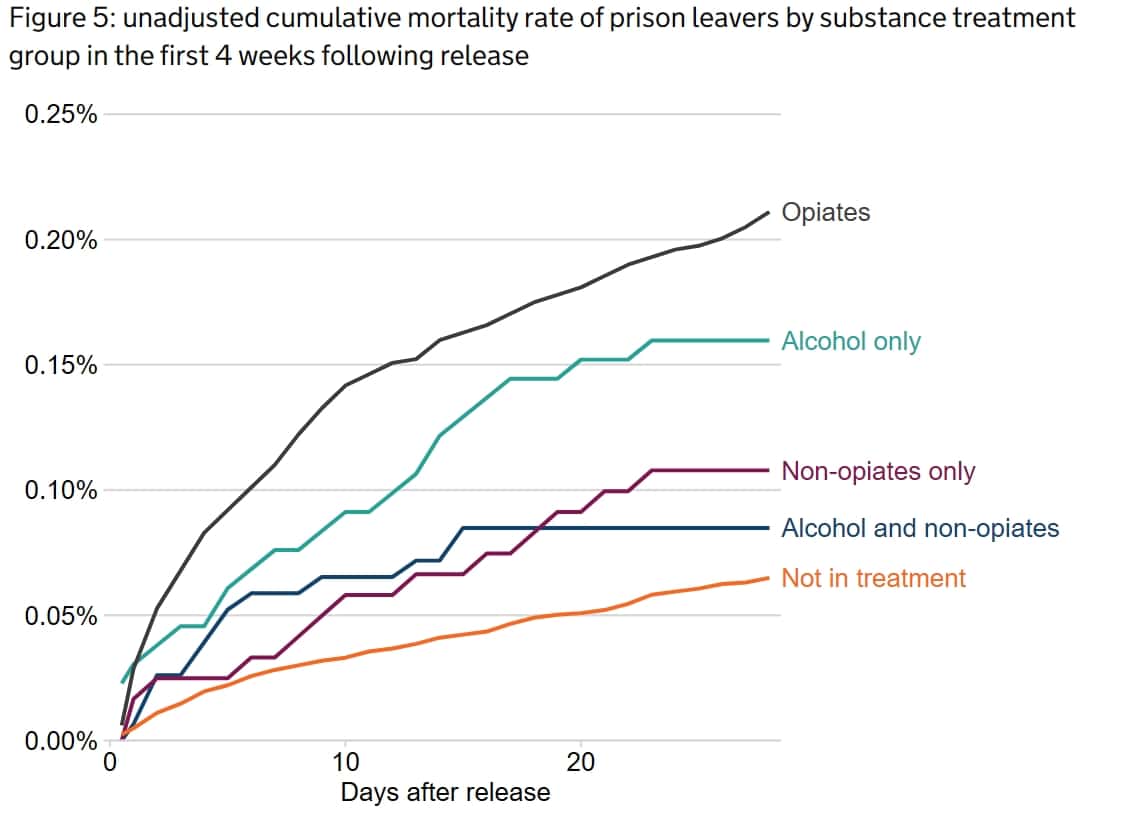
- prison leavers in treatment for opiates had the highest rate of mortality at 0.21%
- prison leavers in treatment for opiates and alcohol only had the highest rates of re-incarceration, at 19.78% and 18.70% respectively
The chart reproduced below show the unadjusted cumulative rate of mortality of prison leavers over the first 4 weeks after release, split by treatment group.
Causes of death
Of the 293 prison leavers who died within 4 weeks of release, 182 (62.1%) were drug-related deaths. The first week after release had the highest risk of death, with 48.5% of all deaths in the first 4 weeks after release occurring in the first 7 days. The proportion of deaths that were drug-related was higher in the first 7 days (71.1%) compared with any of the following 3 weeks.
The value of OST
Of the 46,214 spells in which the prisoner received OST on their final day in prison, 75 resulted in the prisoner dying within 4 weeks (0.16%). Of the 15,108 spells in which the prisoner did not receive OST on the final day, 53 resulted in death within 4 weeks (0.35%).
The researchers calculated that receiving OST on the final day in prison was associated with a 50% reduced risk of all-cause mortality.
Conclusions
This research was partly done to explore whether the three datasets could successfully be combined to study the impact of OST.
The research cohort were released between 2018 and 2022 before long acting injectable buprenorphine (normally described using its brand name, Buvidal) was available in English prisons. Buvidal is now available in every English prison (albeit its use is limited) and its value to people being released at risk of opiate overdose is that the injection lasts for a period of 4 weeks and is highly protective of opiate overdose (although people may, of course, still overdose on other substances).
It may be that the findings of this research encourage the funding of the wider prescription of Buvidal to further drive down overdose rates for opiate users released from prison.
Thanks to Andy Aitchison for kind permission to use the header image in this post. You can see Andy’s work here