
Sensory criminology
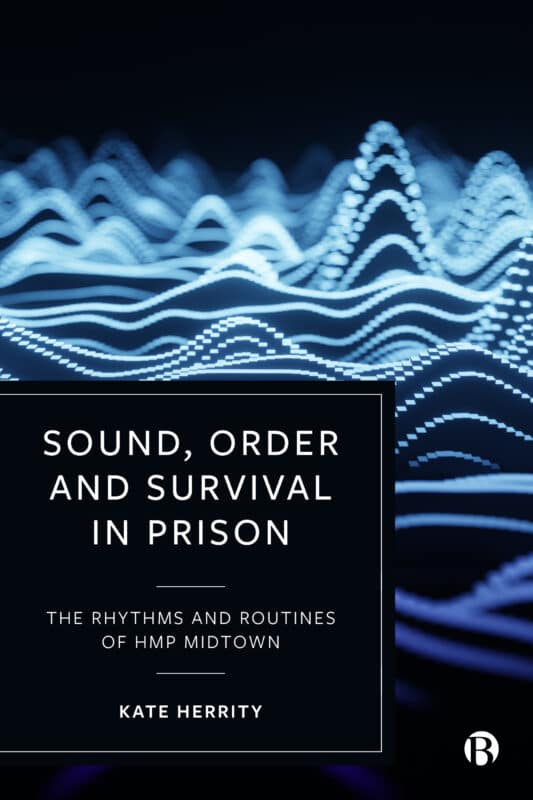
This is a guest post by Kate Herrity, Mellon-Kings Research fellow in Punishment at Cambridge University, writing about her new book: Sound, Order and Survival in Prison: the rhythms and routines of HMP Midtown. Kate curates www.sensorycriminology.com which accompanies sensory penalities.
Many years ago, while I worked as a library assistant, I went on a work development trip to HMP Wandsworth. Standing in the central control point I was overwhelmed by the swirling cacophony, ricocheting around the walls, off spartan surfaces and through the spurs. Years later, the social significance this might have for those who live and work in prison was the starting point of my PhD. Having long submitted and put off setting down to write it into a book, I finally revisited fieldnotes, transcripts, interviews, and recollections of the time I spent at HMP Midtown – the fictional name of the prison where I conducted my fieldwork. I found I wanted to start again rather than reproducing my thesis. Sound, Order and Survival in Prison: The Rhythms and Routines of HMP Midtown remains an exploration of the social significance of sound to the prison social world but is also the story of a relationship between a prison and its community, both within and beyond its walls.
Sensescapes
As I make tentative steps to return to studying prisons in the wake of COVID, I find their sensescapes strange. Familiar clangs and bangs are doused with strange odours of cleaning products, signalling new sanitary systems, and heightened precarity. Environments are subject to greater flux and unpredictability wrought by population growth, threatening to split at the seams, and a court system buckling under the weight of its backlogs. In this sense, Sound, Order and Survival is also a snapshot of a prison in the just before times. Its main themes though, are introduced into a system perhaps a little more receptive to their implications.
The underlying contention: that sound, and the sensory more broadly, are a fruitful means of understanding the strains of living and working in prison environments, is more pressing as overcrowding reaches crisis levels. Sound provides a means of “reading”, or ‘sensemaking, how “bubbly” or “spikey” the emotional climate is, and thus the likelihood of incident. Learning the “everyday tune that’s normal for here”, to quote Derek, a senior officer at Midtown, is thus integral to safety and survival. Conversely, sound sensitivity, fear or aversion, is associated with a range of conditions more prevalent amongst those living and working in prison (such as PTS(d), neurodivergence, depression, anxiety). In spaces where it is impossible to effectively curate the sensory environment, how might this impact on people exposed to the cacophonies of overcrowded prison spaces and their ability to adjust to life outside?
Sound as a conduit of power
Sound can be understood as a conduit of power, a means of instilling a sense of powerlessness and becoming ‘of’ the place: “Even when I get out… all I hear is keys and I think I’m in jail.” (Cam).
Frequently, prison studies are concerned with relational aspects of authority and its absence, in the way power is exercised and the quality ascribed to interactions between staff and prisoners. Central as these aspects of prison life are, the potency of prison spaces is also heightened, remade, through engagement with the material environment in everyday routine. Unlocking a door reminds both the officer of their work-identity and the prisoner of their relative reliance upon the key-holder, evoking anxiety in the event they await news of a loved one or suspect they may be subject to an unwanted move. Sounds of everyday life in prison spaces reverberate with their meaning, imposing a sense of the power of place on all those subject to it. As Officer Tone reflects
“downstairs where there’s no natural light … I didn’t even think about it until someone pointed that out to me, how does that affect a person, going…down into the bottom of the dungeon, drab and dreary?”
The rhythms of everyday living
Listening to the rhythms of everyday living prompted a consideration of the way the men at Midtown experienced time, not in the singularity of their own doing of it, but, particularly in a local prison, alongside the varying fortune and conditions of those they lived with. Sound, a powerful means of memory elicitation, added other dimensions to their sentence. Not only were they serving sentences alongside others, some with a prospect of returning home in sight, others on the torturous, never-ending cruelties of IPP sentences farcically over tariff, but also with alternative selves. Sounds from outside filtered through the porous prison walls, reminding them of loved ones, other lives, other choices, the tantalising possibilities of future living beyond the wall. Sound
“makes you remember that there is normality going alongside you…it can bring you down, cos you’re hearing stuff, or you miss home, or … if I hear the football stadium roaring when they’re playing, I’ll be like yay go on Midtown … It kind of brings me up d’you know?” (Lamar).
The polyrhythmic everyday
Listening to everyday life inside added texture and distinction to power and order, aspects of prison life which are often ill-defined, sometimes becoming interchangeable in discussion of them. Over the year, I became familiar with the “polyrhythmic” every day. An arrhythmic one in which violence, fire or cell-spins had brought the regime to a standstill, jarring rhythms emphasising heightened wariness.
Most informatively I learned to recognise the aural elements of practices which worked to return order. Staff and prisoners worked in various formal and informal ways to restore a semblance of normality and relieve the pressure of a day which had either already gone, or which threatened to tip into arrhythmia as tensions ratcheted. All manner of activities, both officially sanctioned and informally improvised, worked to restore a co-produced sense of routine.
Controlled unlock, humour, singing, running naked circuits around the wing were a symphony of cooperative efforts to restore order. Perceptions of fairness, or legitimacy had little place in the process but rather a shared desire to return to a predictable, comfortable state in which everyone could breathe. In a sense then, this is a book about a shared community, threatened by shifts in penal culture which cast the prison ever further beyond the public eyeline, a book about sound in prison, that is about neither prison nor sound.
You can buy Sound, Order and Survival here.
Thanks to Pawel Czerwinski for kind permission to use the header image in this post which was previously published on Unsplash.