Trial and error?
A new (21 January 2026) report by the Institute for Government says that the impact of restricting jury trials will have a negligible impact on the courts backlog. The report, Trial and error?: The impact of restricting jury trials on court demand, argues that the government’s reforms – particularly judge-only trials – will unlock only relatively modest reductions in demand given the scale of institutional upheaval. The IfG argues that instead the Government should focus on reversing productivity declines.
Halving jury trials
In early December the recently installed justice secretary, David Lammy, unveiled plans to radically restrict the number of jury trials that take place each year in England and Wales. This change is in response to the ever-growing case backlog in the crown court, which sits at almost 80,000, up 12% since the general election and more than double what it was at the end of 2019 as you can see from my chart below.
Government proposals
There are three key elements to the government’s proposals:
- Encouraging magistrates’ to hear more cases by raising their maximum sentencing powers from 12 to 18 months, with the possibility of further increasing them to two years.
- Introducing judge-only trials for around a quarter of crown court trials, known as ‘swift courts’ or the ‘crown court bench division’.
- Removing the right of defendants in moderately serious (‘either-way’) cases to decide if they want to be tried in a magistrates’ court or the crown court.
The Ministry of Justice estimates that if these reforms are enacted slightly less than half of trials that would currently be heard by a jury would instead be heard by magistrates (around a third) or a judge alone (around a sixth).
All of the most serious ‘indictable only’ cases, such as robbery, rape and the most serious violent assaults, will continue to be eligible for a jury trial. Only moderately serious ‘either-way’ cases will be eligible to be heard in magistrates’ courts or by a judge alone: this covers a wide range of offences like fraud, serious theft, drug supply and most weapons offences.
The proposals would most likely reduce demand on the courts, particularly the crown court, where the case backlog and delays are most severe.
Limited impact
However, the IfG says that these would produce relatively minor gains, particularly given the institutional upheaval, political controversy and likely damage to public confidence from substantially reducing access to jury trials. It acknowledges that they would reduce demand on the crown court, in both the number of cases and the total amount of time it takes to hear those cases. But the reductions are not substantial – while the number of jury trials will fall by around half, the time it takes to hear cases is likely to fall less than 10%. There are three reasons for this:
- A lot of court time is spent handling other types of case and hearings.
- The trials moving to the ‘bench division’ or magistrates’ courts will be the least serious cases in the crown court, which on average only take half as long to hear as the most serious cases.
- Judge-only trials are estimated to be 20% quicker than jury trials, but will only account for around a quarter of crown court trials, so the overall impact is likely to be extremely marginal.
Judge-only trials
The Government’s reforms will result in around a quarter of trials that reach the crown court being dealt with by a judge sitting alone in the ‘bench division’. This is only likely to amount to a few thousand cases. If the MoJ’s estimate that these cases will be heard 20% quicker is correct, that would save less than 2% of total court time. Even if they have underestimated the impact and cases save 30% of court time across all hearings, that would reduce total demand by 2.5%. Given the uncertainty around whether this will be realised and the risks of having judges sitting alone to decide both verdict and sentence, this is a very marginal gain.
Focus on productivity
The IfG argues that there is an alternative which enjoys broad support across the sector and could begin much faster: improving court productivity. Productivity is at the heart of the problem in the criminal courts. The crown court is hearing almost 20% fewer hours per sitting day so far in 2025/26 than it was in 2016/17. If it had got through an equivalent number of cases per day in 2024 as in 2016, the case backlog would have fallen by at least a few thousand. Instead, it grew by nearly 8,000 (10%).
The reasons for this fall in productivity include a shortage of criminal lawyers, poor court administration and a long-running lack of investment in court buildings and physical and technological infrastructure.
As the IfG points out, these are not quick or easy problems to fix, but the Institute argues, there are opportunities for meaningful improvements before 2029. These could be done alongside more moderate proposals to handle some more cases in magistrates’ courts, which would be less likely to provoke backlash.
The report recommends that the Government focus on understanding what is driving differences in court productivity around the country, with crown courts in Liverpool and much of Wales consistently cited as high performers. Are there particular approaches to how cases are listed for trial or judicial behaviour that could be applied elsewhere? What explains the wide variation in the proportion of trials rescheduled at the last minute?
To be fair to the Government, phase two of the Independent Review of the Criminal Courts (conducted by Sir Brain Leveson) is focused on court efficiency and should address many of these key questions when it is published this Spring.
Conclusion
The Institute for Government is widely respected and does not have a political axe to grind. We must wait and see whether the Government pays attention to the report, but it will certainly have added to the widespread opposition to jury reforms within the legal profession.
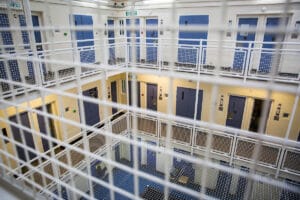
Thanks to Andy Aitchison for kind permission to use the header image in this post. You can see Andy’s work here