There's something in the water
The Home Office has just (13 April 2026) published the latest findings from its Wastewater Analysis for Narcotics Detection (WAND) Programme which takes samples from wastewater treatment plants (WWTPs, or sites) across England and Scotland. WAND utilises wastewater analysis, which is a method used internationally, to provide robust and timely estimates of drug consumption in England and Scotland.
The new report presents, for the first time, national (England) level estimates of drug consumption and market value estimates based on an experimental and new methodology. Please note that, given its experimental nature, the Home Office has only applied this approach to data for England.
Wastewater analysis
Wastewater analysis is a rapidly developing scientific discipline with the potential for monitoring real-time population-level trends in illicit drug use. Originally used in the 1990s to monitor the environmental impact of liquid household waste, the method has since been used to estimate illicit drug consumption in different cities.
It involves sampling a source of wastewater, such as a sewage influent to a wastewater treatment plant. This allows scientists to estimate the quantity of drugs consumed in a community by measuring the levels of illicit drugs and their metabolites excreted in urine.
Estimates for England
England level estimates of drug consumption cover the period August 2024 to July 2025. These estimates are experimental and based on a new analytical method developed by Aqua Clear, Eurofins, and Ginkgo Biosecurity UK Limited, which extrapolates findings from the 42 sites where testing takes place in England (covering 28% of the population). A central estimate and confidence interval are provided for each estimate.
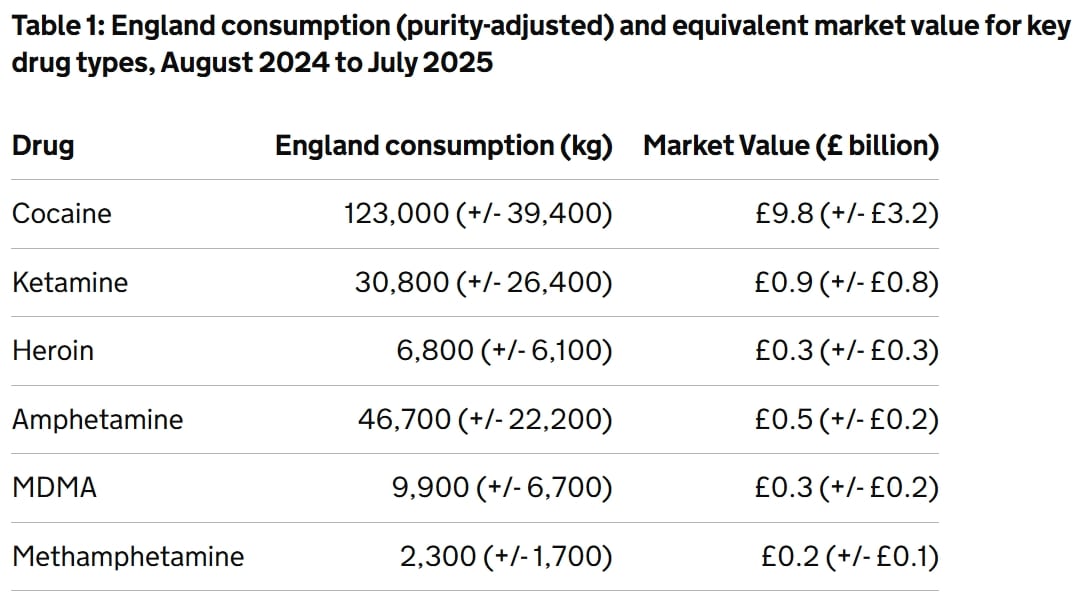
Overall, WAND shows cocaine has the highest estimated consumption and market value of the 6 key drug types measured. The programme does not currently test for cannabis due to complexities of the sampling method. The England level estimates show that between August 2024 and July 2025:
- cocaine had the highest estimated consumption and market value, with around 123,000 kilograms (kg) consumed, equating to a £9.8 billion market value
- ketamine consumption was estimated to be 30,800kg equating to a £0.9 billion market value
- heroin consumption was estimated to be 6,800kg equating to a £0.3 billion market value
- amphetamine consumption was estimated to be 46,700kg, equating to a £0.5 billion market value
- MDMA consumption was estimated to be 9,900kg equating to a £0.3 billion market value
- methamphetamine consumption was estimated to be 2,300kg, equating to a £0.2 billion market value
Trends in drug consumption (England only)
To compare trends in drug consumption between 2021 and 2025, the 16 sites (covering 18% of England’s population) that have been sampled continuously since 2021 are used and an average taken of the wastewater samples collected in January to April in each year.
Since the last drug consumption estimates were published in the March 2025 wastewater analysis report, an improved methodological approach has been applied to provide more robust consumption estimates.
The latest trend analysis shows the largest increase in estimated consumption is for ketamine and MDMA. There have been decreases in estimated consumption of heroin and amphetamine. Comparing January and April 2021, with January and April 2025, the overall consumption estimates (measured in milligrams per 1,000 people per day) increased for:
- MDMA (232%)
- ketamine (229%)
- methamphetamine (61%)
- cocaine (26%)
However, there were estimated decreases for:
- heroin (-40%)
- amphetamine (-27%)
Patterns in drug consumption (England and Scotland)
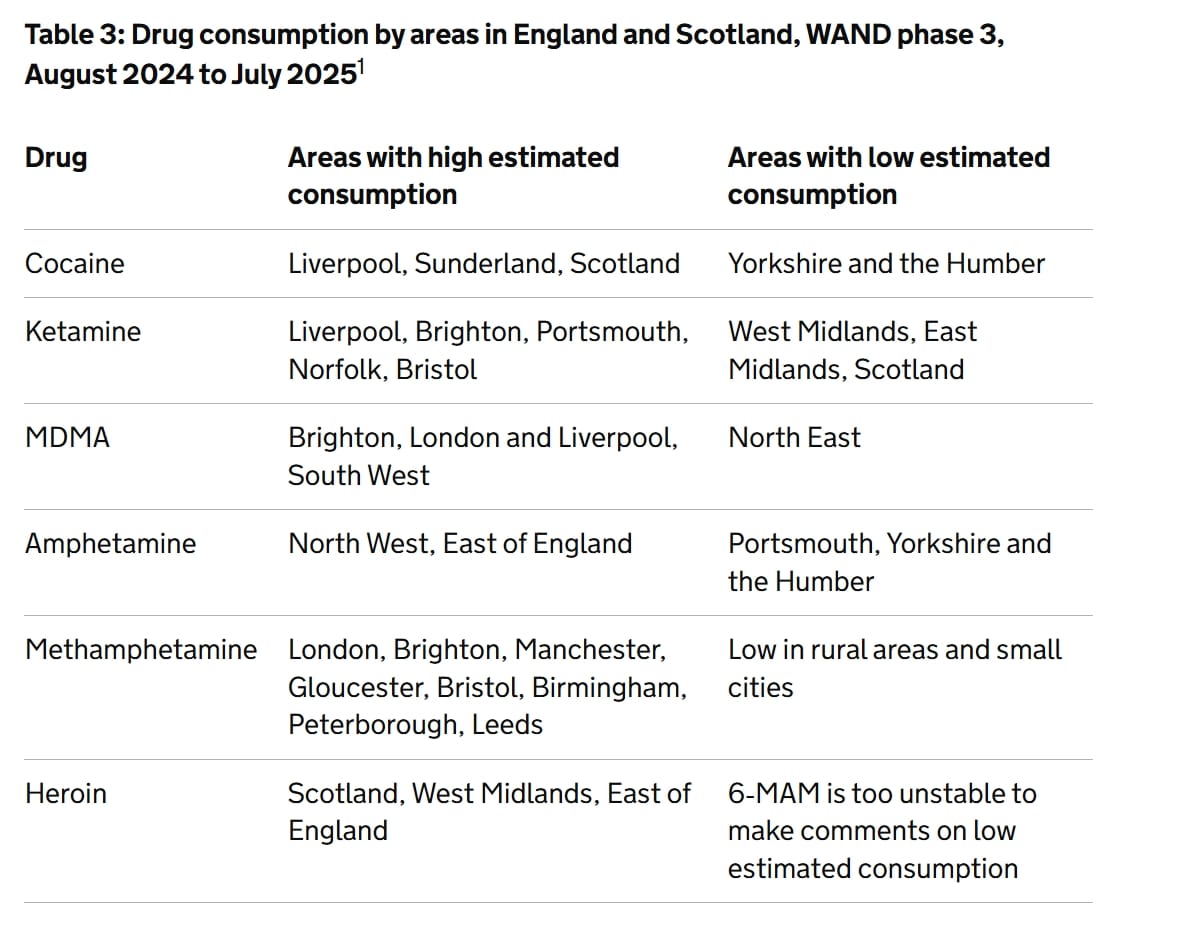
The analysis of wastewater data across the 50 sites included in WAND phase 3 across England and Scotland reveals a clear geographical variation in drug consumption. Most drugs, particularly cocaine, MDMA, and methamphetamine, show higher concentrations in urban areas, with London, Manchester, Liverpool, and Brighton being notable hotspots.
Certain drugs, such as MDMA and cocaine, show high weekend usage and low weekday usage, as would be expected from usage as a recreational drug. Conversely, drugs such as ketamine, amphetamine and methamphetamine are consumed more consistently throughout the week indicating more regular and potentially problematic use.