Cautious optimism
Yesterday (31 March 2026) Clinks published its latest annual annual State of the Sector report. For over a decade, Clinks has surveyed the voluntary sector working with people in contact with the criminal justice system, capturing a snapshot of the landscape and the conditions in which these organisations operate. This year’s report is based on 200 survey returns from Clinks’ members and a dozen focus groups.
The policy context
The report includes the views of the sector on current Government policy in the criminal justice system. There was cautious optimism surrounding the Government’s pledge in the Independent Spending Review to increase funding for the voluntary sector and a positive reaction to the establishment of the Women’s Justice Board. However, there were also a number of areas of concern including:
- The impact of early release schemes and consequent increasing demand on the sector.
- Uncertainty around the coming policy and commissioning changes (particularly the impact of the Sentencing Act) and their impact on the sector.
- The apparent lack of a strategic long-term approach to justice policy.
- The OneHMPPS model, in particular the large size of areas and their lack of fit with other government bodies.
These concerns were amplified by the challenging economic climate with organisations reporting significant increases in their running costs.
Challenges
A majority (60%) of organisations reported working with more service users and an even larger proportion reported that their service users had more complex needs (75%) and required more urgent assistance (66%).
Their work to address these needs was hampered by gaps in the wider support landscape – particularly a lack of accommodation, insufficient support focus on resettlement and meeting needs related to mental health/neurodivergence; and insufficient engagement from probation.
Other difficulties included the length of time to get new staff vetted and staff wellbeing – staff taking on larger caseloads and having to work more intensively was leading to difficulties in retention with staff leaving for statutory sector due to higher salaries.
Funding
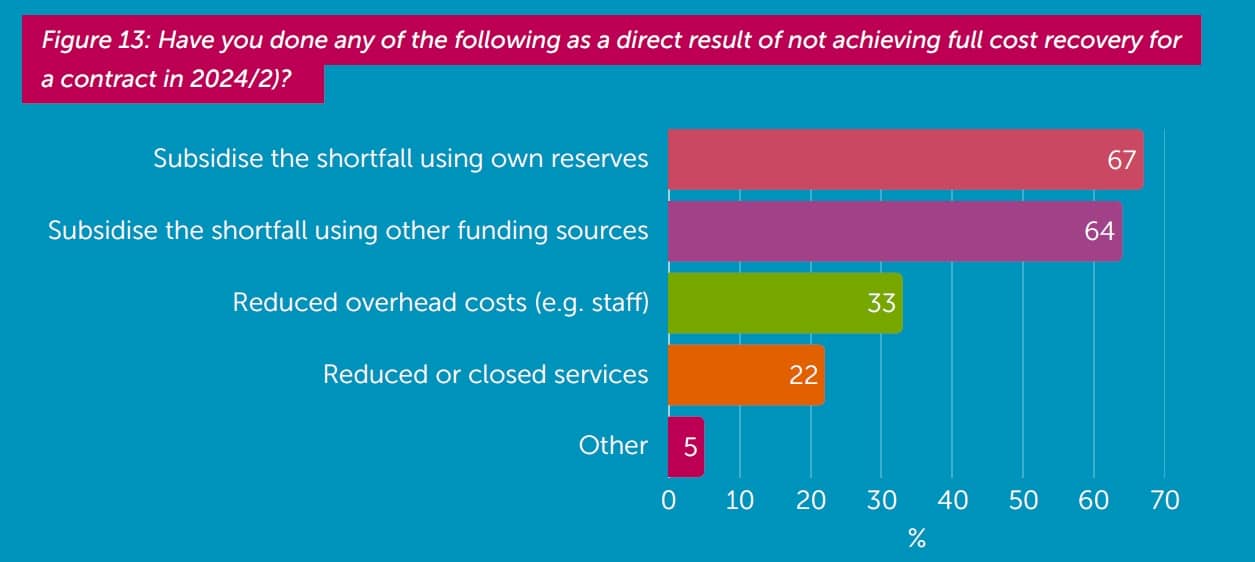
There was a mixed picture on funding with 46% survey respondents saying that their overall level of funding had increased while 29% reported that it had fallen. Organisations reported that it was harder to secure funding from trusts and foundations. The most worrying findings were that 59% organisations said their level of funding was not sufficient to deliver service to a high quality and that only 25% achieved full cost recovery on all services they delivered under contract.
Positive developments
The report also includes a number of positive trends including:
- Increased working with partners and coalitions of organisations
- The greater involvement of people with lived experience
- The continuing development of trauma-informed practice for both men and women
- Positive feedback on working with funders particularly on co-commissioning, access to funders, more support and increased dialogue.
Looking to the future
Voluntary organisations involved in the report focused on a number of future concerns including worries about their financial sustainability, the rise of populism and anti-rehabilitation ideas and the difficulties of undertaking work in prisons because of challenging operating environment.
Conclusions
In addition to actions to address the concerns outline above, the report identifies the support required from policymakers which, inevitably, includes funding asks.
Many organisations focused on the need
for funding service delivery at different stages of the criminal justice system, including (Clinks makes it clear this this is not an exhaustive list):
- Community-based support to cater for the provisions within the Sentencing Act and the increased demand this will place on voluntary sector organisations
- Early intervention work for a range of groups, specifically: families impacted by the criminal justice system; women, in order to provide support before they reach crisis point and need becomes very complex, and to include mental health support for women experiencing high levels of trauma; and young girls from South Asian communities (an organisation reported noticing an increase in numbers from this community coming into contact with the CJS).
- Long-term support for young people with multiple needs, and for support for young people who may have missed accessing support for those needs in the past
- Community projects to help keep children safe and divert them from involvement in crime
- Support people in contact with the criminal justice system into sustainable employment
- Increased statutory funding of arts provisions within prisons