MoJ budget
Last week (11 February 2025), the Institute for Fiscal Studies published an invaluable analysis of the Ministry of Justice’s spending over the last twenty years. The report will provide vital ammunition for those submitting evidence to the (ever-growing) number of Government reviews into different aspects of the CJS. It is manna from heaven for justice nerds like myself.
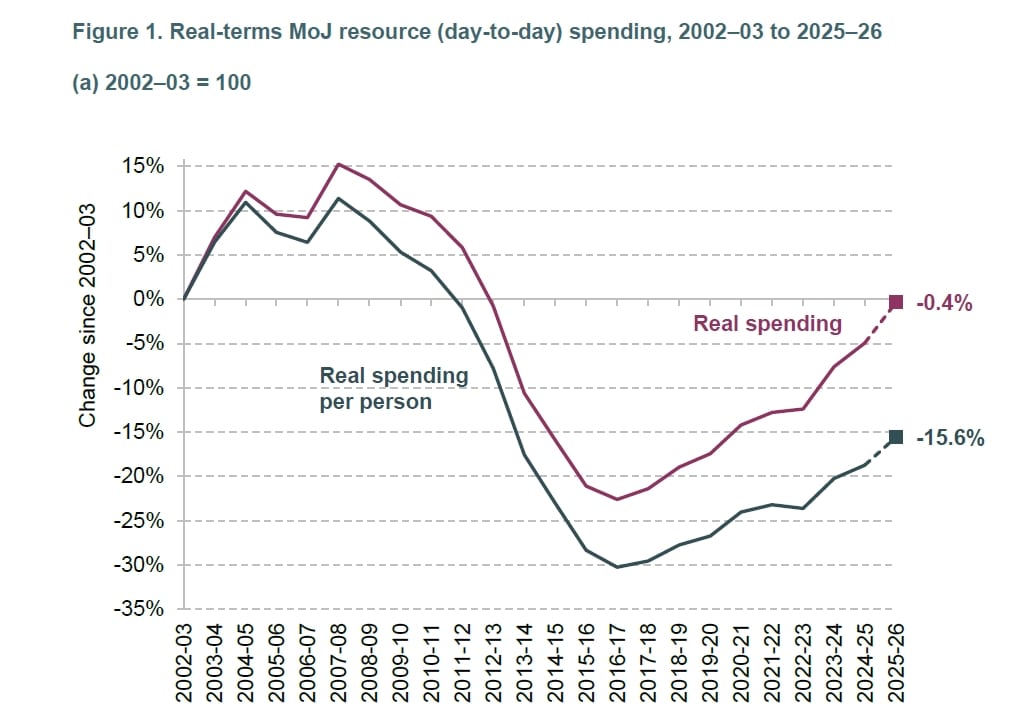
As regular readers know, the Ministry of Justice is responsible for prisons, probation, courts, tribunals, the judiciary, legal aid, and other key functions of our justice system in England and Wales. The department’s budget was cut sharply in the 2010s (by around one-third). Recent funding injections have been substantial, but have not been enough to offset earlier cuts. In 2025–26, real-terms day-to-day spending by the Ministry of Justice is set to be 14% lower than in 2007–08, and 24% lower in per-person terms (per head of population in England and Wales).
Headline findings
Many areas of government spending experienced cuts during the 2010s. But the Ministry of Justice has fared worse than the average department since 2007–08; it has even fared worse than other ‘unprotected’ departments (outside of health, education and defence). Had the Ministry of Justice’s day-to-day budget increased at the same rate as the average department since 2007–08, it would have been some 41% (£4.5 billion) higher in 2024–25. If it had grown in line with the average ‘unprotected’ department, it would have been 9% (£1.0 billion) higher.
Other findings include:
- The Ministry of Justice has been a relative budget winner since 2019, including at the 2024 Autumn Budget. Its total budget (including both day-to-day and capital funding) is expected to grow at an average real rate of 5.6% between 2023–24 and 2025–26, compared to 4.3% for departmental spending as a whole.
- Even so, the total Ministry of Justice budget is set to be no higher in 2025–26 than it was 20 years ago. This is despite a 27% larger economy and a 16% larger English and Welsh population in 2025–26 compared with 2005–06.
- Between 2007–08, when justice spending peaked, and 2025–26, whereas the total Ministry of Justice budget faced average annual real terms cuts of 0.4% per year, total spending by departments increased by 1.2% per year, and total spending by other ‘unprotected’ departments (outside of health, education and defence) increased by 0.5% per year. This takes the Autumn Budget 2024 plans for 2025–26 as given.
- Of the main components of the Ministry of Justice budget, HM Courts and Tribunals Service has been relatively protected (experiencing a 3% real-terms cut to its day-to-day budget between 2007–08 and 2023–24), while HM Prison and Probation Service and the Legal Aid Agency have seen larger cuts (11% and 29% in real terms, respectively).
- Capital funding for the Ministry of Justice has sharply increased in recent years – the budget has trebled since 2019–20 – after falling to almost zero in the mid-2010s. The prison system has been the main beneficiary of this about-turn: more than 80% of the increase in Ministry of Justice capital spending between 2019–20 and 2023–24 went to HM Prison and Probation Service.
- Given reasonable assumptions about what might happen to ‘protected’ budgets in June’s Spending Review, ‘unprotected’ budgets such as that of the Ministry of Justice could face real-terms cuts over the rest of the parliament.
The report also provides useful information on the trends within different components of justice spending.

Courts, prisons & probation
The MoJ has responsibility for providing a broad range of services and functions, but its budget has three primary components: HM Prison and Probation Service (HMPPS); HM Courts and Tribunals Service (HMCTS); and the Legal Aid Agency. Combined, these three areas accounted for 86% of the department’s day-to-day spending in 2023–24 (see chart above), of which 47% (£5.3 billion) was HMPPS, 20% (£2.3 billion) was HMCTS and 19% (£2.2 billion) was the Legal Aid Agency.
The remainder of MoJ RDEL (technical term for departmental budgets excluding capital spending) was made up of ‘Policy, Corporate Services and Associated Offices’ (i.e. central departmental functions, which accounted for 8% of the total) and other smaller budget lines (including Higher Judiciary Salaries, the Criminal Injuries Compensation Authority, and various other bodies, which together accounted for 6% of the total).
According to the MoJ annual report and accounts, overall MoJ RDEL fell by 13.9% in real terms between 2007–08 and 2023–24. Within that, the (fee-adjusted) HMCTS budget fell by just 2.6%, the HMPPS budget fell by 11.5% and the Legal Aid Agency budget fell by a whopping 28.7%.
In other words, within the total, spending on courts and tribunals was relatively protected. The prisons and probation budget fell broadly in line with funding for the department as a whole (by around 12%, despite a 7% increase in the prison population between 2009 and 2024, and no meaningful reduction in the probation caseload).
Spending on legal aid was cut back especially sharply, largely as a result of deliberate policy changes (such as the Legal Aid, Sentencing and Punishment of Offenders Act (LASPO) 2012).
The plans published at the October 2024 Autumn Budget imply that the overall MoJ resource budget will grow by around 8% between 2023–24 and 2025–26, but it is not (yet) possible to say what this will mean for HMCTS, HMPPS or the Legal Aid Agency.