Cassia Rowland from the Institute for Government sums up their new Public Services Performance Tracker on criminal courts.
The performance of the criminal courts
Each year, the Institute for Government’s Public Services Performance Tracker takes a data-driven look at the state of nine key public services, examining spending, staffing, demand, productivity and performance. The criminal justice chapters cover the police, criminal courts and prisons. Last week, I summarised the key findings from the police chapter. Up this week – the criminal courts.
Total spending on courts remains below 2010/11, but the crown court has been prioritised and is receiving record funding
In 2023/24, just before Labour came into government, day-to-day spending by HM Courts and Tribunals Service (HMCTS) and the Crown Prosecution Service (CPS) was well below 2010/11 in real terms: 12% and 9% respectively. But both were relative winners in the 2025 spending review. We project that day-to-day spending on courts will rise about 2.4% a year from 2023/24-2028/29, and 3.5% a year for the CPS – taking both back to around 2010/11 levels by 2028/29.
The crown court, however, is already receiving record funding. 111,250 court days have been funded for 2025/26, slightly above the previous high in 2016, and further increases are planned. This contrasts notably with spending on criminal legal aid, which is down more than a third since 2010/11 despite post-pandemic increases.
There are serious shortages of both lawyers and court staff, and courts are struggling simultaneously with inexperience and an ageing workforce
The number of publicly funded criminal lawyers has fallen substantially, particularly solicitors. In March 2024, there were almost 5,000 fewer solicitors in criminal legal aid firms than in 2015: a drop of 30%. This decline has shown no signs of reversing, despite recent increases in criminal legal aid spending.
Most concerningly, early to mid-career lawyers are being lost the fastest. The number of criminal legal aid solicitors under 35 has fallen 45% since 2014/15. Things are even worse among duty solicitors, who provide free legal advice in police stations and magistrates’ courts: 40% are now over 55. This is a ticking time bomb. As these lawyers retire, there will be no one coming up to replace them – with severe consequences for access to legal representation.

Among barristers, there is a similar hollowing out of the middle ranks of the profession. But at the same time, very junior barristers are taking on both more and more complex work. In 2015/16, just 2% of criminal legal aid work (in value terms) went to barristers with less than three years of experience. By 2023/24, that had risen to 12%. Legal advisers, HMCTS lawyers who provide legal information to magistrates, are even more inexperienced. In March 2025, 25% of all legal advisers were trainees.
There have also been cuts to non-legal court staff, with total HMCTS staff down 20% since 2010/11, and 12% of the workforce now agency or contract staff.
Magistrates’ courts are dealing with fewer cases, despite growing backlogs and increasing reliance on the fast-track ‘single justice procedure’
The number of cases coming into magistrates’ courts is now back to pre-pandemic levels. But the courts are closing fewer cases: 5% fewer than in 2019. And the cases they are dealing with are both simpler and more frequently handled via the controversial ‘single justice procedure’, a streamlined process where a single magistrate hears cases based on paper submissions behind closed doors.
Completed cases for more serious ‘indictable only’ or ‘triable either way’ offences, which typically take longer to deal with, fell 12% from 2019 to 2024. This is despite the fact that two thirds of cases are now closed using the fast-track single justice procedure, which should have freed up time for more serious cases. The number of trials has also continued to tumble, down from nearly 80,000 in 2010 to 50,000 in 2019 and just 34,000 in 2024. This all adds up to magistrates’ courts doing a lot less than before the pandemic, creating a growing backlog of cases: this hit 360,000 in June this year, up 62% since December 2019.

In the crown court, demand is rising – but it is poor productivity, more than growing demand, that means the system can’t keep up
The volume of cases coming into the crown court is also rising, 9% higher in 2024 than 2016. But once you account for changes in case complexity, demand in 2024 was no higher than 2016, and lower than the early 2010s. This is largely because straightforward sentencing cases sent from magistrates’ courts now make up a much bigger share of cases.
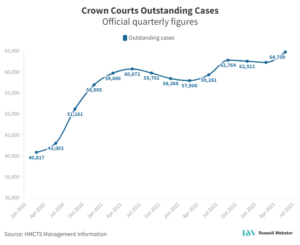
But like magistrates’ courts, the crown court is still getting a lot less done. 5% fewer cases were closed in 2024 than 2016, and 16% fewer if you account for case complexity. This is despite more cases being dropped, the court sitting for slightly more days and many fewer jury trials, which are by far the most time-intensive cases to deal with. If the court had managed to completed as many trials each day in 2024 as in 2016, it would have heard more than 5,000 more trials – 40% more than it did in reality. Instead, the backlog of cases has continued to mount, now approaching 80,000 cases.

The government should address causes of poor productivity before restricting jury trials or embarking on other structural reform
Workforce shortages, chaotic court administration, crumbling, leaking buildings and technology failures are all driving low productivity. Trials are frequently cancelled on the day because a lawyer is not available or one or both sides are not ready for trial. More and more trials are cancelled because cases are ‘overlisting’, even though fewer trials are being scheduled per day.
The government needs to get to grips with these problems to improve productivity and stop spiralling case backlogs. Structural reforms or major restrictions to jury trials, as proposed by Sir Brian Leveson in phase one of his Independent Review of the Criminal Courts, are not the only solution.
Public Services Performance Tracker has been funded by the Nuffield Foundation, but the views expressed are those of the authors and not necessarily the Foundation.
Thanks to Andy Aitchison for kind permission to use the header image in this post. You can see Andy’s work here