

This is a guest blog from the team at Switchback.
The growing problem of prison recalll
The numbers paint their own picture; the use of licence recall is out of control;
- One in five people in custody are on recall.
- The rate of recall has nearly doubled in the last 15 years.
- Between April and June 2024, there were 3 licence recalls for every 4 prison releases.
- Over 73% of recalls do not relate to a new offence.
This problem is an underacknowledged factor in the prison population crisis, and Switchback has published a new report presenting recommendations for urgent change. Several other justice organisations have also recently published work highlighting the growing problem with recall.
As long as the probation service is recalling nearly as many people as the prison service is releasing, there is no path out of the prison capacity crisis.
Recent political momentum
There are glimmers of political will to address the crisis. Lord Chancellor Shabana Mahmood recently announced plans to change legislation so that individuals serving standard determinate sentences under four years will no longer be eligible for standard recall. This is a step that acknowledges the scale of the problem but stops short of fixing it. We welcome this move to reform, but recognise that more fundamental change is needed.
The Independent Sentencing Review also recognised the impact of recall and recommended that the Government “Introduce a new model for recall for those serving standard determinate sentences, with stricter criteria and threshold.”. We welcome this recommendation.
“There’s no firm structure on who goes back or why they go back or what they go back for. It’s just you’re getting recalled, you’re getting recalled.”
New peer led research
To address the recall crisis and provide insight and recommendations for policymakers considering how to address it, Switchback published a new report.
Over the last year we have worked in partnership with our Experts by Experience Board – made up of former Switchback Trainees – and a trained researcher from Toynbee Hall to look in detail at this issue. We have used the participatory action research methodology to develop this research, with our Experts by Experience Board leading on the project as peer-researchers. Together, they surveyed 26 men and conducted in-depth interviews with six of them, producing insight rooted in lived experience.
We came to seven key findings. We have summarised some of the key themes across our findings. Alongside our written report, we have worked with visual artist Michael D. Kennedy to bring the findings to life in the form of a comic book strip.
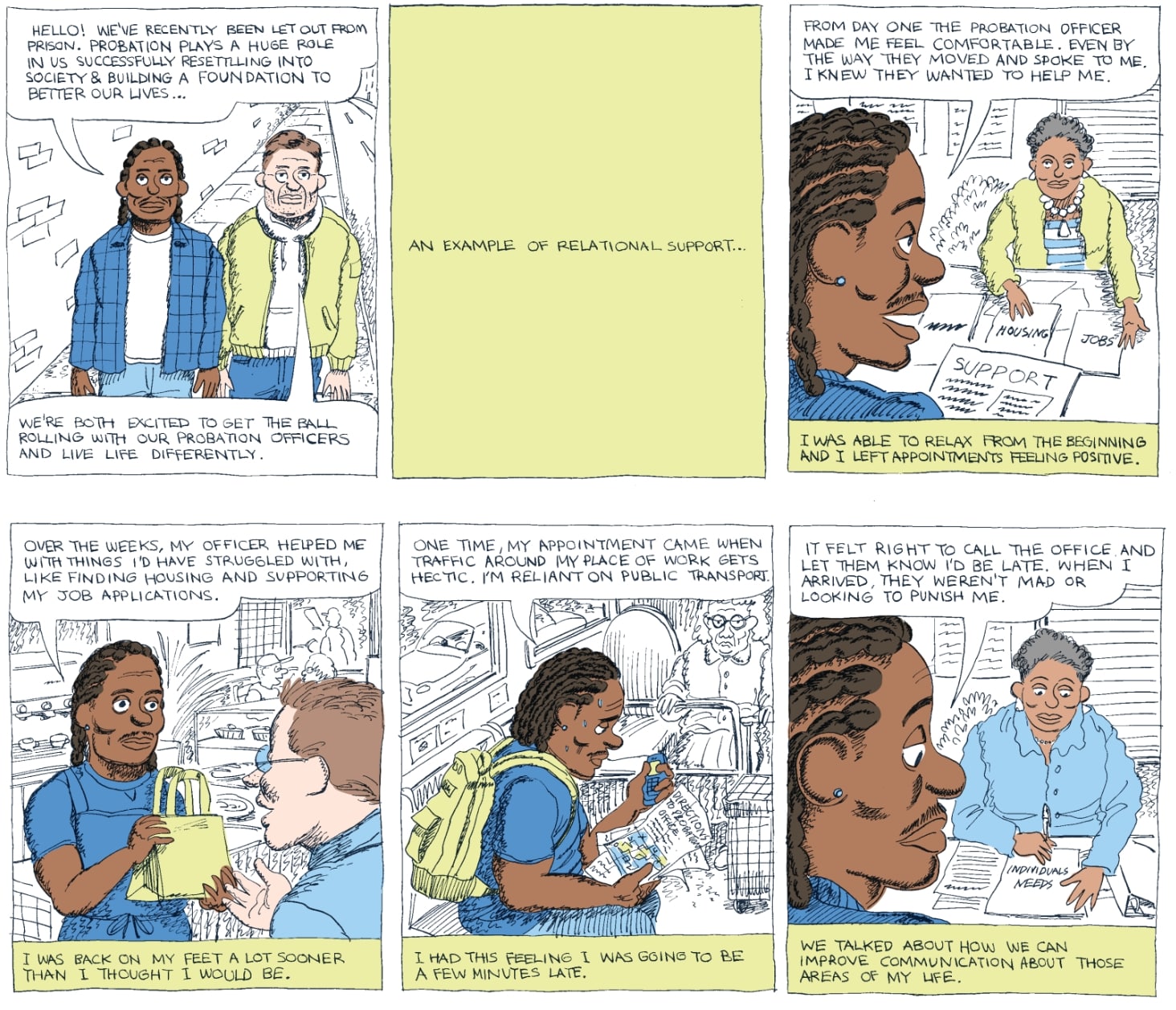
Relationships are key to preventing recalls
“When there’s no relationship, all they’ve got is just pages full of notes about an ‘offender’, a person they’ve never met. How can you make decisions based on that?”
Throughout our research, participants highlighted that positive relationships were crucial. Good relationships create the space for individuals to reach out for support, provide context and insight when mistakes happen, and bring clarity on licence conditions.
However, the majority of men we surveyed did not have good relationships with their probation officers. Most told us that they would not share crucial information like mental health or employment challenges. These limited relationships between probation officers and people on licence are impacting rehabilitation and driving the rate of recall.
Communication challenges
Fewer than 1 in 10 people we surveyed said that their recall was explained clearly and in detail. The system is overly reliant on verbal communication that often take places in overwhelming circumstances. This does not account for the high levels of neurodiversity, speech and language needs and trauma experienced by people on licence. Throughout our research people described not fully understanding the licence conditions or the steps they needed to take to avoid being recalled.
Decision making is inconsistent, threshold is too low
“There’s no firm structure on who goes back or why they go back or what they go back for. It’s just you’re getting recalled, you’re getting recalled.”
Recall decisions are largely at the discretion of probation officers with no clear structure to support decision-making. Rules are enforced inconsistently. We heard many troubling cases where recall was being used as a means to manage non-compliance with a lack of alternative enforcement or escalation options available to probation officers.
Recommendations
Through our report we have made seven detailed recommendations for change. The recommendations cover both urgent actions to bring the recall rate under control and longer term reform.
Introduce an independent decision maker for non-emergency recall decisions
This step would improve levels of accountability, independence and transparency In decision making, It could relieve the pressure on individual probation officers to be solely accountable for the actions of individuals who are not recalled and allow them greater capacity to focus on creating rehabilitative relationships.
Get support right for people when they’re leaving prison
Resettlement gaps drive recall and reoffending. Too many people are released without anywhere to live or any realistic pathway to safe and stable accommodation. Getting support right on release will have an impact on the high rates of recall, one to one human support is a crucial part of this. We are calling for a national resettlement framework with one to one support at it’s heart.
Create a clear structure for decision making with the right escalation options
HMIP originally recommended this action in 2021. This step would equip probation officers with escalation options to respond to non-compliance and provide clearer guidance on how to evaluate risk in relation to recall decisions. This would improve consistency and raise the threshold for recall while also supporting under pressure probation officers with guidance and resources.
Conclusion
The issues with recall cannot be brushed aside. It’s a core part of the prison population crisis and the justice system’s failure to effectively resettle people leaving prison. Positive relationships, clear communication, consistent decision-making and adequate support are essential to tackling the problem and giving people a real chance to thrive after release.
Thanks to Andy Aitchison for kind permission to use the header image in this post. You can see Andy’s work here








2 responses
Blimey. Probation practitioners are supposed to treat the people they’re supervising as fallible human beings! Gasp! Apparently this needed pointing out.
News to me that individual probation officers make the decision on recall. They absolutely cannot and do not! They can recommend but have to identify why and alternatives.
Maybe this was the situation in years gone but not for a long time. Misinformation can go both ways.