
Earned regression
A new (4 November 2025) briefing by the Howard League for Penal Reform argues that the government’s flagship proposal to address prison overcrowding risks ending in failure because it relies on a flawed and unfair punishment process that could lead to people being released without supervision or support. The Sentencing Bill, which recently received its third reading in the House of Commons, introduces a new ‘earned progression’ model that would enable some people to be released from prison one-third of the way through their sentences.
But the Howard League briefing entitled, Earned regression?, argues that the proposal, which was recommended by an Independent Sentencing Review led by former Secretary of State for Justice, David Gauke, may result in further overcrowding and injustice in the prison system because of the way the government has decided to implement it.
The model
The earned progression model was conceived by Mr Gauke as a more transparent model for people serving “standard determinate prison sentences” (i.e. not those serving life or other sentences without fixed length) It was designed to incentivise offenders to use time in prison positively through an earned progression scheme, enabling them to bring forward their automatic release date to the one third point of their sentence. Mr Gauke sets out three core principles for the scheme:
- The scheme should assume that offenders will comply with the scheme criteria from the outset and be released at the one third point of a sentence. The release point is pushed back towards the halfway point when there is non-compliance with the earned progression scheme. Consideration should be given to timeliness of confirmation of release date to allow for appropriate pre-release planning to take place.
- The criteria for compliance should include, but not be limited to, compliance with prison rules. Actions which violate prison rules (for example, offences against discipline, such as engaging in any threatening, abusive or violent behaviour, possessing unauthorised articles) and do not follow lawful instructions by immigration officials in deportation proceedings (preserving their legal right to appeal) would result in the offender’s release point being pushed back. The criteria for compliance should also include the expectation that the offender will engage in purposeful activity and attend any required work, education, treatments and/or training obligations where these are available. This Review holds the view that, as prison capacity eases and fuller regimes become possible, compliance requirements for earned release should become more demanding.
- The criteria for compliance should be as objective and easy to administer as possible by using current processes and minimising additional layers of decision-making/bureaucracy as far as possible.
Concerns
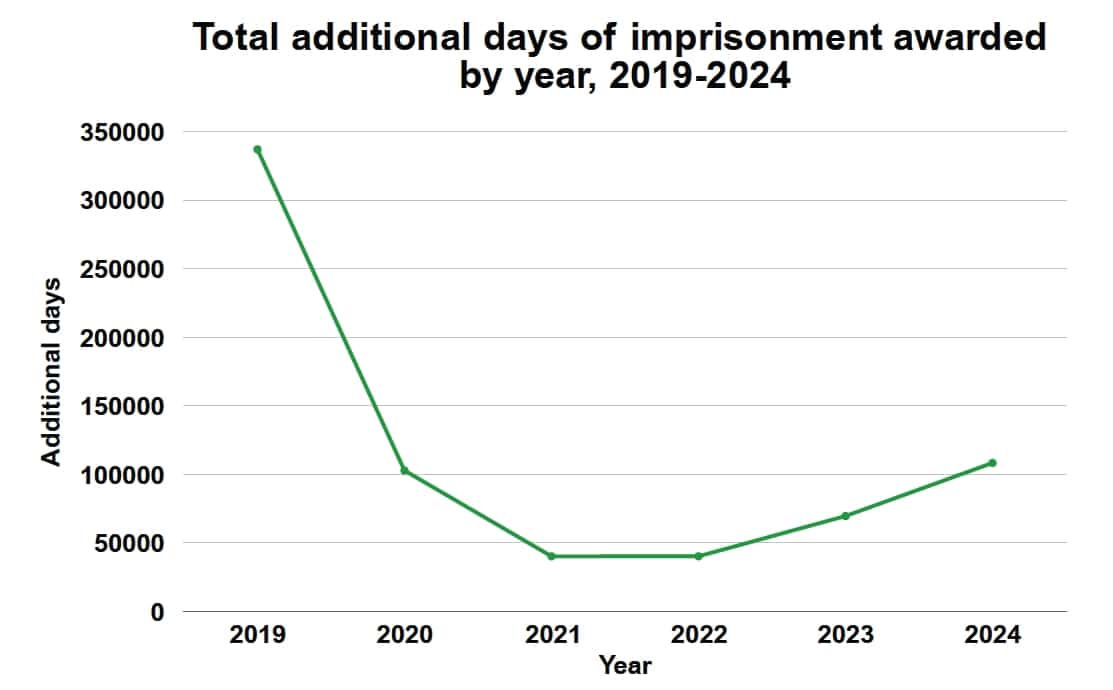
The Howard League’s concerns about the model related to the Government’s statement that any additional time served due to non-compliance or poor behaviour will be administered under the current additional days system. The MoJ has indicated that it intends to double the maximum number of added days per incident that an independent adjudicator can impose (from 42 to 84). There will also not be a maximum cap on time in custody under the new earned progression model, as recommended by the Independent Sentencing Review in its final report.
The Howard League argues that, far from incentivising good behaviour, the evidence suggests that additional days do not have a positive effect on good order and discipline. They are used disproportionately against certain groups, such as young adults and people from ethnic minorities. There are also concerns around whether the process is fair and just, commonly referred to as procedural fairness.
There were 108,366 additional days awarded in 2024 – totalling almost 297 years of imprisonment – a 56% rise on the number awarded in 2023.
The Howard League’s fundamental concern is that if additional days become the default mechanism in enforcing an earned progression model in prisons, then their use –
already rising – would increase dramatically in short order. with the result that a concept designed to reduce the number of people in prison will, in reality, increase it.
Thanks to Andy Aitchison for kind permission to use the header image in this post. You can see Andy’s work here