A new (8 April 2026) rapid response report from the Parliamentary Office of Science and Technology examines the issue of facial recognition technology in policing. UK police forces have used facial recognition technology for around a decade now and the report asks the key questions:
- How does it work?
- How is it used? and
- What are the opportunities and concerns?
What is facial recognition?
While we might all think we know the answer to this question; it is very helpful to be walked through the process with clarity. Facial recognition technology (FRT) is a biometric technology that estimates the degree of similarity between two faces.
UK police forces use FRT to help identify people. FRT identifies people by checking an image of a person against a list of known individuals to find matches. FRT uses artificial intelligence (AI) and machine learning to train systems to recognise faces.
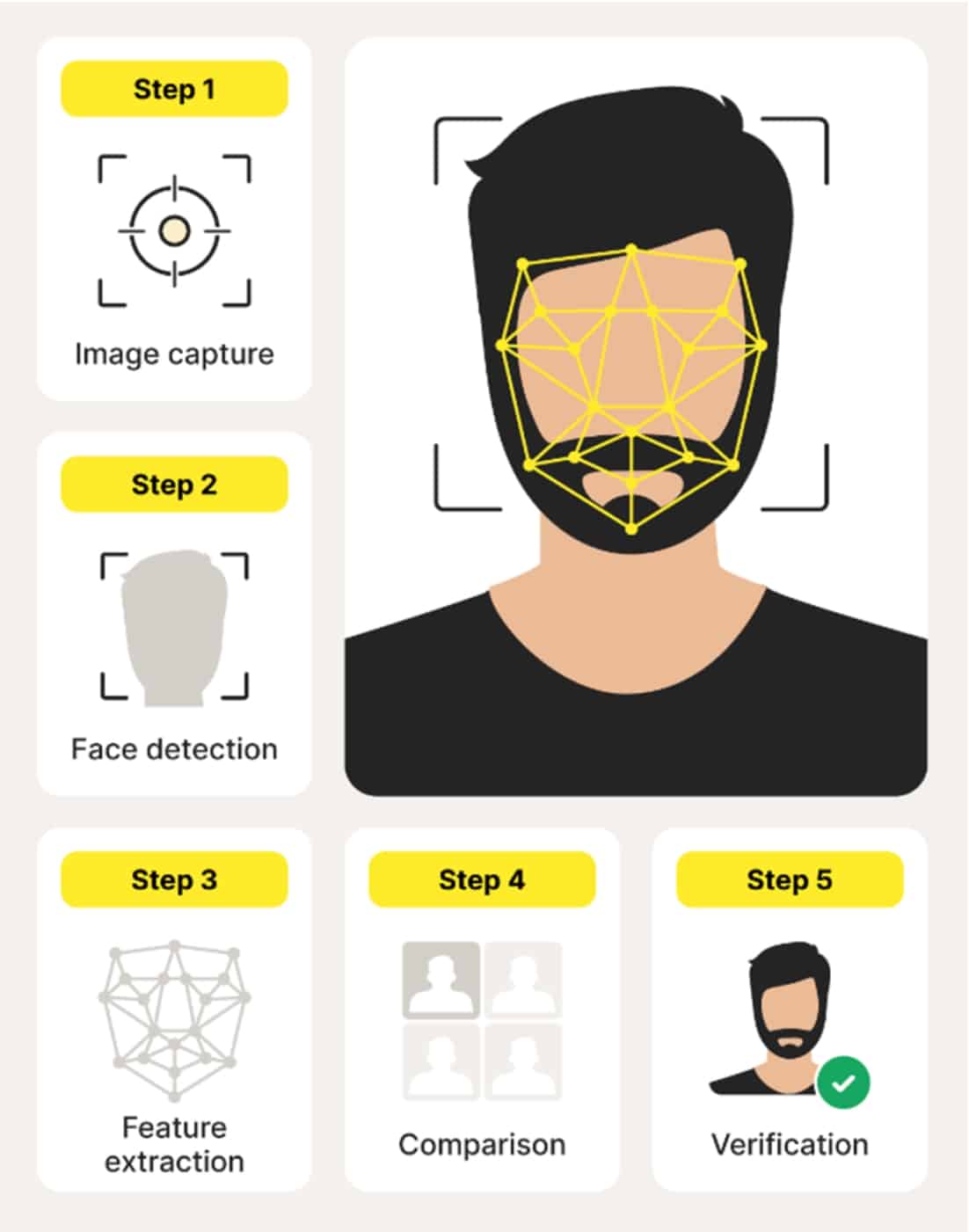
FRT speeds up identification and frees up police time. FRT can be broadly organised into three steps:
- Input and facial detection: an image of a face is captured and uploaded.
- Features extraction: facial features are extracted and translated into a numerical template.
- Classification: the numerical template is used to create a ‘similarity score’ with other numerical templates in a database to verify or identify a person.
Similarity scores indicate the similarity between someone’s numerical template and a numerical template in a database. Types of numerical templates in databases include ID records or people wanted by the police.
The infographic below shows the process.
Three types of facial recognition technology used by the police
UK police forces primarily use FRT software from private sector companies including NEC, Cognitec and Idemia. Police use three types of FRT:
- Retrospective Facial Recognition (RFR): RFR is used across UK police forces to identify suspects after an incident. Images of a suspect are collected from sources such as CCTV, mobile phones and social media. They are compared with reference images of known individuals in the Police National Database, which holds over 16.5 million facial records. The RFR system lists the most similar images. Matches are verified by an operator and passed to investigating officers.
- Live Facial Recognition (LFR): LFR is used by 13 of the 43 police forces in England and Wales, with a national rollout planned. LFR uses mounted cameras in public spaces to capture live images of passers-by. Scans are compared with a ‘watchlist’ from national databases of suspects wanted by the police or the courts. If a potential match is found, police near the camera are notified and decide on a course of action. If there is no match, images are automatically deleted. Police forces are expected to notify the public about their use of LFR unless there is a critical and time-sensitive threat.
- Operator-Initiated Facial Recognition (OIFR): OIFR is a near real-time method currently used by South Wales and Gwent Police forces and is being trialled by the Metropolitan Police. Police officers check someone’s identity by comparing their photo with a list of known people using a mobile app. The main purpose of OIFR is to identify someone who cannot, or will not, give their identity.
Concerns
The main concerns about FRT include the risk of FRT misuse, data security, intrusion of privacy and inaccurate technology. Although, the technology is improving rapidly, there are concerns.
The error rate of LFR has been found to increase by up to 9.3% when used outside a testing environment. Factors influencing the accuracy of LFR include crowded places, poor-quality images or partially concealed faces.
FRT more broadly is less good at identifying individuals from low-quality and distorted images, such as old or low-resolution custody images and poor-quality CCTV. Tests on one FRT used by UK police forces in 2025, which found that black women were the subject of the highest percentage (9.9%) of false positive identifications
Tests on a commonly used RFR algorithm in 2025 showed a higher rate of false positives for faces of Black and Asian people. The RFR technology was implicated in the wrongful arrest of an Asian man in January 2026.
What is the future of facial recognition in policing?
In January 2026, the Home Office announced plans to expand FRT to every regional police force in England and Wales by purchasing 40 new LFR vans. The government says the LFR vans will target violent and sexual offenders in high-crime areas as part of its VAWG strategy.
The first permanent facial recognition cameras were installed and used with officers present in South London in October 2025, although results from this pilot are not yet published.
Privacy and civil rights campaigners have consistently called for improved oversight of the technology.