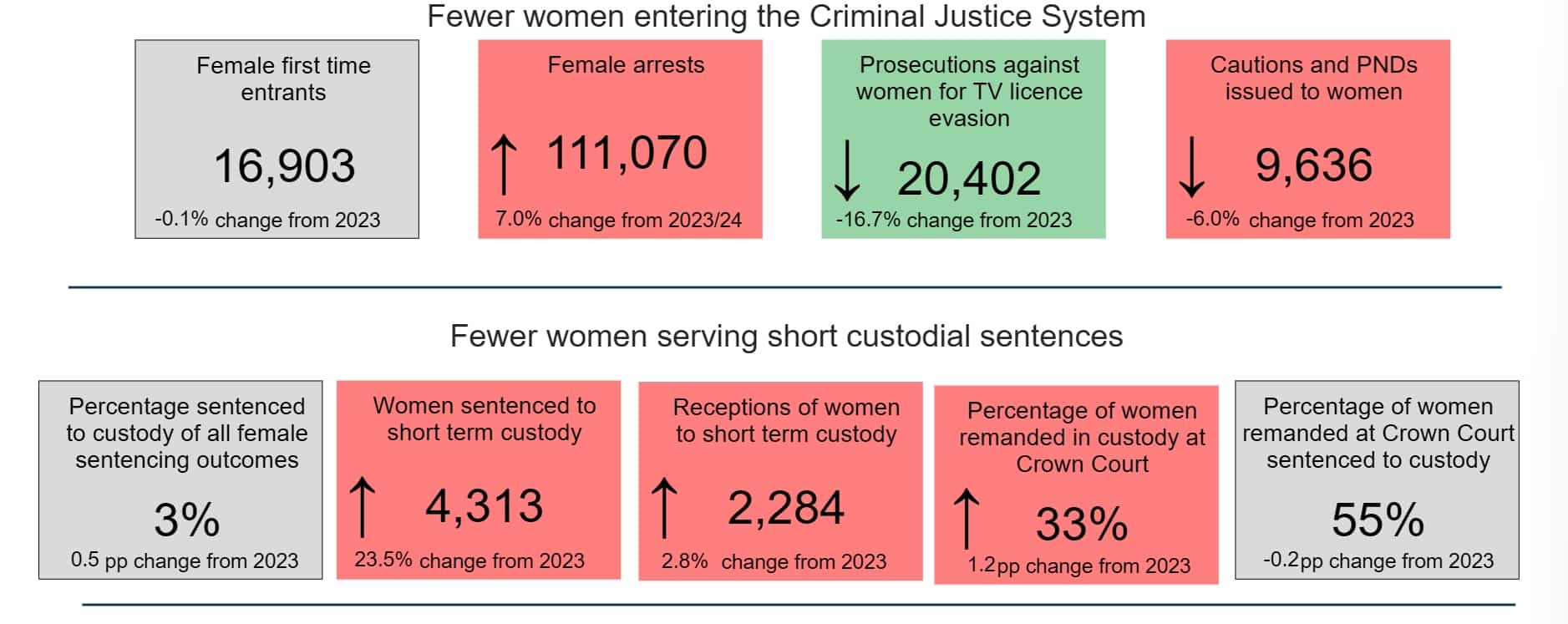
The MoJ has just (13 March 2026) published its Female Offender Strategy Dashboard which presents the key metrics identified in the Female Offender Strategy Delivery Plan via a web-based data visualisation tool. This is a very useful resource and allows users to conduct custom analysis, including by locality, ethnicity and age depending on the data set. The dashboard provides a range of data on the four priority areas of the strategy:
- Fewer women entering the criminal justice system
- Fewer women serving short custodial sentences
- Better outcomes for women in custody
- Protecting the public through better outcomes for women on release
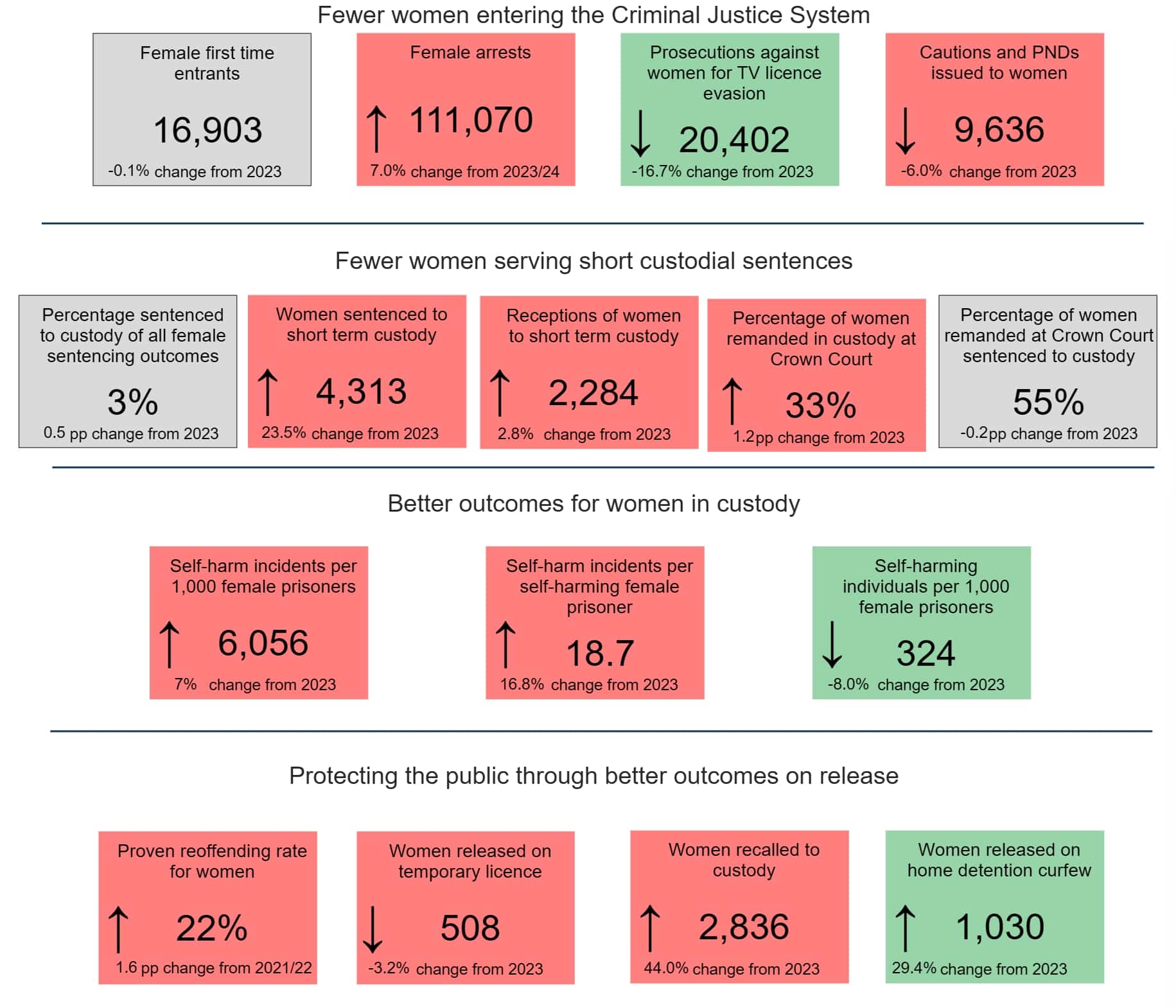
The headline metrics (which apply to adult women only) are usefully summarised on the front page of the dashboard. For each metric, the most recent year’s data is compared with the 2023. However, the detailed information available in the rest of the dashboard helpfully shows trends over the last five years. I have reproduced the summary below and you can see that performance is generally poor with key metrics worsening in ten areas and improving in just three.
First time entrants
The main news here is the big rise in the number of women being arrested, up by 111,070 since 2023/24. While the number of women prosecuted for not paying their TV licence has fallen by a sixth (down 20,402 or 16.7%) since 2023, the number of women prosecuted for truancy offences remain at double that of men (4,744 in 2024 compared to 2,336).
Short custodial sentences
In 2024, 4313 adult women were sentenced to immediate custody of less than 12 months, the majority of whom (4069) received six months or less. This represents a shocking 23.5% increase since the previous year in those sentenced to custody of less than 12 months.
The percentage of women remanded in custody at Crown Court also increased by 1.2% on last year, up to 33%.
Self-harm
In 2024 the self harm rate in prisons which hold female prisoners was 6,056 per 1,000 prisoners, an increase of seven per cent from 2023. This self harm rate is 8.8 times the equivalent rate in prisons holding male prisoners. The female self-harm rate has been increasing every year since 2018.
In 2024 female prisoners who self harmed did so an average of 18.7 times, a 17% increase from 2023. This number of incidents per self harming individual is 4.2 times greater than in prisons holding male prisoners. The number of incidents per self-harming female prisoner has been increasing since 2018.
Outcomes on release
The outcomes for women released from prison are not promising to say the least. The main area of concern is the fact that In 2024 there were 2,836 recalls of women to custody, an increase of 44% from the previous year. Recalls of women to custody accounted for 8% of all recalls in 2024
Conclusion
While the data itself may be disappointing to say the least, the MoJ must be commended on its transparency and in making the data both accessible and customisable to end users. It does mean that the MoJ is accountable for its (failure to) deliver on its female offender strategy and the commitment to update the information annually provides a healthy challenge to the Government. Clearly, most of the data in this dashboard relates to the period before this Government came into power, we must wait for next year’s dashboard to see whether there are any signs of these worrying trends reversing.