The Prisons and Probation Ombudsman
Yesterday (10 July 2025), the Prisons and Probation Ombudsman Adrian Usher published his second Annual Report, covering the year 2024 to 2025. The PPO has three main investigative duties: to investigate the death of people in any form of detention (including approved premises); to investigate the deaths of prisoners in the first 14 days post-release and to investigate complaints made by anyone in detention or on probation. In this blog post, I pick out 10 facts from the report that I hope you will find of interest.
Fatal incidents investigations
1 Tragically, the PPO started investigations into 486 deaths last year, a 35% increase on the year before.
2 There were 398 deaths in prisons (106 more than last year). 73 people died in the first 14 days post- release (20 more). 12 people died in probation approved premises (2 more). One person died in the immigration removal estate (same as last year).
3 The PO took an average of 21 weeks to produce an initial report for a death by natural causes and 33 weeks for all others.
4 256 people in detention died from natural causes. 100 deaths, tragically, were self-inflicted. There were 86 other “non-natural” deaths and five homicides. 36 deaths were awaiting classification and the cause of death could not be ascertained in three cases.
5 Non- natural deaths are defined as: “These deaths have not happened organically; they are non-natural but cannot be readily classified as self-inflicted or homicide. They include accidents and cases where the post-mortem has not ascertained a cause of death. This category also includes drug-related deaths where there is not enough evidence to classify them as a self-inflicted death.”
6 The highest number of self-inflicted deaths was at HMP Leeds where seven people died.
7 One of the primary reasons for fatal incident investigations is for the PPO to identify processes and procedures which could be improved to prevent further deaths where possible. In 2024/25, the PPO made a total of 506 recommendations following deaths in custody of which:
- 165 were made about healthcare provision
- 62 about general administration
- 62 about suicide and self-harm prevention
- 37 about emergency response
Complaints
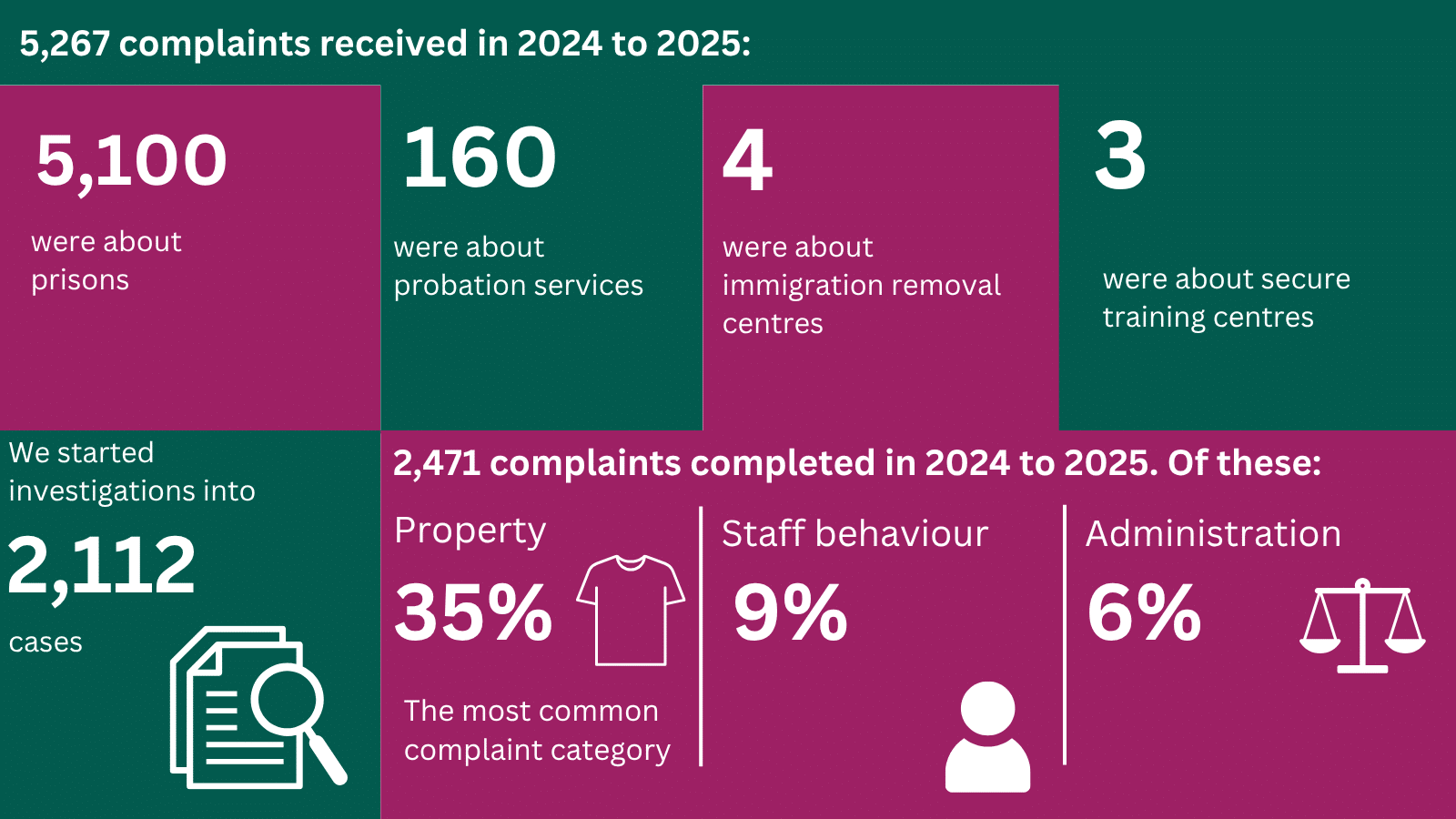
8 The PPO received 5,267 complaints last year, an increase of 15% There were 5,100 complaints about prisons (up by 755) and 160 about probation services (down by 59).
9 The top seven categories of complaints which were completed in the year were:
- Property (868)
- Staff behaviour (224)
- Administration (139)
- Adjudication (135)
- Categorisation (107)
- Incentives & earned privileges (106)
- Money (99)
10 The PPO launched the Independent Prisoner Complaint Investigations (IPCI) Ambassadors scheme in 47 prisons, the scheme recognises the valuable role that volunteer prisoners play in understanding the local complaints processes and the scheme enables Ambassadors to guide others in how to make a complaint, and to know when and how to contact IPCI. Full details can be found here.
Conclusions
In his foreword, the Ombudsman Adrian Usher highlights a number of key concerns including:
- overcrowding and restrictive regimes which have “a knock-on negative effect on prisoners’ mental health and increase the risk of suicide and self-harm”.
- The cost of prisoner phone calls which is currently being renegotiated with providers. “Contact between prisoners and their loved ones is so vital for reducing reoffending and maintaining positive mental health. The current system has considerable room for improvement.”
- The care of people with epilepsy.
We must hope that the Sentencing Review reduces prison numbers and that next year’s PPO report does not make such distressing reading.