

25% Scottish prisoners have been in care
Last week (16 October 2020), the Scottish Prison Service published the findings from its biennial prison survey which was completed by 30% of all people in Scotland’s 15 prisons between July and August last year. The results are fascinating (although I have no clue as why it took 14 months to publish the report). Below I share some of the facts that I found of interest, I hope they interest you too.
1: Basic demographics
Of the population of 93% males and 7% females, a quarter were on remand (24%) and 76% were sentenced. The average age of those in custody was 33 yrs. The majority of respondents were Scottish (85%), with a minority of respondents stating that they were from another ethnic background.
2: Recidivism
Two in five respondents had ‘never’ previously served a prison sentence (40%), or had served between 1 and 5 sentences (40%). One tenth of those reporting in the survey had served between 6 and 10 sentences (9%) or over 10 sentences (11%).
3: Atmosphere and relationships
Just over three quarters (77%) reported the atmosphere in their hall/dormitory as ‘very relaxed’, ‘fairly relaxed’ or ‘neither relaxed nor tense’ which is a 10% decrease in satisfaction rate from the 2017 Survey (87%).
Relationships between those in custody and staff were judged to be positive by the vast majority of respondents. A majority of respondents described their relationship with others in their hall and officers in their hall in positive terms (95% and 89% respectively).
4: Disability and long-term illness
Over one third of participants reported having a disability (38%); this number has increased from the 2017 survey results (34%). The number of individuals reporting to have a disability in prison has been continuously rising over recent years. Of the 38% reporting to have a disability, over two thirds stated that staff were aware of their disability (69%).
A similar trend can be viewed with regards to those respondents reporting to have a long term illness. Some 41% of respondents reported having a long term illness in 2019, which is an 11% increase from 2011. Of the 41% reporting to have a long term illness almost two thirds (63%) stated that staff were aware of this.
5: Drug use
Respondents were asked a series of questions about drug use before and during their current sentence. Two fifths of respondents stated that their drug use was a problem for them on the outside (41%), with 45% confirming that they had been under the influence of drugs at the time of their offence and 16% reporting they committed their offence to get money for drugs. A quarter were receiving treatment for drug use before they were imprisoned (24%).
Approximately two fifths (39%) said that they had used illegal drugs in prison at some point, a figure which has remained the same since 2015. Of these, 83% said their drug use has changed during their current period in prison. Just over four in ten respondents drug use decreased (44%) and in the region of one fifth reported an increase in drug use (20%) or the same use but different drugs (22%). One in ten stated that they only started using drugs in prison (12%).
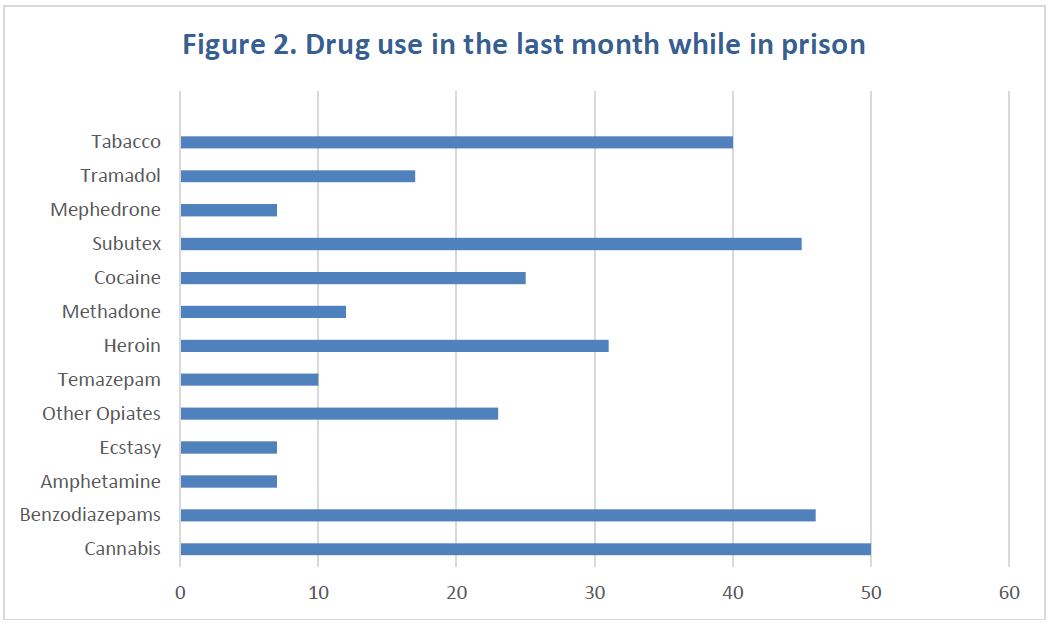
Just over one quarter reported they had used drugs in the month prior to the survey while in prison (28%). The most commonly used drugs were cannabis (50%), benzodiazepines (46%), subutex (45%), and heroin (31%) all of which have decreased in terms of usage since 2017.
6: Vaping/smoking
SPS introduced a smoke free prisons policy on 30 November 2018 to protect and improve the health and well-being of both individuals in custody and staff.
Respondents were asked a number of question in relation the use of electronic cigarettes or vaping. Six in ten use e-cigarettes or ‘Vape’ while in prison (60%). Two fifths (40%) of those who Vaped expressed a desire to give up. Just over half of all respondents had received advice on smoking and its related health risks since coming into prison (53%) and six in ten were made aware that although vaping may be less harmful than smoking it is not risk free (60%).
7: Visits and contact with family and friends
Individuals in custody were asked to comment on a number of aspects relating to family contact. Nine out of ten were in regular contact with someone outside the prison (91%). The most common forms of contact were telephone (58%), followed by letter (57%) and visits (43%). One fifth received visits weekly (22%), while 9% received visits fortnightly, and 11% received visits monthly.
The majority of respondents reported positively on ability to arrange visits (81%), access to family and friends (79%). Three quarters considered that respectful behaviour was shown by staff in relation to visits (75%), were content with facilities for children (77%), disabled visitors (76%) and the timing of visits (73%).
8: Children
Almost two thirds of those taking part in the survey reported having children (61%). Of these, approximately a third had one child (30%) or two children (30%). On fifth had three children (19%) and one in ten had four children (10%), a minority had five (5%) or six children (5%). Just over a third (37%) were receiving visits from their children, while 63% said they were not. In the region of half who were caring for their children before they went into prison (54%) also thought that they would be caring for their children when they were released (47%).
9: In care as a child
One quarter indicated that during their up-bringing they had been in care (25%) and of these six in ten had been in care at the age of sixteen (60%). Two thirds of those reporting were cared for in a residential home (64%). One third spent time in a secure unit (33%) and three in ten were looked after in a foster family (30%). Sixteen percent were cared for by a family member and a minority 8% specified ‘other’.
10: Safety and bullying
Just over a quarter reporting in the survey (27%) expressed fearing for their safety in the last month which is an increase in comparison to the 2017 survey of 16%. Three fifths (60%) of these respondents expressing concern highlighted that another individual in custody made them fear for their safety, 46% feared for their safety from a group of people in custody, 40% from a prison officer, 20% from a group of prison officers (excluding control and restraint), and 8% from a non-uniformed member of staff.
Respondents were asked to indicate whether they had experienced any bullying in the last month. Of those who indicated that they had been bullied (15%), two thirds said that this involved name calling (66%). Other common types of bullying involved physical abuse (41%), drugs (23%), money (22%) and property/possessions (22%).




One Response
This is heartbreaking news, and I pray for those who are struggling with substance misuse. I’ve always appreciated my probation officer and companies like https://ampprobation.com/services/probation/ that assist many criminals in regaining control of their life following incarceration or time in jail. I’d even prefer to be one if it meant I could repay those who helped me alter my habits.