Lived experience
The latest (24 October 2025) Academic Insight publication from HMI Probation is titled Embracing the views and perspectives of those with lived experience. Written by David Honeywell, a Criminology Lecturer at Arden University, the report acknowledges the value of designing and improving services with input from people with lived experience while illustrating numerous persistent structural hurdles and challenges.
Dr Honeywell argues that it is important to recognise that being so open about past convictions and adopting the dual identity of ex-offender and academic can be a form of self-labelling and stigmatisation, potentially re-opening old wounds when continually reflecting upon difficult experiences.
He advocates the creation of safe and inclusive spaces, where all views and perspectives are respected and valued (paying full regard to the processes of rehabilitation and desistance) and says that, ultimately, the more that we can pull together differing perspectives and types of evidence, the more confident we can become in how to deliver high-quality probation and criminal justice services.
Identity transitions, dual identities, and indelible stains
Drawing on his own lived experience, Dr Honeywell argues that at the crux of successful desistance is identity transformation, discussing how convict criminologists are able to combine their past criminal identities and present law-abiding identities to create new identities. He suggests that the the objective of the convict criminologist is to:
“develop a successful academic career through which they provide critical perspectives on prisons and the wider criminal justice system (including through research with/on prisoners and former prisoners)
then seek to develop a collective knowledge through their experiences and expertise to influence policy change through academic work and connections to advocacy/campaign” groups
He talks of how the struggles that come from having a criminal record can persist through an entire life:
“The key is to never give up trying, and, as a convict criminologist, this can mean revisiting the pains of desistance for the sake of teaching and research.”
Dr Honeywell notes that “outside of the academic world, ex-offenders are routinely employed in prisons, and it seems that prisons have come a long way”. While this is true, there are of course very many people with lived experience of the justice system who are denied access to working in both prison and probation by an often inflexible vetting system.
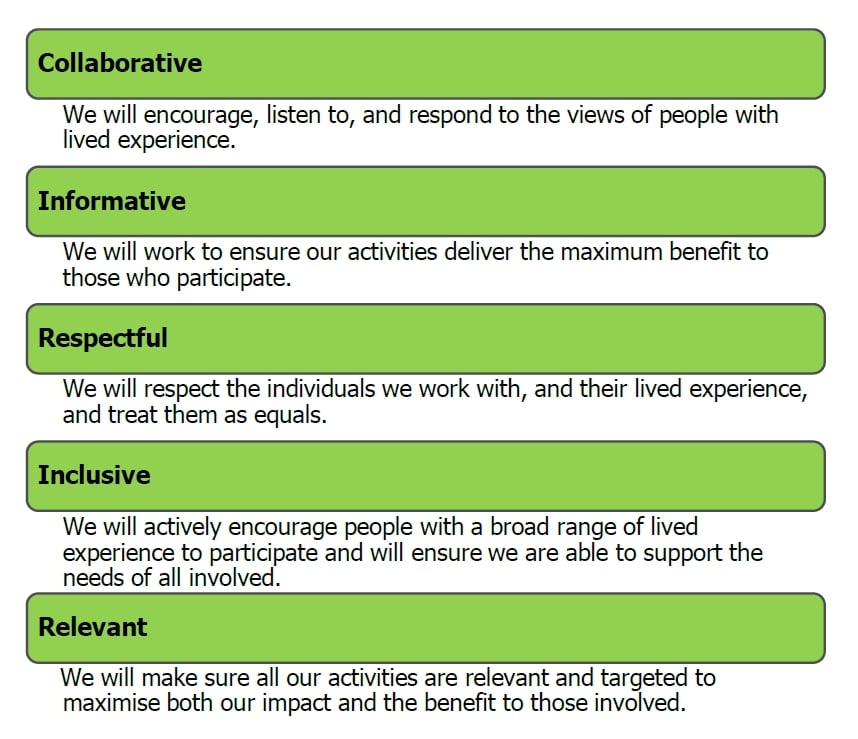
The review includes an infographic of the Probation Inspectorate’s own principles for involving people with lived experience in its work:
Conclusions
The review helpfully addresses the personal costs of being a lived experience researcher in the criminal justice sector and emphasises that deciding to pursue this career has to be an individual choice with full awareness of the consequences:
“My lived experience only became relevant once I decided to share my past experiences and ‘come out’ as an ex-offender. Not everyone with lived experiences wants to share their most personal experiences and especially their most painful memories. To put this into perspective, you would have to imagine the worst thing you have done in your life and then continually reflect upon it when speaking at conferences, teaching students, and writing papers. This may seem a worthy cause, but it can also be paralleled to repeatedly ripping a plaster off a cut which can then never heal.”
Dr Honeywell concludes with a reminder of the value of listening to and respecting lived experience:
“Most importantly though is that prisoners’ and ex-prisoners’ voices are being heard and their experiences are being taken seriously. For all those involved in the overseeing and delivering probation and criminal justice services, the core message is that there is significant value from giving people with a lived experience a voice, ensuring that this happens in way which is collaborative, non-tokenistic, sensitive, respectful and inclusive.”
Thanks to Brett Jordan for kind permission to use the header image in this post which was previously published on Unsplash.